
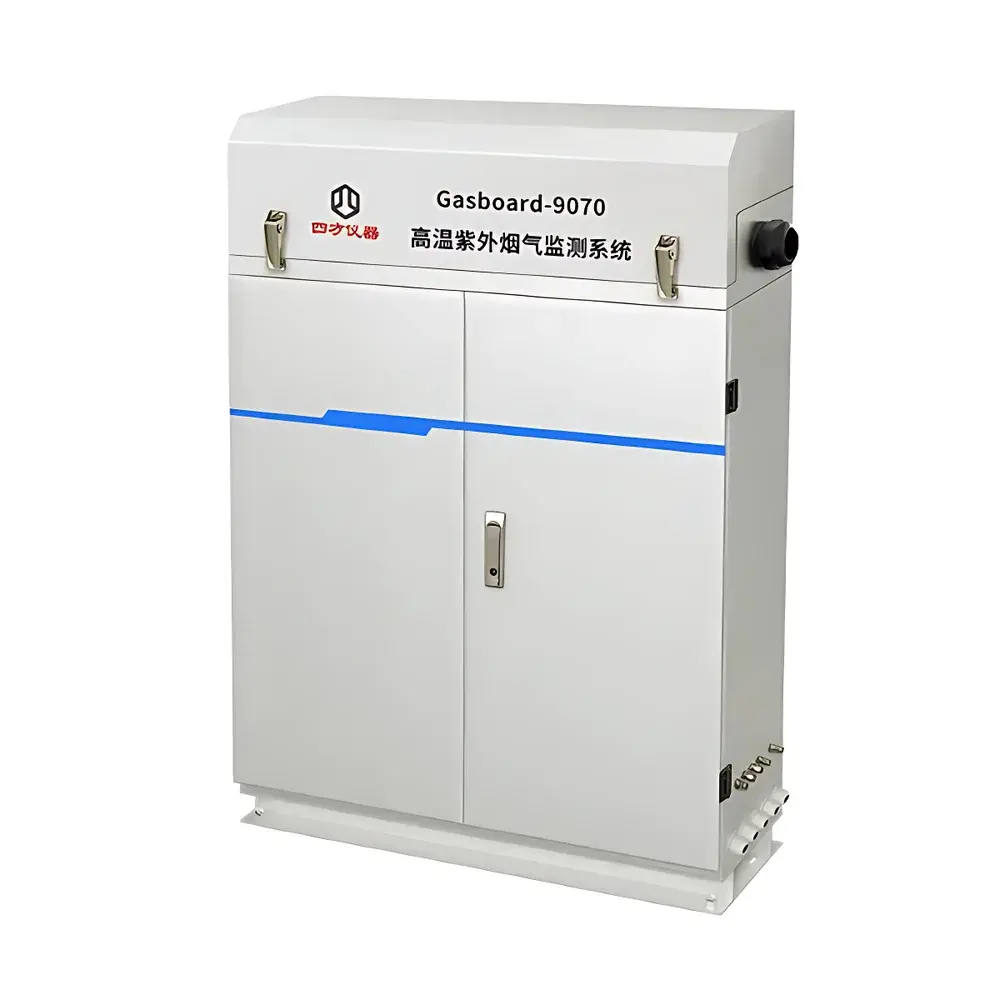
CUBIC INSTRUMENTS Gasboard-9070 High-Temperature UV Differential Optical Absorption Spectroscopy (UV-DOAS) Flue Gas Monitoring System
| Brand | CUBIC INSTRUMENTS |
|---|---|
| Origin | Hubei, China |
| Model | Gasboard-9070 |
| Measurement Principle | UV-DOAS |
| Measured Gases | SO₂, NO, NH₃ |
| Measurement Range (SO₂) | 0–1000 mg/m³ (desulfurization inlet), 0–50 mg/m³ (emission stack) |
| Measurement Range (NO) | 0–100 mg/m³ (inlet), 0–50 mg/m³ (emission) |
| Measurement Range (NH₃) | 0–20 mg/m³ (both inlet & outlet) |
| Accuracy | ≤ ±2% F.S. |
| Repeatability | ≤ 1% |
| Response Time (T₉₀) | ≤ 60 s |
| Resolution | 0.1 ppm |
| Operating Ambient Temperature | 0–50 °C |
| Power Supply | 220 V AC, 800 W |
| Purge Air Pressure | 0.4–0.8 MPa |
| Analog Outputs | 4 × 4–20 mA |
| Digital Outputs | 8 × relay |
| Communication Interfaces | RS485, RS232 |
Overview
The CUBIC INSTRUMENTS Gasboard-9070 is a high-temperature, extractive flue gas monitoring system engineered for continuous, real-time quantification of sulfur dioxide (SO₂), nitric oxide (NO), and ammonia (NH₃) in demanding industrial exhaust streams. It employs ultraviolet differential optical absorption spectroscopy (UV-DOAS), a well-established, physics-based analytical technique that exploits the unique electronic absorption fingerprints of target gases in the 190–230 nm spectral region. Unlike non-dispersive infrared (NDIR) or electrochemical sensors, UV-DOAS provides inherent selectivity through spectral deconvolution—enabling simultaneous multi-gas analysis without cross-sensitivity from water vapor, CO₂, or O₂ interference. The Gasboard-9070 features a heated optical path maintained at >180 °C throughout the entire sample handling train—including the probe, heated sampling line, and multipass absorption cell—to prevent condensation, adsorption, and catalytic loss of reactive species such as NH₃ and SO₂. This thermal management architecture ensures metrological integrity across variable stack conditions typical of coal-fired power plants, cement kilns, waste-to-energy facilities, and metal smelters.
Key Features
- True simultaneous multi-component analysis of SO₂, NO, and NH₃ using UV-DOAS—no sequential measurement cycles or switching valves
- High-sensitivity multipass absorption cell with effective optical path length >1.5 m, enabling sub-ppm detection limits (0.1 ppm resolution) and low measurement ranges optimized for SCR ammonia slip monitoring (0–20 mg/m³ NH₃)
- Full-path high-temperature conditioning (>180 °C) from probe tip to detector, minimizing wall adsorption and chemical conversion losses—critical for accurate NH₃ quantification in wet, acidic flue gas
- Extractive sampling design eliminates dependence on in-situ optical alignment, stack vibration, or particulate obscuration; compatible with high-dust, high-moisture, and high-temperature (up to 400 °C at probe) environments
- Onboard spectral interference correction algorithms compensate for overlapping absorption bands from ozone (O₃), chlorine (Cl₂), and other trace UV-absorbing species, ensuring robustness under complex emission matrices
- Automated zero/span calibration capability with integrated solenoid valve manifold and optional certified gas cylinders—supports unattended operation per EPA Method 6C and EN 15267-3 requirements
- Modular hardware architecture with isolated analog outputs (4 × 4–20 mA), digital relay outputs (8 channels), and dual serial interfaces (RS232/RS485) for seamless integration into DCS, SCADA, or CEMS platforms
Sample Compatibility & Compliance
The Gasboard-9070 is designed for direct integration into regulatory-compliant Continuous Emission Monitoring Systems (CEMS). Its measurement performance meets or exceeds key international standards including EN 15267-3 (QAL1 certification framework), EN 14181 (ASTM D6522 equivalent for periodic quality assurance), and Chinese HJ 75–2017 and HJ 76–2017 technical specifications for flue gas CEMS. The system’s ≤±2% F.S. accuracy and ≤1% repeatability satisfy Tier 2 data validity criteria under EU IED and U.S. EPA Performance Specification 2 (PS-2) for SO₂/NOₓ analyzers. All wetted materials—including PTFE-lined stainless-steel sample lines, quartz optical windows, and Hastelloy-C276 flow components—are selected for minimal surface reactivity with acidic and alkaline gases. The instrument supports GLP/GMP-aligned audit trails when interfaced with compliant data acquisition software, and its firmware architecture allows traceable configuration logging required for FDA 21 CFR Part 11 compliance in regulated industrial settings.
Software & Data Management
The Gasboard-9070 operates with embedded firmware supporting local display (LCD + keypad), remote configuration via Modbus RTU over RS485, and full parameter access through ASCII command protocol over RS232. Optional PC-based CEMS software provides real-time spectral visualization, time-series trending, alarm event logging, and automated report generation (PDF/CSV) aligned with HJ 76–2017 mandatory formats. Data storage includes 30-day onboard flash memory buffering with timestamped raw spectra, calibrated concentrations, and diagnostic flags (e.g., lamp intensity decay, cell temperature deviation, purge pressure status). All communication protocols are configurable for secure TLS-enabled Ethernet gateways (via external converter), enabling cloud connectivity for centralized fleet monitoring while preserving data sovereignty and cybersecurity boundaries per IEC 62443-3-3.
Applications
The Gasboard-9070 delivers mission-critical measurements in applications where precise NH₃ slip control, SO₂ desulfurization efficiency verification, and NOₓ reduction performance assessment are essential. Primary deployment sites include selective catalytic reduction (SCR) and selective non-catalytic reduction (SNCR) ducts in thermal power stations; bypass flues upstream and downstream of wet limestone FGD systems; calcination and clinker cooling zones in cement production; sintering and blast furnace gas cleaning trains in integrated steelworks; roasting and electrolytic off-gas streams in aluminum smelting; and post-combustion scrubber outlets in municipal solid waste incinerators. Its ability to resolve sub-2 ppm NH₃ in high-SO₂ backgrounds makes it particularly suited for optimizing reagent injection rates and preventing ammonium bisulfate (ABS) fouling in air preheaters—directly supporting operational reliability and maintenance interval extension.
FAQ
What is the minimum detectable concentration for NH₃ in emission stack applications?
The system achieves a resolution of 0.1 ppm (≈0.12 mg/m³ at 0 °C, 101.3 kPa) for NH₃, with validated quantification down to 0.5 ppm under field conditions per HJ 76–2017 verification procedures.
Can the Gasboard-9070 operate without an external calibration gas supply?
Yes—the instrument supports automatic zero calibration using clean, dry purge air and can perform span checks via internal reference spectra; however, regulatory-grade QAL2 validation requires traceable certified gases.
Is the optical cell resistant to corrosion from HCl or HF in waste incineration flue gas?
The absorption cell uses fused silica optics and Hastelloy-C276 structural components, providing proven resistance to halogen acid corrosion up to 50 ppm HCl at 180 °C; optional quartz liner upgrades available for HF-rich streams.
How does the system handle particulate loading above 10 g/m³?
The heated probe incorporates a dynamic cyclonic filter with back-purge capability, and the sample conditioning unit includes a heated ceramic membrane filter (pore size 0.5 µm), maintaining stable flow and optical transmission even under extreme dust loads.
Does the Gasboard-9070 support MODBUS TCP for Ethernet integration?
Native support is RS485 Modbus RTU; Ethernet integration requires an external industrial protocol gateway—configuration templates and register maps are provided in the Engineering Manual v3.2.







