
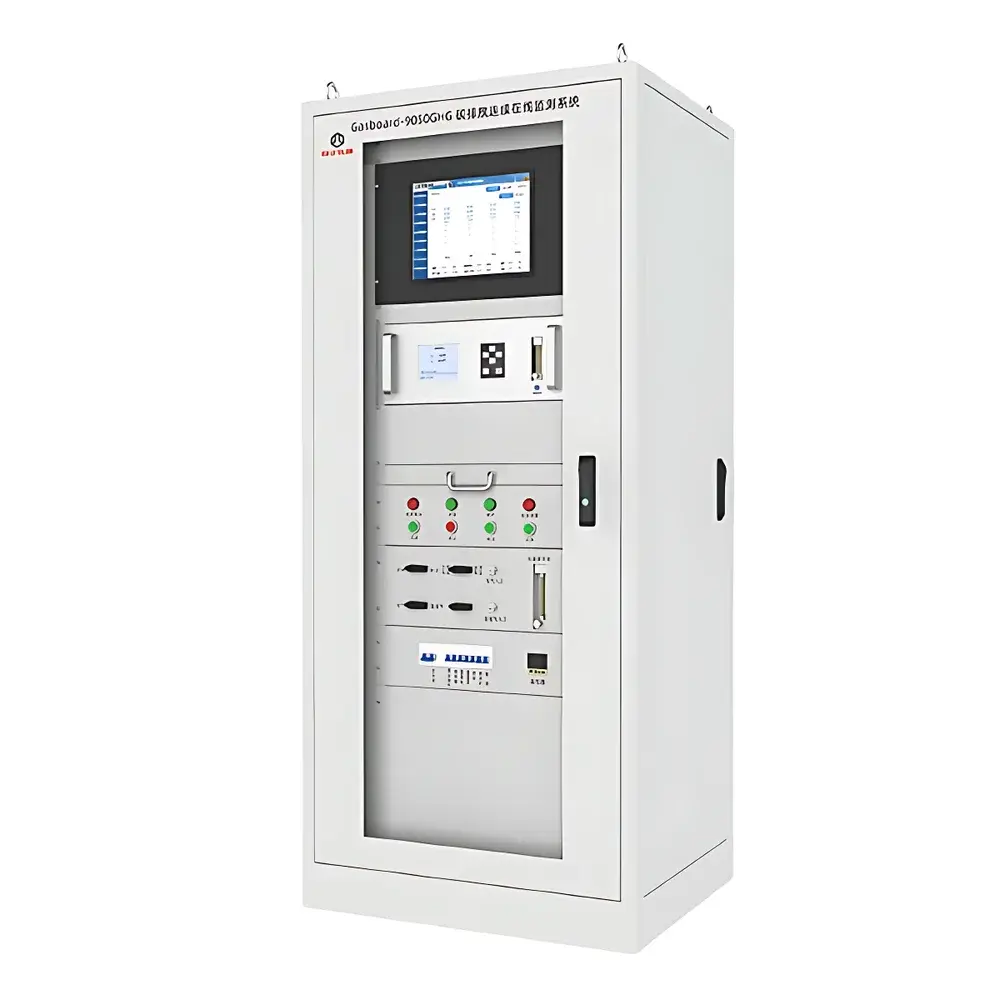
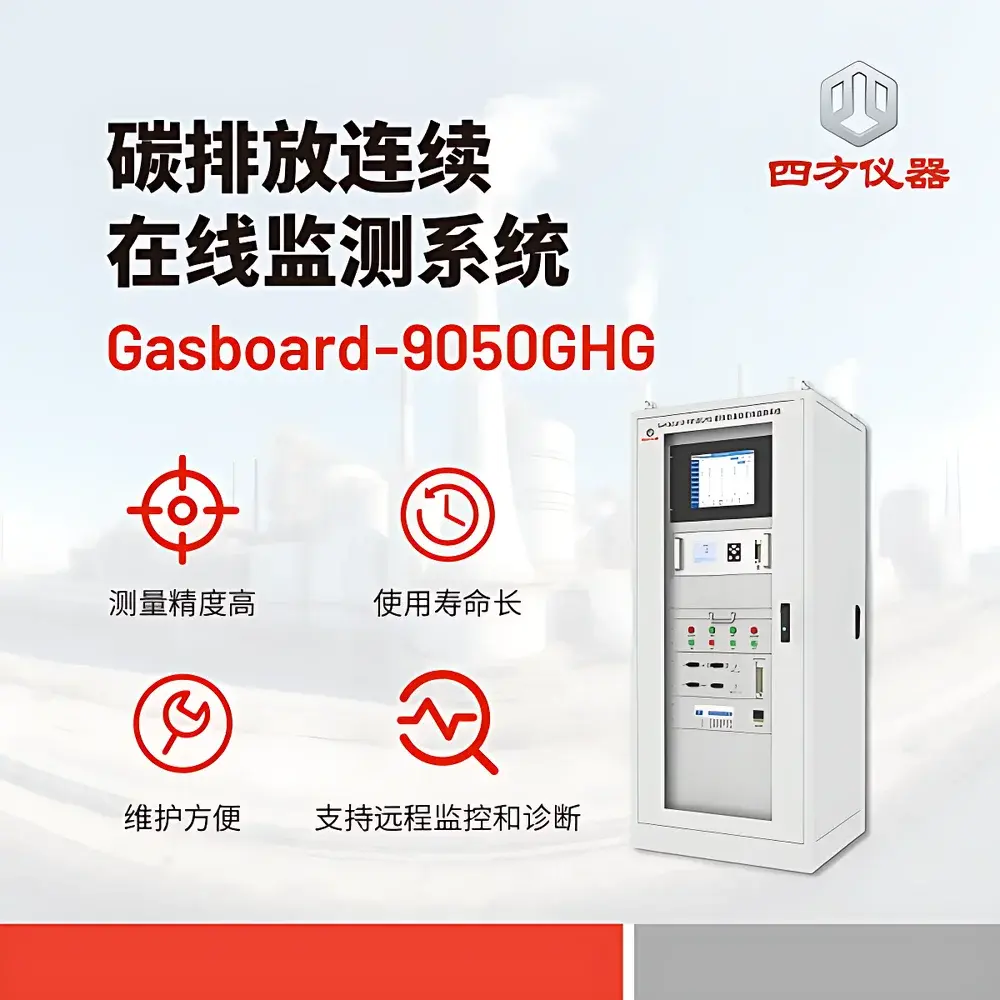
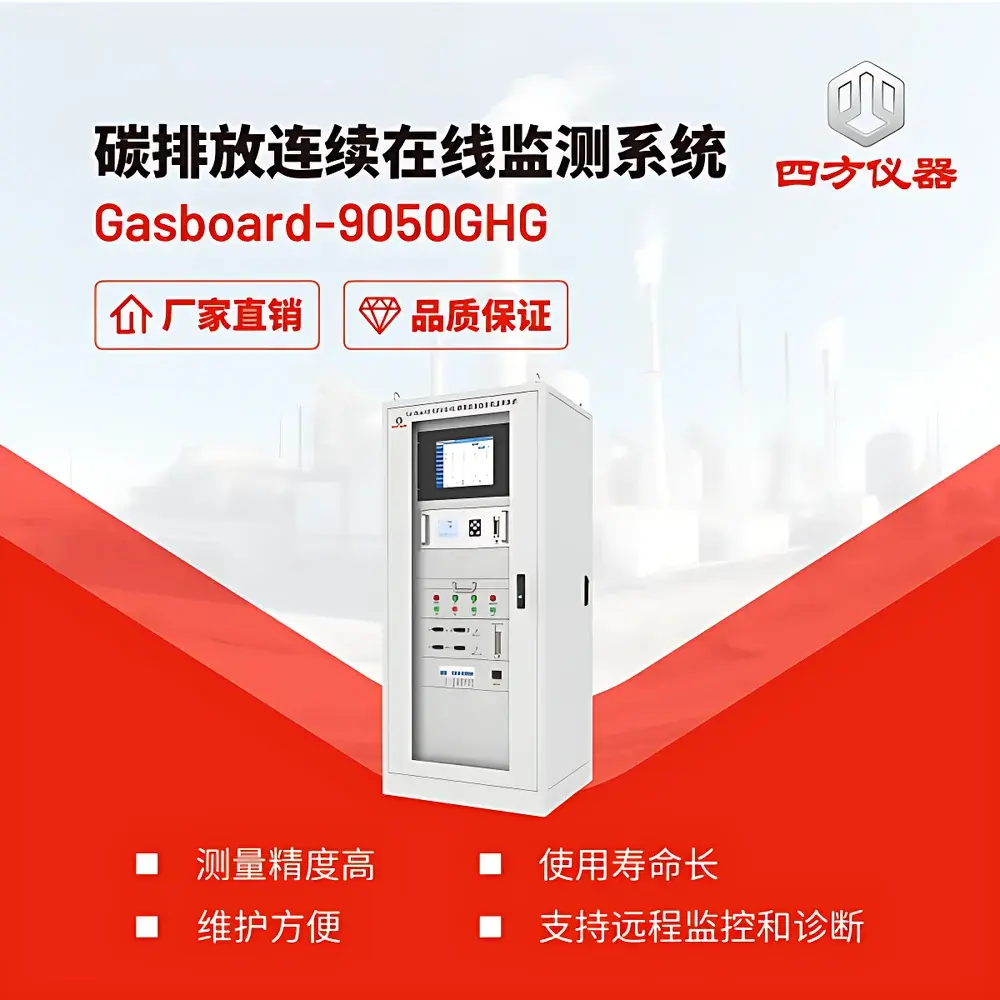
CUBIC INSTRUMENTS Gasboard-9050GHG Continuous Emissions Monitoring System (CEMS) for Greenhouse Gases
| Brand | CUBIC INSTRUMENTS |
|---|---|
| Origin | Hubei, China |
| Model | Gasboard-9050GHG |
| Measurement Principle | NDIR (CH₄/CO₂/CO/N₂O), Electrochemical (O₂) |
| Measurands | CH₄, CO₂, CO, N₂O, O₂ |
| Accuracy | ≤±1% F.S. (CH₄/CO₂/CO/N₂O), ≤±2% F.S. (O₂) |
| Repeatability | ≤±1% F.S. |
| Response Time (T90) | <25 s |
| Detection Limits | CH₄/CO/N₂O: 0–1000 ppm |
| CO₂/O₂ | 0–25% vol |
| Resolution | CH₄/CO/N₂O: 1 ppm |
| CO₂/O₂ | 0.01% vol |
| Flue Gas Temp. Range | 0–300 °C |
| Heated Line & Probe Temp. | 120–180 °C |
| Protection Rating | IP54 |
| Dimensions (L×W×H) | 800 × 760 × 1800 mm |
| Ambient Temp. | −20 to +50 °C |
| Humidity | <95% RH (non-condensing) |
| Power Supply | 220 V AC ±10%, >3000 W |
| Compressed Air Requirement | 0.4–0.8 MPa, oil-free, dust-free, moisture-free |
| Max. Air Consumption | 2.2 m³/h |
| Avg. | 0.45 m³/h |
| Max. Sample Flow | 2 L/min |
| Avg. | 1.5 L/min |
| Communication Interfaces | RS-485, RS-232, 4–20 mA, Ethernet |
Overview
The CUBIC INSTRUMENTS Gasboard-9050GHG is a fully integrated, continuous emissions monitoring system (CEMS) engineered for regulatory-grade, real-time quantification of key greenhouse gases (GHGs) and oxygen in industrial flue gas streams. Designed in accordance with international performance standards for stationary source emission monitoring—including ISO 14064-1, EN 15267, and EPA Method 3A/7E—the system employs a multi-technology architecture to ensure robustness under harsh stack conditions. Core gas measurements rely on non-dispersive infrared (NDIR) spectroscopy for CH₄, CO₂, CO, and N₂O, leveraging proprietary optical filters and temperature-stabilized detectors to minimize spectral interference and drift. Oxygen is measured via high-stability electrochemical detection (ECD), providing independent validation of combustion efficiency. The system’s modular architecture separates sampling, conditioning, analysis, and data handling into four interoperable units: (1) GHG & O₂ analysis module, (2) flue gas parameter module (temperature, pressure, velocity, humidity), (3) data acquisition unit (DAU), and (4) central processing & communication unit. All wet-end components—including probe, heated sample line, and particulate filter—are maintained at 120–180 °C to prevent condensation and ammonium salt deposition, ensuring long-term stability in high-moisture, low-velocity exhaust environments.
Key Features
- Multi-technology gas sensing: NDIR for CH₄/CO₂/CO/N₂O and electrochemical detection for O₂—optimized to suppress cross-sensitivity between CO₂ and CO, or CH₄ and N₂O, common in conventional dual-beam NDIR platforms.
- High-integrity hot-wet sampling: Integrated high-temperature ceramic filter (metal sintered) at the probe tip, coupled with programmable pulse back-purge using clean compressed air (0.4–0.8 MPa), extends maintenance intervals to ≥6 months under typical coal-fired or cement kiln conditions.
- Automatic calibration & zeroing: Built-in zero-air pump enables periodic air-based auto-zero without external calibration gas cylinders; supports optional span calibration via modulated gas injection ports compliant with EN 14181 QAL2 requirements.
- Self-diagnostic firmware: Real-time sensor health monitoring—including detector signal-to-noise ratio, reference cell stability, and heater current diagnostics—triggers event logs and status flags traceable via Modbus TCP or OPC UA.
- Ruggedized mechanical design: IP54-rated enclosure with reinforced steel frame; all internal wet-path materials (316L stainless steel, alumina ceramics, PTFE-lined tubing) resist corrosion from SO₂, HCl, NOₓ, and condensate up to 300 °C flue gas inlet temperature.
Sample Compatibility & Compliance
The Gasboard-9050GHG is validated for use across diverse fixed emission sources including thermal power plants, waste incinerators, cement clinker kilns, glass furnaces, and petrochemical crackers. Its heated extraction system accommodates flue gas matrices with particulate loadings up to 5 g/m³ (dry basis), moisture content up to 25% v/v, and acid gas concentrations ≤1000 ppm SO₂. The system meets the essential performance criteria defined in EU BREF documents for Large Combustion Plants (LCP BREF) and Waste Incineration (WI BREF), as well as China’s HJ 75–2017 and HJ 76–2017 technical specifications for CEMS. Data integrity complies with GLP-aligned audit trail requirements: all configuration changes, calibration events, and fault recoveries are timestamped, user-logged, and stored locally with ≥12 months retention. Optional 21 CFR Part 11-compliant software modules support electronic signatures and role-based access control for regulated QA/QC workflows.
Software & Data Management
The embedded DAU runs a Linux-based real-time OS with deterministic I/O scheduling, supporting dual-mode operation: standalone local display (7″ touchscreen HMI) or networked integration via Ethernet (TCP/IP, Modbus TCP, OPC UA). Raw analog outputs (4–20 mA) and digital protocols enable seamless connection to DCS, SCADA, or central environmental management systems (EMS). The optional CEMS-Link™ software suite provides remote visualization, trend analysis, compliance reporting (e.g., hourly/daily average exceedance alerts per national GHG reporting thresholds), and automated generation of XML-formatted reports aligned with national emission trading system (ETS) submission templates. All measurement data are stored with millisecond-resolution timestamps and include metadata on ambient conditions, calibration history, and diagnostic flags—enabling full traceability during regulatory audits.
Applications
- Continuous monitoring of CO₂, CH₄, and N₂O for mandatory GHG reporting under national carbon markets (e.g., China National Carbon Market, EU ETS Phase IV).
- Combustion optimization and excess air control via synchronized O₂ + CO + CO₂ profiling in boilers and furnaces.
- Leak detection and quantification (LDAR) support in biogas upgrading and landfill gas recovery facilities.
- Performance verification of selective catalytic reduction (SCR) and flue gas desulfurization (FGD) systems through longitudinal CO and NOₓ co-monitoring (with optional add-on module).
- Research-grade emission factor derivation for IPCC Tier 3 methodology applications in industrial process studies.
FAQ
What regulatory standards does the Gasboard-9050GHG comply with for GHG monitoring?
It conforms to HJ 75–2017/HJ 76–2017 (China), EN 15267-3:2017 (EU), and supports alignment with ISO 14064-1:2018 and EPA 40 CFR Part 98 subpart C requirements when configured with certified calibration procedures.
Can the system operate without external calibration gases?
Yes—it features an integrated zero-air pump for automatic air-based zero calibration; however, span calibration requires certified standard gases per QAL2 requirements for regulatory compliance.
Is the heated sampling line suitable for high-dust applications like cement kilns?
Yes—the probe incorporates a self-cleaning metal sintered filter and programmable back-purge cycle, validated for continuous operation in particulate-laden streams up to 5 g/m³.
Does the system support remote firmware updates and diagnostics?
Yes—via secure SSH/TLS-enabled Ethernet interface; all diagnostic logs, sensor health metrics, and configuration snapshots can be retrieved remotely for predictive maintenance planning.
What is the minimum required compressed air quality for the back-purge system?
Oil-free, dust-free, and dew-point-controlled air at 0.4–0.8 MPa; ISO 8573-1 Class 2:2:2 or better is recommended to prevent filter clogging and valve wear.
Related Products







