
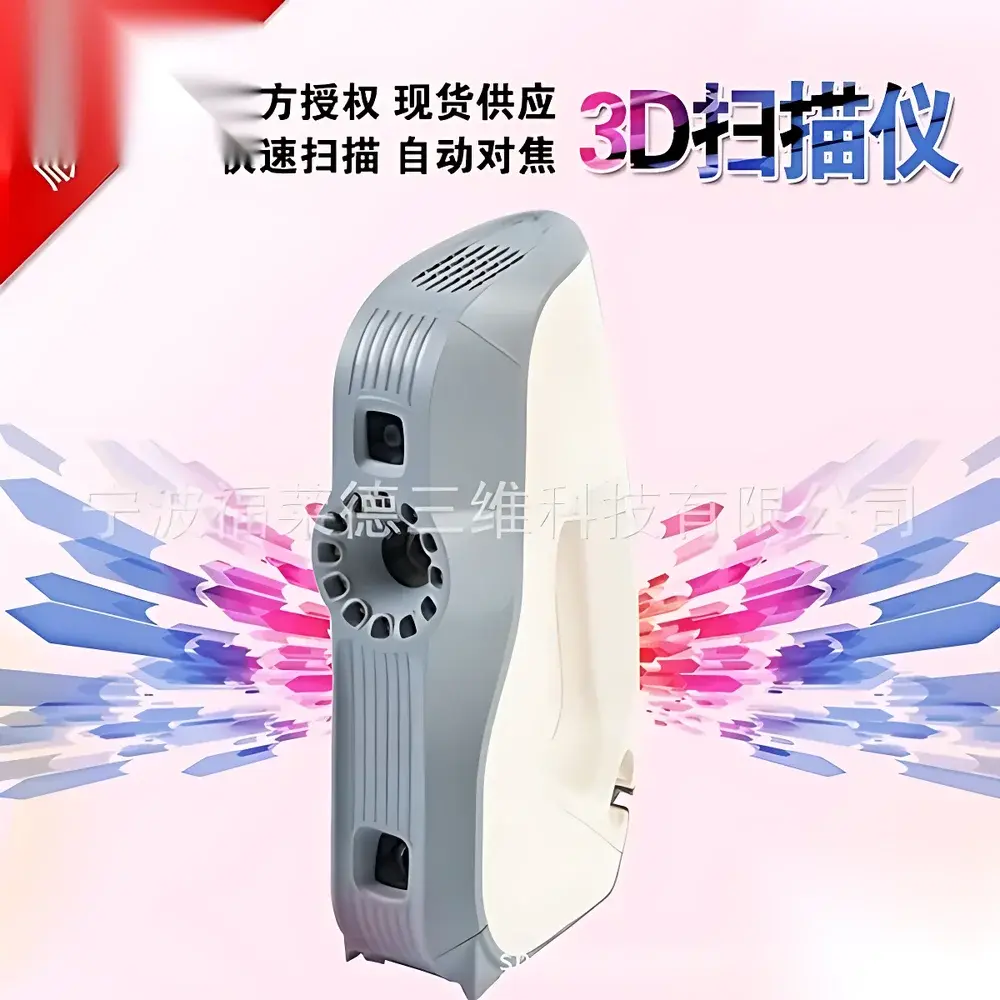
Artec Eva Color Handheld 3D Scanner
| Brand | Artec |
|---|---|
| Origin | Imported (Non-Chinese) |
| Manufacturer Type | Authorized Distributor |
| Model | Eva |
| Technology | Structured Light 3D Scanning |
| Weight | ~0.85 kg |
| Scan Speed | Up to 16 fps |
| Resolution | Up to 0.5 mm |
| Accuracy | Up to 0.1 mm |
| Texture Capture | Full-color RGB (2.3 MP) |
| Field of View | 244 × 169 mm (at 400 mm distance) |
| Working Distance | 0.4–1.0 m |
| Power Supply | Internal battery (6+ hrs) or USB-C powered |
| Output Formats | STL, OBJ, PLY, AOP, ASC, PDF, VRML, X3D, 3MF |
| Software Included | Artec Studio (v19+) |
| Compliance | CE, FCC, RoHS |
Overview
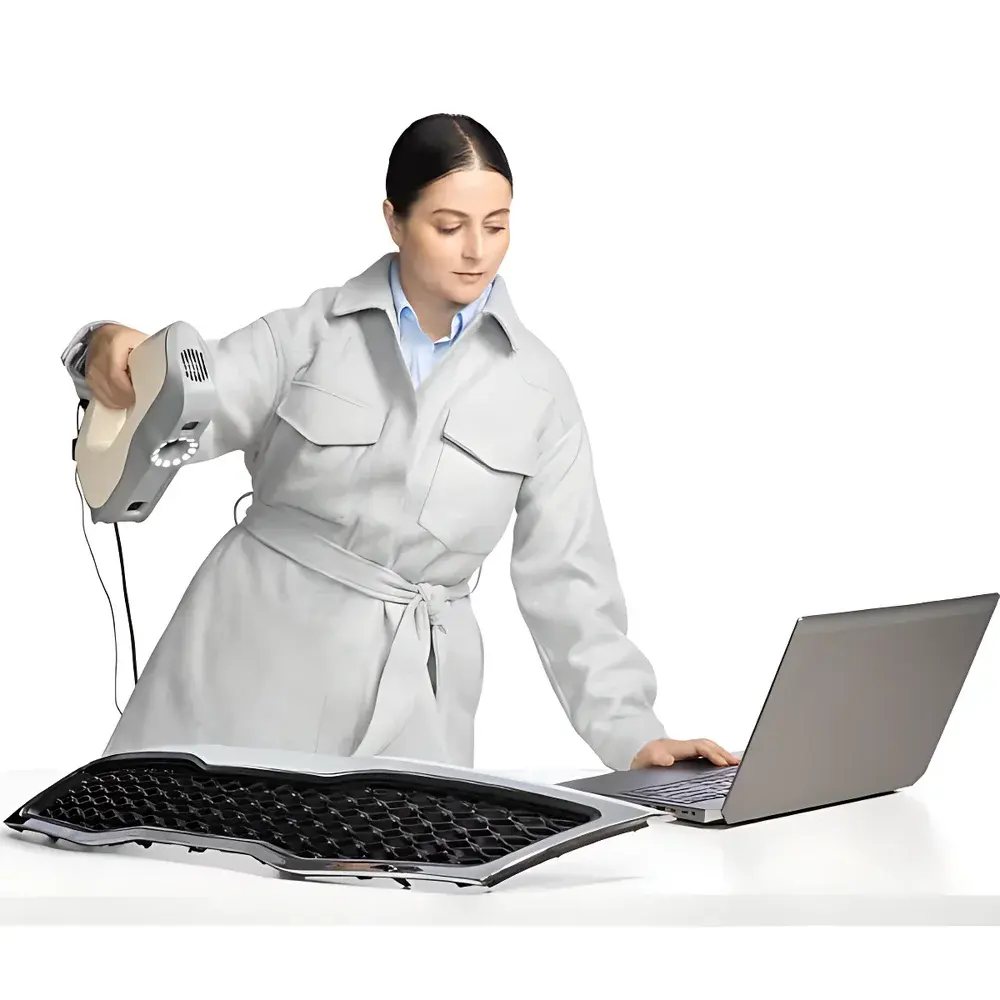
The Artec Eva Color Handheld 3D Scanner is a professional-grade, portable structured light 3D imaging system engineered for high-fidelity digitization of medium-sized objects ranging from anatomical specimens and industrial components to cultural heritage artifacts and forensic evidence. Operating on the principle of triangulation-based fringe projection, Eva projects a sequence of calibrated sinusoidal light patterns onto the target surface and reconstructs 3D geometry by analyzing pattern deformation through dual high-resolution CMOS sensors. Unlike laser-based scanners, its non-contact, eye-safe white-light illumination enables reliable capture of challenging surfaces—including glossy, dark, or low-contrast materials—without surface preparation or spray application. Designed for laboratory, workshop, and field deployment, Eva delivers real-time mesh generation with full-color texture mapping at up to 16 frames per second, making it suitable for dynamic scanning workflows where speed, repeatability, and photorealistic surface fidelity are critical.
Key Features
- Portable ergonomic design weighing only 0.85 kg, enabling extended handheld operation without fatigue or external support structures.
- Integrated dual-camera system with synchronized 2.3-megapixel RGB sensors for simultaneous geometric and photometric data acquisition.
- Real-time 3D reconstruction with on-device preview and adaptive mesh refinement during scanning—no post-hoc alignment required for most single-pass captures.
- Intelligent auto-calibration and dynamic exposure control ensure consistent accuracy across varying ambient lighting conditions and object reflectivity profiles.
- Battery-powered operation (6+ hours continuous use) or direct USB-C tethering for uninterrupted desktop integration and power delivery.
- Native compatibility with Artec Studio software for advanced processing including automatic hole filling, sharp edge preservation, noise filtering, and NURBS surface conversion.
Sample Compatibility & Compliance
Eva supports non-destructive 3D digitization of diverse specimen types commonly encountered in scientific, industrial, and conservation laboratories—including human anatomical models, metallic engine components, composite aerospace parts, archaeological fragments, and biological tissue replicas. Its structured light methodology complies with ISO/IEC 17025 requirements for measurement traceability when used within validated workflows. The device meets CE marking directives for electromagnetic compatibility (EMC Directive 2014/30/EU), low voltage safety (LVD Directive 2014/35/EU), and environmental conformity (RoHS Directive 2011/65/EU). While not certified for clinical in-vivo use under FDA 21 CFR Part 820 or ISO 13485, Eva is routinely deployed in GLP-aligned research environments for preclinical prototyping, dimensional metrology, and documentation purposes.
Software & Data Management
Artec Studio v19+ provides a comprehensive, scriptable platform for end-to-end 3D data handling—from raw point cloud registration and global optimization to automated texture blending and export-ready mesh export. The software supports audit-trail logging for critical operations, enabling compliance with internal QA protocols and facilitating reproducibility reporting. Export formats include industry-standard STL, OBJ, and PLY for CAD interoperability; ASCII/CSV point clouds for statistical shape analysis; and PDF 3D for interactive technical documentation. All project files retain metadata such as timestamp, operator ID, scanner firmware version, and calibration history—essential for traceability in regulated environments.
Applications
- Quality Control & Reverse Engineering: Rapid verification of castings, machined parts, and additive-manufactured components against nominal CAD models using deviation color maps and GD&T overlays.
- Biomedical Research & Education: Creation of anatomically accurate digital phantoms, orthopedic implant fitting studies, and surgical planning models derived from physical specimens or cadaveric material.
- Cultural Heritage Documentation: High-resolution archival scanning of sculptures, fossils, and fragile artifacts with photorealistic texture retention for virtual museum curation and restoration planning.
- Forensic Science: On-scene capture of footwear impressions, tool marks, and skeletal remains for comparative analysis and courtroom visualization.
- Automotive & Aerospace Prototyping: In-process validation of body panels, exhaust systems, and composite airframe sections during iterative design cycles.
FAQ
Is Artec Eva suitable for scanning human subjects in motion?
Yes—Eva’s high frame rate and real-time tracking allow stable capture of seated or slow-moving individuals, widely applied in ergonomics, prosthetics fitting, and anthropometric studies.
Does Eva require reflective markers or surface treatment?
No—its structured light engine is optimized for unprepared surfaces, including black anodized metals, polished alloys, and matte organic materials.
Can scan data be integrated into SolidWorks or Fusion 360?
Yes—native export to STEP, IGES, and polygonal formats enables seamless import and parametric modeling workflows in major MCAD platforms.
What is the minimum feature size resolvable by Eva?
Under optimal conditions (stable hold, ideal working distance, high-contrast texture), Eva resolves surface details down to approximately 0.5 mm, with geometric accuracy specified at ±0.1 mm.
Is remote operation supported for lab-controlled environments?
Artec Studio supports networked license management and scripted batch processing via Python API, enabling integration into automated imaging pipelines and centralized data repositories.




