
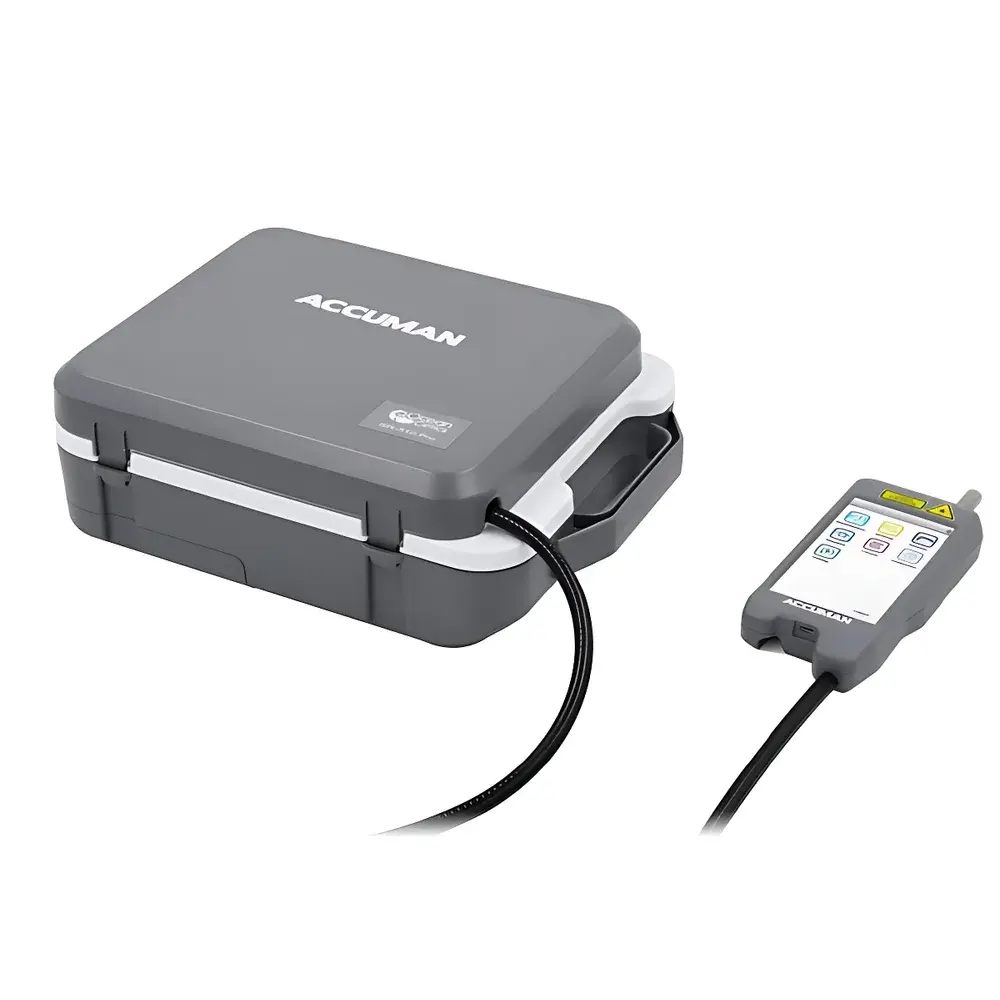
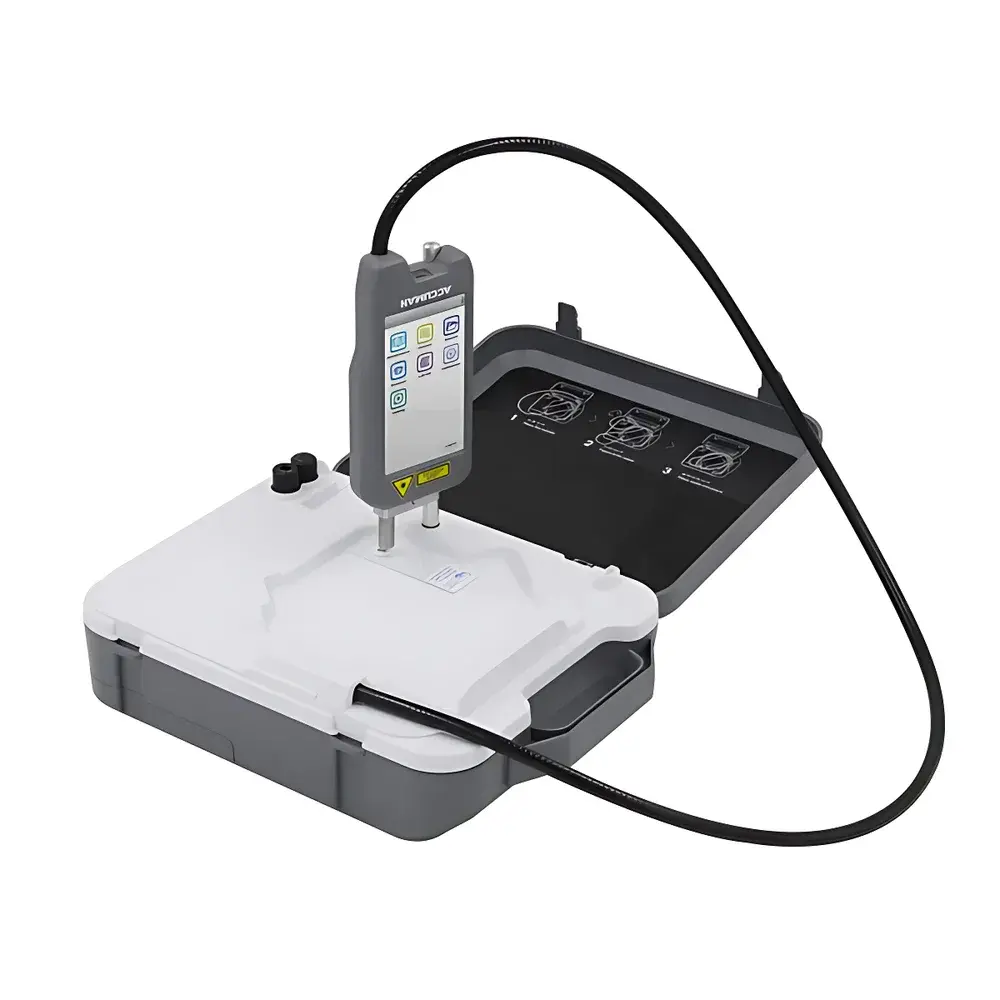
Ocean Optics ACCUMAN SR-510 Pro Portable Research-Grade Raman Spectrometer
| Brand | Ocean Optics |
|---|---|
| Origin | USA |
| Model | ACCUMAN SR-510 Pro |
| Instrument Type | Portable/Handheld Raman Spectrometer |
| Spectral Range | 200–3900 cm⁻¹ (configurable) |
| Spectral Resolution | 4–12 cm⁻¹ (dependent on grating and spectral window) |
| Laser Wavelength | 785 nm ± 0.5 nm, linewidth < 2 cm⁻¹, frequency stability < 0.1 cm⁻¹ |
| Laser Power | Up to 350 mW, 10-step linear adjustment |
| Detector | TE-cooled back-illuminated thin CCD array |
| Signal-to-Noise Ratio | 1000:1 |
| Integration Time | 0.1–30 s |
| Display | 4.5″ 720p capacitive multi-touch LCD |
| Data Interfaces | USB 2.0, Wi-Fi |
| Battery Life | >5 hours (rechargeable Li-ion) |
| Weight | 330 g (handheld probe), 3.8 kg (main unit) |
| Dimensions | 15.5 × 7.4 × 2.5 cm (probe), 29 × 22 × 10 cm (unit) |
| Operating Temperature | 0–45 °C |
| Software Features | Fluorescence background subtraction, spectral similarity matching, quantitative modeling, PDF/CSV/TXT/JDX/RDB export |
| Compliance | ASTM E1840, ISO 8573-1 (for optical path integrity), GLP/GMP-ready audit trail in software log |
Overview
The Ocean Optics ACCUMAN SR-510 Pro is a portable, research-grade Raman spectrometer engineered for high-fidelity molecular fingerprinting outside the confines of the traditional laboratory. Based on confocal dispersive Raman spectroscopy with 785 nm excitation, it leverages a stabilized single-mode diode laser and a thermoelectrically cooled, back-illuminated thin CCD detector to deliver laboratory-comparable signal-to-noise performance in field-deployable form. Its optical architecture minimizes fluorescence interference while preserving vibrational mode resolution across broad spectral windows—from 200 cm⁻¹ (low-frequency lattice modes) up to 3900 cm⁻¹ (high-frequency C–H/O–H stretches)—enabling rigorous identification and quantification of crystalline polymorphs, amorphous phases, biological macromolecules, and trace contaminants. Designed for scientific rigor rather than operational convenience alone, the SR-510 Pro meets the analytical demands of peer-reviewed research, regulatory documentation, and cross-platform method transfer.
Key Features
- Research-Grade Optical Core: Integrated TE-cooled back-illuminated thin CCD ensures low dark current (90% at 785 nm), critical for weak Raman scattering detection.
- Stabilized 785 nm Laser Source: Frequency-stabilized diode laser with <0.1 cm⁻¹ wavelength drift over 8 hours supports reproducible peak position calibration—essential for inter-instrument comparability and long-term trend analysis.
- Configurable Spectral Performance: Interchangeable gratings enable user-selectable trade-offs between spectral range (200–2000, 200–3000, or 200–3900 cm⁻¹) and resolution (4–12 cm⁻¹), validated per NIST-traceable polystyrene standards.
- Embedded Quantitative Workflow: On-device chemometric engine supports partial least squares (PLS) regression modeling, spectral library matching (with cosine correlation and Euclidean distance metrics), and automated fluorescence baseline correction using asymmetric least squares (AsLS) algorithms.
- Field-Ready Mechanical Design: IP52-rated enclosure, shock-absorbing elastomer housing, and dual-mode operation (standalone handheld probe + PC-synchronized acquisition) ensure robustness during transport and deployment in non-climate-controlled environments.
Sample Compatibility & Compliance
The ACCUMAN SR-510 Pro accommodates solid powders, tablets, films, liquids, gels, and irregular surfaces via interchangeable sampling optics—including fiber-coupled probes (NA 0.22, 7.5 mm working distance), micro-positioning stages, and optional microscope-integrated modules for spatially resolved mapping. All optical paths comply with ISO 8573-1 Class 4 particulate cleanliness specifications to prevent stray-light artifacts. The instrument’s firmware and data management software support ALCOA+ principles: attributable, legible, contemporaneous, original, accurate, complete, consistent, enduring, and available. Audit trails record user actions, parameter changes, and calibration events in accordance with FDA 21 CFR Part 11 requirements when operated under controlled IT governance.
Software & Data Management
OceanView Raman Edition v3.x provides a validated, modular interface for instrument control, real-time spectral preview, batch processing, and report generation. Raw spectra are stored in vendor-neutral formats (.jdx, .rdb) alongside metadata-rich .csv exports containing wavenumber, intensity, integration time, laser power, and temperature logs. The embedded database manager supports hierarchical spectral libraries (e.g., pharmaceutical APIs, gemstone references, polymer additives) with version-controlled updates. All quantitative models undergo internal cross-validation (leave-one-out, k-fold) prior to deployment; model parameters—including RMSECV, R², and VIP scores—are exported with final reports in PDF format compliant with ISO/IEC 17025 documentation standards.
Applications
- Pharmaceutical Quality Control: Polymorph screening of active pharmaceutical ingredients (APIs), counterfeit drug detection, and blend uniformity assessment per USP and ICH Q5A guidelines.
- Materials Science: Characterization of carbon allotropes (graphene, nanotubes), stress/strain mapping in thin-film semiconductors, and phase transitions in battery cathode materials.
- Cultural Heritage & Forensics: Non-invasive pigment identification in paintings, ink differentiation in questioned documents, and gemstone origin verification using lattice-mode signatures.
- Environmental Monitoring: In situ detection of microplastics in water matrices, hydrocarbon contamination in soil, and airborne particulate composition via fiber-optic probe coupling.
- Academic Teaching: Hands-on instruction in vibrational spectroscopy principles, spectral interpretation, and chemometrics—supported by preloaded pedagogical datasets and guided workflows.
FAQ
Is the ACCUMAN SR-510 Pro suitable for GMP-regulated environments?
Yes—when deployed with configured audit trails, electronic signatures, and validated software protocols, it satisfies core elements of Annex 11 and 21 CFR Part 11 for analytical instrumentation used in manufacturing and release testing.
Can the spectral resolution be adjusted without hardware replacement?
No—resolution is determined by fixed grating selection at time of configuration; however, multiple grating options are factory-installable and documented in the instrument’s calibration certificate.
Does the system support external triggering or synchronization with other instruments?
Yes—TTL-compatible trigger input/output ports enable precise timing coordination with stage controllers, pulsed lasers, or thermal chambers for time-resolved or correlative measurements.
What calibration standards are supplied, and how often is recalibration required?
NIST-traceable polystyrene and silicon wafers are included; annual recalibration is recommended, with wavelength accuracy verified to ±0.5 cm⁻¹ and intensity linearity validated across three decades of signal amplitude.
Is remote operation supported over enterprise networks?
Yes—Wi-Fi connectivity operates in infrastructure mode with WPA2-Enterprise authentication; SSH-based CLI access is available for IT-administered fleet management and script-driven batch acquisitions.





