
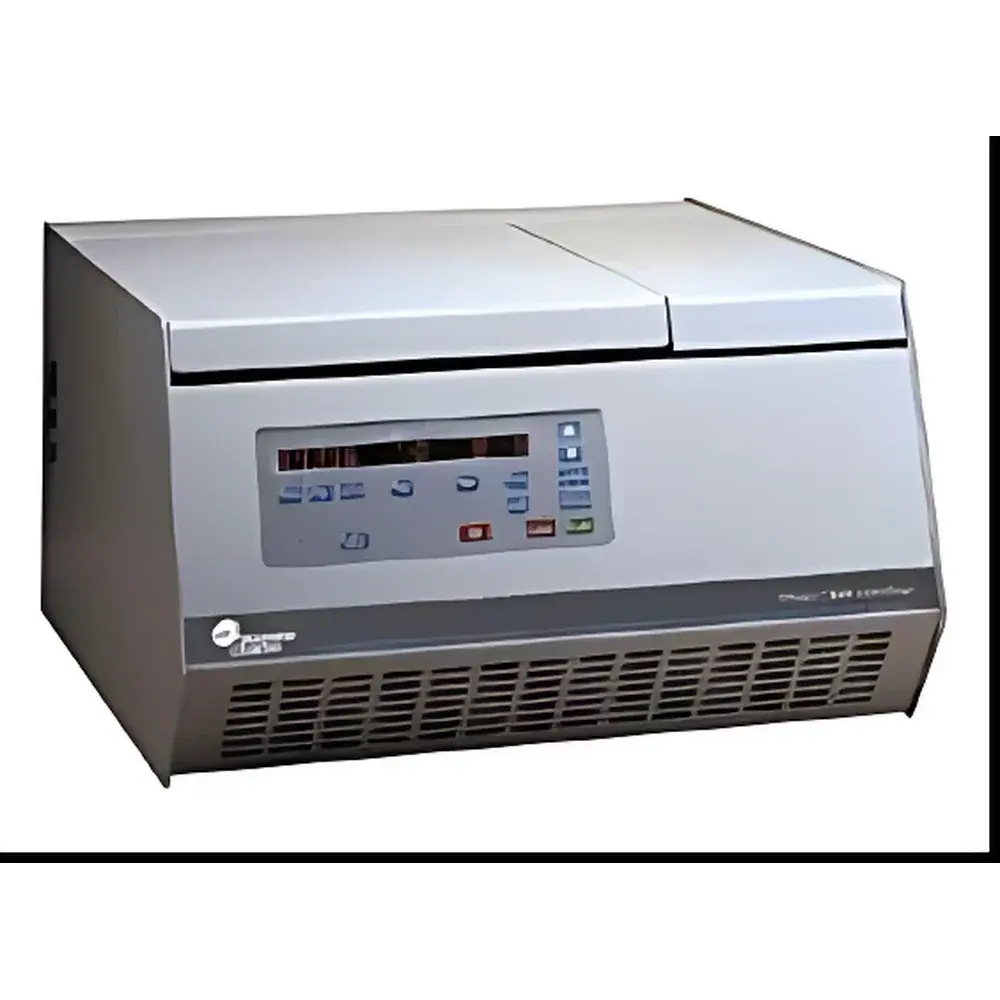
Beckman Coulter Allegra 64R High-Speed Refrigerated Benchtop Centrifuge
| Brand | Beckman Coulter |
|---|---|
| Origin | USA |
| Product Category | Imported |
| Model | Allegra 64R |
| Instrument Type | Benchtop Centrifuge |
| Speed Range | 10,000–30,000 rpm |
| Max RCF | 64,400 × g |
| Max Capacity | 510 mL |
| Temperature Range | –20 °C to +40 °C |
| Dimensions (W×D×H) | 38 × 61 × 66 cm |
| Rotor Compatibility | 13 interchangeable rotors (11 fixed-angle, 2 swing-bucket) |
| Sample Vessel Range | 0.25–85 mL |
| Acceleration/Deceleration Profiles | 10 programmable settings |
| Timer Range | 1 min–9 h 59 min or continuous/short-run mode |
| Display | Digital LCD with real-time RPM/RCF conversion |
| Drive System | Brushless induction motor |
| Safety Features | Automatic rotor recognition, imbalance detection, overspeed protection, biocontainment swing buckets, interlocked safety lid, stainless-steel chamber ring |
Overview
The Beckman Coulter Allegra 64R is a high-performance refrigerated benchtop centrifuge engineered for precision subcellular fractionation, viral pelleting, and macromolecular isolation in regulated and research-intensive laboratory environments. Operating on the principle of sedimentation under controlled gravitational force (RCF), the Allegra 64R delivers up to 64,400 × g at 30,000 rpm—enabling applications traditionally reserved for floor-standing ultracentrifuges to be executed efficiently on the benchtop. Its compact footprint (0.4 m²) and integrated refrigeration system allow seamless integration into space-constrained core facilities, QC labs, and academic research suites without compromising thermal stability or mechanical reliability. Designed and manufactured in the United States, the instrument complies with IEC 61010-1 for electrical safety and meets ISO 13485-aligned quality system requirements for medical device–adjacent instrumentation.
Key Features
- High-Performance Rotor Flexibility: Supports 13 certified rotors—including 11 fixed-angle and 2 swing-bucket configurations—enabling compatibility with tubes ranging from 0.25 mL microcentrifuge tubes to 85 mL conical centrifuge bottles. BioSafety-certified swing buckets provide sealed containment for BSL-2 agents and aerosol-prone samples.
- Precision Control Architecture: Microprocessor-based control system with touch-sensitive interface, real-time RPM/RCF interconversion, and 100 rpm speed increments. Programmable acceleration/deceleration profiles (10 settings) minimize sample disturbance during spin-up and braking phases.
- Thermal Integrity Under Load: Environmentally compliant refrigerant (R-134a-free alternative) maintains setpoint temperatures between –20 °C and +40 °C. Even at maximum RCF (64,400 × g), the system sustains sample temperature ≤4 °C—critical for preserving labile proteins, nucleic acids, and organelle integrity.
- Robust Mechanical Design: Brushless induction drive eliminates carbon brush wear, ensuring long-term torque consistency and reduced maintenance intervals. Stainless-steel chamber ring and auto-locking safety door meet ANSI Z245.1 impact resistance standards.
- Comprehensive Safety Protocols: Integrated rotor identification, dynamic imbalance sensing, overspeed cutoff, and temperature runaway monitoring conform to GLP/GMP operational expectations. All rotors are individually serialized and validated per Beckman Coulter’s rotor certification program.
Sample Compatibility & Compliance
The Allegra 64R accommodates diverse biological and biochemical sample types—including mammalian cell lysates, bacterial pellets, exosome preparations, purified antibodies, and viral suspensions—across standard polypropylene, polycarbonate, and ultraclear centrifuge tubes. Rotors are validated for use with common tube manufacturers (e.g., Eppendorf, Thermo Fisher, Corning) and comply with ASTM F2119 for centrifuge rotor fatigue life assessment. The system supports audit-ready operation in FDA-regulated environments: full electronic log generation, user-access-level controls, and optional password-protected method locking align with 21 CFR Part 11 data integrity guidelines when paired with Beckman Coulter’s CentriLog™ software.
Software & Data Management
While the Allegra 64R operates autonomously via its embedded controller, it interfaces seamlessly with Beckman Coulter’s CentriLog™ PC-based software suite for method archiving, run history export (CSV/PDF), and remote diagnostics. CentriLog™ enables version-controlled protocol storage, user-defined calibration logs, and timestamped event tracking—including rotor usage cycles, temperature excursions, and error codes. Audit trails include operator ID, date/time stamps, and parameter changes—supporting ISO/IEC 17025 accreditation requirements for testing laboratories.
Applications
- Isolation of mitochondria, lysosomes, and microsomes from tissue homogenates
- Pelleting of enveloped viruses (e.g., influenza, SARS-CoV-2 pseudovirions) at ≥100,000 × g equivalent sedimentation efficiency
- Clarification of recombinant protein expression supernatants prior to chromatography
- Preparative separation of plasma-derived extracellular vesicles (EVs)
- Routine bacterial cell harvesting (E. coli, Bacillus spp.) with minimal thermal stress
- QC testing of vaccine formulations requiring cold-chain-compatible centrifugation
FAQ
What is the minimum and maximum sample volume supported by the Allegra 64R?
The system accommodates volumes from 0.25 mL (in microcentrifuge tubes) up to 85 mL (in swing-bucket configurations), depending on selected rotor and tube type.
Does the Allegra 64R support validation documentation for GxP environments?
Yes—rotor certificates, factory calibration reports, and IQ/OQ templates are available upon request. When used with CentriLog™, the system supports ALCOA+ data integrity principles.
Can the instrument maintain –20 °C at maximum speed?
No—the refrigeration system prioritizes sample temperature stability over ambient setpoint under high-RCF loads; at 30,000 rpm, the lowest achievable and sustained sample temperature is 4 °C.
Is rotor autoclaving permitted?
Fixed-angle aluminum rotors may be autoclaved at 121 °C for 20 minutes; swing-bucket rotors and polymer components require chemical disinfection only—refer to Beckman Coulter’s Rotor Care Manual for material-specific protocols.
How frequently must the refrigeration system be serviced?
Annual preventive maintenance is recommended, including refrigerant pressure verification, condenser coil inspection, and door seal integrity testing—per Beckman Coulter Service Bulletin SB-ALG64R-2023.



