
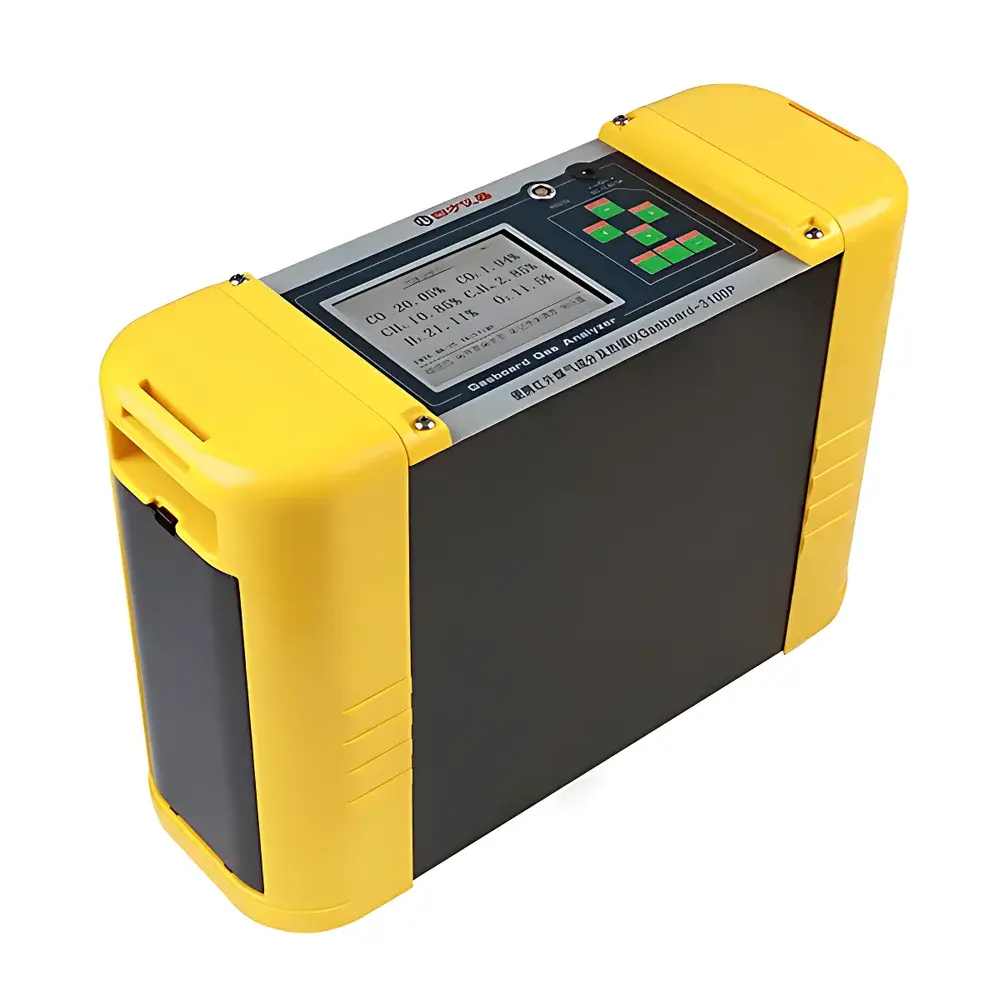
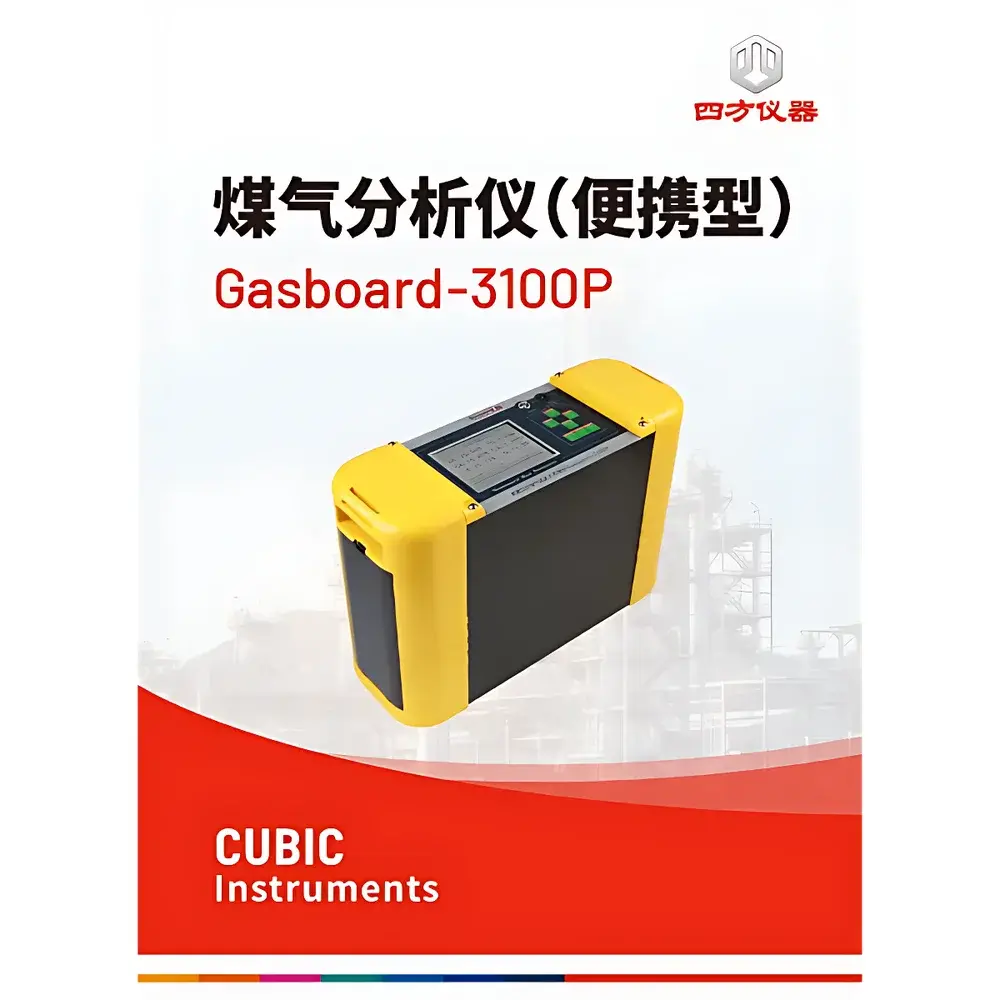
CUBIC INSTRUMENTS Gasboard-3100P Portable Combustion Experiment Gas Analyzer for Universities and Research Institutes
| Brand | CUBIC INSTRUMENTS |
|---|---|
| Origin | Hubei, China |
| Model | Gasboard-3100P |
| Measurement Principle | NDIR (CO, CO₂, CH₄, C₂H₂, C₂H₄, CnHm), TCD (H₂), ECD (O₂) |
| Response Time | T₉₀ < 15 s (NDIR) |
| Measurement Range | CO/CO₂/CH₄/H₂: (0–100)% |
| O₂ | (0–25)% |
| C₂H₂/C₂H₄/CnHm | (0–10)% (optional) |
| Resolution | 0.01% |
| Repeatability | ≤1% FS |
| Linearity Error | ±1% FS (NDIR gases) |
| Sample Flow Rate | 0.7–1.2 L/min |
| Inlet Pressure | 2–50 kPa |
| Dimensions (L×W×H) | 412 × 152 × 294 mm |
| Weight | 9 kg |
| Power | Rechargeable Li-ion battery |
| Communication | RS-232 |
| Thermal Value Units | kcal/m³ and MJ/m³ (switchable) |
| Self-Diagnostic Function | Yes |
| Sample Requirements | Dust-free, moisture-free, oil-free |
Overview
The CUBIC INSTRUMENTS Gasboard-3100P is a portable multi-component gas analyzer engineered for precise, real-time composition and calorific value analysis of fuel gases in combustion research, industrial process monitoring, and biogas characterization. It integrates three complementary sensing technologies—non-dispersive infrared (NDIR) spectroscopy for CO, CO₂, CH₄, C₂H₂, C₂H₄, and total non-methane hydrocarbons (CnHm); thermal conductivity detection (TCD) for H₂; and electrochemical detection (ECD) for O₂—to deliver simultaneous, interference-minimized quantification of up to eight gas species and derived higher heating value (HHV). Designed specifically for university laboratories, national research institutes, and pilot-scale combustion test rigs, the instrument operates without consumables or carrier gases, eliminating operational dependencies associated with wet chemical (Orsat), chromatographic (GC), or flame ionization methods. Its measurement architecture complies with fundamental physical principles defined in ISO 10156 (gas detection), ASTM D1945 (gas analysis by GC—used as reference for validation), and supports traceability frameworks required under GLP-compliant experimental protocols.
Key Features
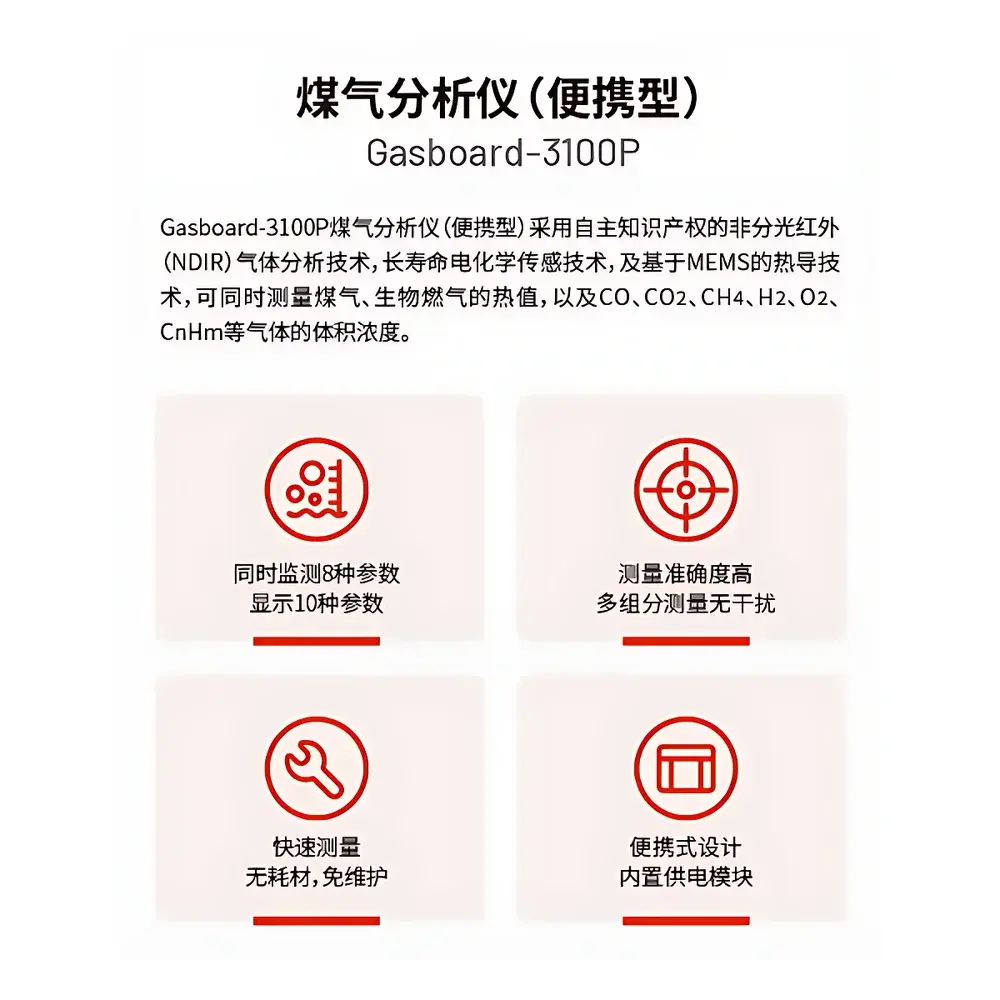
- Multi-technology sensor fusion: Independent NDIR channels eliminate cross-sensitivity—e.g., CnHm does not interfere with CH₄ quantification; CO, CO₂, and CH₄ exert no measurable effect on H₂ measurement via TCD.
- Integrated calorific value calculation: Real-time HHV computation (kcal/m³ or MJ/m³) based on measured volumetric concentrations and standardized thermodynamic coefficients per ISO 6976 and EN 15403.
- Robust portable form factor: 9 kg weight, integrated sampling pump, and sealed enclosure rated for Class II, Division 2 environments enable deployment in lab fume hoods, combustion chamber exhaust ducts, and field biogas collection points.
- Intelligent power management: Soft-start circuitry prevents low-voltage operation; battery state-of-charge monitoring ensures data integrity during extended unattended measurements.
- No consumables or calibration gases required for routine operation: Factory-calibrated sensors maintain stability over 12 months under typical lab conditions, reducing total cost of ownership versus GC-based or Orsat systems.
- Self-diagnostic firmware: Continuous sensor health monitoring with status flagging for optical path contamination, electrode saturation, or thermal drift—critical for audit-ready experimental records.
Sample Compatibility & Compliance
The Gasboard-3100P accepts dry, particle-free, oil-free sample streams within 2–50 kPa inlet pressure and 0.7–1.2 L/min flow range—compatible with standard Tedlar® bags, stainless steel sampling lines, and conditioned extractive probes. It is validated for use with syngas, blast furnace gas, coke oven gas, producer gas, biogas (from anaerobic digestion or pyrolysis), natural gas blends, and laboratory-generated combustion effluents. All sensor modules meet EMC Directive 2014/30/EU and RoHS 2011/65/EU requirements. While not intrinsically safe certified, its design aligns with IEC 60079-0 general requirements for non-explosive atmosphere instrumentation. Data logging meets minimum ALCOA+ criteria (Attributable, Legible, Contemporaneous, Original, Accurate) when paired with timestamped RS-232 output.
Software & Data Management
Internal firmware supports automatic storage of up to 10,000 measurement records with UTC timestamps, gas composition arrays, and calculated HHV. Data export is supported via RS-232 serial interface to host PCs or SCADA systems using ASCII-based protocol (Modbus RTU optional on request). No proprietary software installation is required—raw output is human-readable and compatible with MATLAB, Python pandas, or LabVIEW parsing scripts. Audit trail functionality includes sensor zero/span history, battery voltage logs, and self-test event timestamps—enabling retrospective verification per FDA 21 CFR Part 11 Annex 11 expectations for research-grade instrumentation.
Applications
- Combustion science labs: Quantitative analysis of exhaust gases from burner rigs, fluidized bed reactors, and laminar flame experiments—supporting kinetic model validation and NOₓ/CO emission correlation studies.
- Metallurgical process control: On-line monitoring of blast furnace top gas, basic oxygen furnace off-gas, and coke oven by-product gas for energy recovery optimization.
- Biogas R&D: Composition profiling of feedstock-dependent digester output (e.g., manure vs. food waste vs. agricultural residue) and thermal value tracking during upgrading trials.
- Fuel substitution studies: Comparative analysis of hydrogen-blended natural gas, synthetic methane, and biomass-derived syngas in engine and turbine test cells.
- Standards development support: Reference-grade composition data generation for inter-laboratory round-robin testing under ISO/IEC 17043 proficiency schemes.
FAQ
Does the Gasboard-3100P require daily calibration?
No. Factory calibration remains stable for ≥12 months under controlled lab conditions. A two-point span check (zero air + certified span gas) is recommended before critical experiments or after mechanical shock.
Can it measure H₂S or NH₃?
Not natively. H₂S and NH₃ are outside the supported analyte set; dedicated electrochemical or UV-DOAS modules would be required for those species.
Is the CnHm channel specific to ethane or propane?
No. CnHm represents the summed concentration of all non-methane hydrocarbons (C₂–C₆+) detected via broadband NDIR absorption—consistent with EPA Method 25A and ISO 8573-5 definitions.
What sample conditioning is recommended for high-moisture biogas?
An optional heated Nafion™ dryer or chilled mirror condenser must be installed upstream to ensure dew point < −10 °C prior to inlet—preventing condensate formation in the optical cell.
How is traceability maintained for calorific value calculations?
HHV algorithms implement ISO 6976 Annex B coefficients and default stoichiometric combustion enthalpies; users may input custom coefficients for atypical fuel matrices via configuration file upload.




