
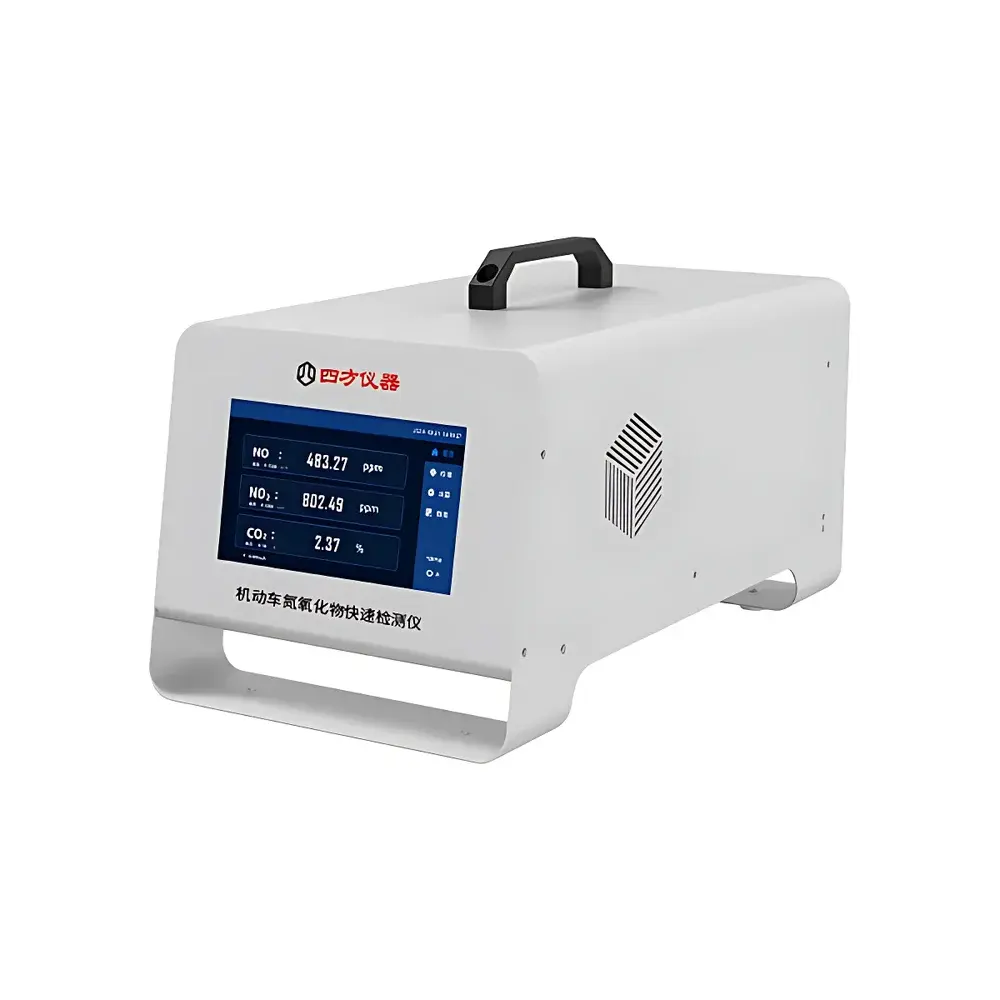
CUBIC INSTRUMENTS Gasboard-5230P Automotive Exhaust NOₓ Analyzer
| Brand | CUBIC INSTRUMENTS |
|---|---|
| Origin | Hubei, China |
| Model | Gasboard-5230P |
| Instrument Type | Online Analyzer |
| Detection Principle | UV Absorption Spectroscopy (NO, NO₂), Electrochemical (CO₂) |
| Measured Components | NO, NO₂, CO₂ |
| Measurement Range | 0–1500 ppm (NO), 0–1000 ppm (NO₂), 0–18% (CO₂) |
| Resolution | 1 ppm (NO/NO₂), 0.01% (CO₂) |
| Accuracy | ±4% FS (NO/NO₂), ±3% FS (CO₂) |
| Response Time | ≤5 s (all channels) |
| Warm-up Time | 800 s |
| Communication Interfaces | RS232, Wi-Fi |
| Operating Temperature | 5–40 °C |
| Operating Humidity | 5–85% RH |
| Operating Pressure | 86–106 kPa |
| Power Supply | DC 12 V |
Overview
The CUBIC INSTRUMENTS Gasboard-5230P is an online automotive exhaust gas analyzer engineered for real-time, continuous measurement of nitrogen oxides (NO and NO₂) and carbon dioxide (CO₂) in vehicle tailpipe emissions. It employs dual-wavelength ultraviolet (UV) absorption spectroscopy for selective, interference-resistant quantification of NO and NO₂—without requiring catalytic NOx converters—complemented by a calibrated electrochemical sensor for CO₂. Designed specifically for regulatory enforcement and field-based emission compliance verification, the Gasboard-5230P operates under dynamic conditions: during chassis dynamometer testing (simulated driving cycles) and on-road mobile monitoring. Its architecture supports synchronized geotagging via integrated BeiDou GNSS positioning, enabling spatially resolved emission mapping and traceable test records aligned with jurisdictional inspection protocols.
Key Features
- Direct, simultaneous UV-spectroscopic detection of NO and NO₂ at 226 nm and 350 nm—eliminating cross-sensitivity from NO₂-to-NO conversion artifacts and reducing calibration drift.
- Multi-stage particulate and moisture filtration system upstream of the optical cell to prevent optical window fouling and maintain long-term photometric stability.
- Compact, ruggedized enclosure rated for mobile deployment; optimized thermal management ensures spectral baseline stability across ambient temperature fluctuations (5–40 °C).
- Embedded Wi-Fi and RS232 interfaces support both local data logging and remote telemetry integration into centralized fleet monitoring platforms or municipal I/M (Inspection & Maintenance) databases.
- Preloaded firmware compliant with Beijing Local Standard DB11/1476–2017 and JJF (Beijing) 130–2024, including built-in audit trails, calibration lockout mechanisms, and timestamped raw spectral data export.
Sample Compatibility & Compliance
The Gasboard-5230P is validated for direct sampling of undiluted or diluted exhaust streams from light-duty and heavy-duty compression-ignition (diesel) and spark-ignition (gasoline) vehicles. Its gas path design accommodates transient exhaust pulses without condensation-induced signal attenuation. The analyzer meets functional requirements for periodic technical inspection (PTI) under GB 3847–2018 and aligns with the metrological traceability framework specified in JJF (Beijing) 130–2024. While not certified to ISO 16183 or EN 15058, its UV absorption methodology adheres to the fundamental principles outlined in ISO 11359-2 for optical gas analysis. Data integrity features—including electronic signature-capable reporting and immutable session logs—support GLP-aligned operational documentation for third-party accreditation bodies.
Software & Data Management
The companion Android/iOS application provides real-time visualization of concentration time-series, GPS-tagged location overlays, and automated report generation in PDF format compliant with DB11/1476–2017 Annex C. All measurements are stored locally with SHA-256 hashed metadata (timestamp, GPS coordinates, instrument ID, operator ID). Remote firmware updates and configuration parameter locking are enforced via TLS 1.2-secured cloud synchronization. Raw UV absorbance spectra (wavelength vs. intensity) and electrochemical voltage outputs are exportable in CSV format for independent validation or secondary analysis. Audit logs record every calibration event, zero/span adjustment, and user login—retained for ≥180 days per internal retention policy.
Applications
- In-service vehicle emission screening at roadside checkpoints and I/M stations.
- On-dynamometer NOₓ certification testing for diesel retrofit verification and aftertreatment system diagnostics.
- Mobile emission inventory studies supporting urban air quality modeling (e.g., CALPUFF input generation).
- Real-world driving emissions (RDE) monitoring campaigns where portability, rapid response (<5 s), and positional accuracy are critical.
- Research applications involving NO/NO₂ ratio dynamics under varying load, speed, and aftertreatment thermal states.
FAQ
Does the Gasboard-5230P require periodic calibration with certified gas standards?
Yes. Per JJF (Beijing) 130–2024, initial calibration and bi-weekly span verification using NIST-traceable NO, NO₂, and CO₂ reference gases are mandatory for regulatory use.
Can the device operate continuously during extended road testing?
Yes. With external 12 V DC power (e.g., vehicle battery via isolated converter), it sustains uninterrupted operation for >8 hours; internal battery backup supports 30 min of emergency logging during power loss.
Is raw spectral data accessible for third-party algorithm development?
Yes. Full-resolution UV absorbance scans (200–400 nm, 1 nm step) and electrochemical sensor output voltages are available via USB mass storage mode or Wi-Fi API endpoint.
How does the system handle high-humidity exhaust samples?
Integrated thermoelectric cooler (TEC) and hydrophobic membrane filter reduce dew point to <5 °C prior to the optical cell, preventing condensate formation and maintaining Beer–Lambert linearity.
What cybersecurity measures protect data transmission over Wi-Fi?
All wireless communications use WPA3-Enterprise authentication with RADIUS server integration; payload encryption follows AES-256-GCM with certificate-pinned TLS handshakes.







