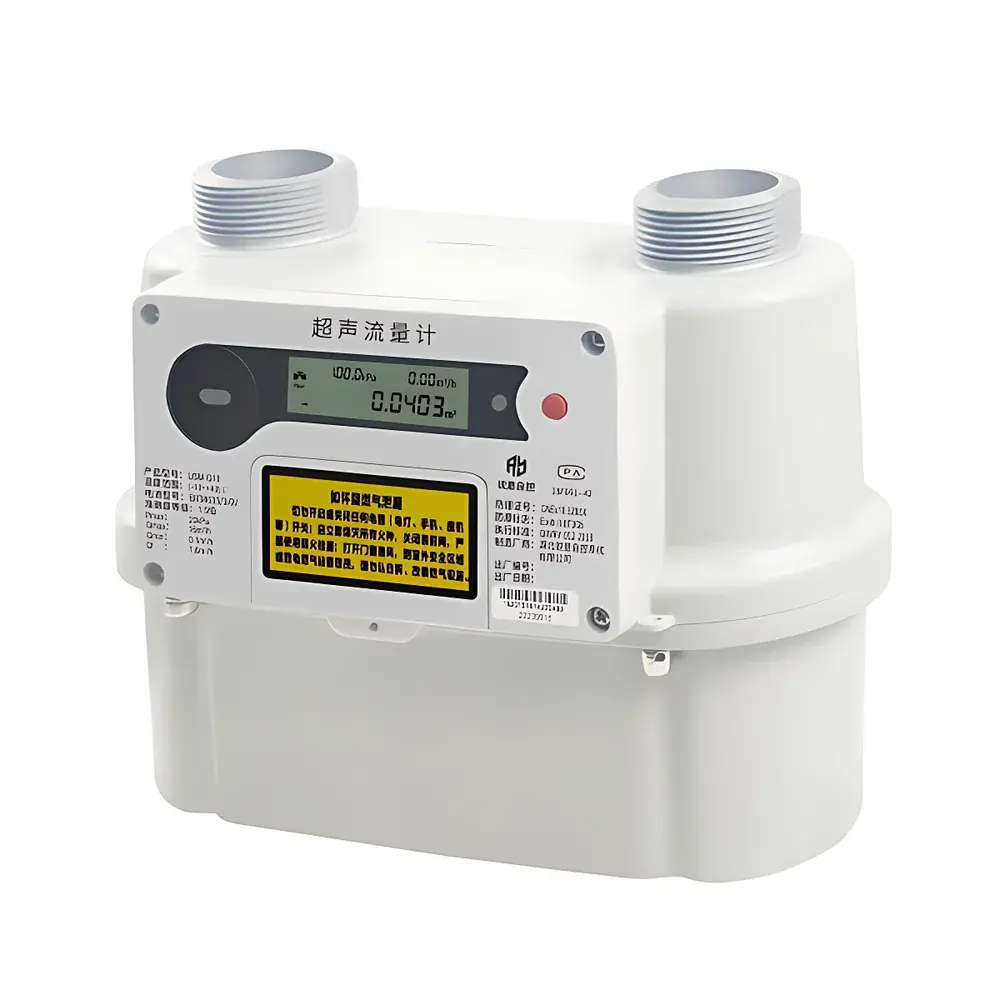
Cubic USM Series Commercial Ultrasonic Gas Meter
| Brand | Cubic |
|---|---|
| Origin | Hubei, China |
| Manufacturer Type | Authorized Distributor |
| Product Category | Domestic |
| Model | USM Series |
| Pricing | Upon Request |
| Technology | Ultrasonic Time-of-Flight (TOF) |
| Measurement Principle | Ultrasonic Transit-Time Difference Method |
| Gas Medium | Natural Gas (NG), Liquefied Petroleum Gas (LPG) – vapor phase only |
| Accuracy Class | 1.5 |
| Flow Range (USM-G6/USM-G10/USM-G16) | 0.06–10 / 0.1–16 / 0.16–25 m³/h |
| Interface | G1½ threaded connection |
| Dimensions (L×W×H) | 246 × 204 × 110.5 mm |
| Weight | 2.3 kg |
| Battery | ER34615, 3.6 V |
| Operating Pressure | 0–30 kPa (gauge) |
| Operating Temperature | −10 °C to +40 °C |
| Storage Temperature | −20 °C to +60 °C |
| Ingress Protection | IP54 to IP65 |
| Explosion Protection | Ex ib IIB T3 Gb |
| Flow Error | ±3% (Qmin < Q < Qt), ±1.5% (Qt < Q < Qmax) |
| Integrated Sensors | Flow, Temperature, Pressure |
| Core Components | Domestically developed ultrasonic transducers and signal processing ASIC |
Overview
The Cubic USM Series Commercial Ultrasonic Gas Meter is a high-reliability, fully electronic flow measurement instrument engineered for accurate volumetric flow metering of natural gas in commercial applications—including restaurants, small industrial facilities, district heating substations, and multi-dwelling buildings. It operates on the ultrasonic transit-time difference principle: two opposing ultrasonic transducers emit and receive acoustic pulses across the gas path; the time differential between upstream and downstream propagation is directly proportional to the average axial gas velocity. This non-intrusive, clamp-on–style integrated probe design eliminates mechanical wear, pressure drop artifacts, and magnetic interference—enabling long-term metrological stability without recalibration drift. Unlike diaphragm meters, the USM Series features no moving parts, zero magnetic sensing elements, and inherently low pressure loss (<100 Pa at Qmax), making it suitable for low-pressure distribution networks compliant with EN 1776 and GB/T 6968 standards.
Key Features
- Ultrasonic time-of-flight (TOF) measurement with dual-path configuration for enhanced velocity profile averaging and turbulence immunity
- Integrated tri-sensor architecture: simultaneous real-time acquisition of volumetric flow rate, static temperature (PT1000-grade), and absolute pressure (piezoresistive MEMS sensor)
- Onboard temperature and pressure compensation per ISO 6976 and AGA Report No. 8, enabling standardized volume calculation (Qstd) at reference conditions (15 °C, 101.325 kPa)
- High turndown ratio up to 1:160 (USM-G16), supporting dynamic load variations typical in commercial cooking or boiler cycling
- Robust aluminum alloy housing with IP54–IP65 ingress protection and Ex ib IIB T3 Gb intrinsic safety certification for Zone 1/2 hazardous areas
- Fully domestic signal processing chain: proprietary ultrasonic ASIC, firmware stack, and transducer assembly—ensuring supply chain resilience and traceable calibration lineage
- Low-power operation powered by a single ER34615 lithium-thionyl chloride battery (3.6 V), rated for ≥10 years under typical 15-min data logging intervals
Sample Compatibility & Compliance
The USM Series is validated for dry natural gas (methane content ≥85%, Wobbe index 47–53 MJ/m³) and vapor-phase LPG (propane/butane blends). It complies with national metrological verification regulations JJG 577–2012 (China) and meets essential requirements of MID Directive 2014/32/EU Annex MI-002 for gas meters (pending notified body certification). Design and testing align with EN 1359 (diaphragm meter reference), EN 1776 (gas meter installation), and IEC 60079-11 (intrinsic safety). The device supports audit-ready data integrity: all parameter changes, firmware updates, and meter resets are timestamped and logged with immutable event records—facilitating GLP/GMP-aligned quality system documentation.
Software & Data Management
Configuration, diagnostics, and data retrieval are performed via IR optical interface or optional M-Bus (EN 13757-3) or LoRaWAN 1.0.2 connectivity. Cubic’s PC-based configuration tool (GasMeterConfig v3.2) provides full access to calibration coefficients, error logs, battery health status, and historical flow profiles (min/max/avg per hour over 36 months). All communication protocols enforce AES-128 encryption and support secure firmware signing. Audit trail functionality satisfies FDA 21 CFR Part 11 requirements for electronic records and signatures when deployed in regulated utility environments. Data export formats include CSV, XML, and DLMS/COSEM-compliant OBIS code mapping.
Applications
- Commercial gas billing for food service establishments (restaurants, bakeries, laundries)
- Sub-metering in mixed-use buildings with centralized gas supply
- Monitoring fuel consumption of low-capacity industrial burners and thermal oil heaters
- Leak detection and baseline load profiling via continuous flow trend analysis
- Integration into AMI (Advanced Metering Infrastructure) platforms for demand-side management
- Replacement of aging diaphragm meters where space constraints, pressure sensitivity, or long-term accuracy retention are critical
FAQ
Does the USM Series require periodic recalibration?
No. As a fully electronic, solid-state meter with no mechanical wear or drift-prone analog components, it maintains its certified accuracy class (1.5) over its entire service life per JJG 577–2012 clause 6.4. Verification intervals are defined by local metrology authorities—not manufacturer recommendation.
Can it operate in condensing or wet-gas environments?
No. The USM Series is designed exclusively for clean, dry gas streams. Liquid droplets or particulate contamination may attenuate ultrasonic signals and compromise measurement integrity. Installation requires upstream filtration (≤5 µm) and moisture separation per EN 1776 section 5.2.3.
Is remote firmware update supported over M-Bus?
Yes. Secure over-the-air (OTA) updates are enabled via signed firmware packages delivered through M-Bus Class B or LoRaWAN. Each update triggers an automatic integrity check and rollback mechanism if verification fails.
What is the minimum flow threshold (Qmin) for billing-grade accuracy?
Per EN 1776 Table 1, Qmin is defined as 0.006 m³/h for USM-G6, 0.01 m³/h for USM-G10, and 0.016 m³/h for USM-G16—corresponding to 1% of each model’s Qt (transition flow).