
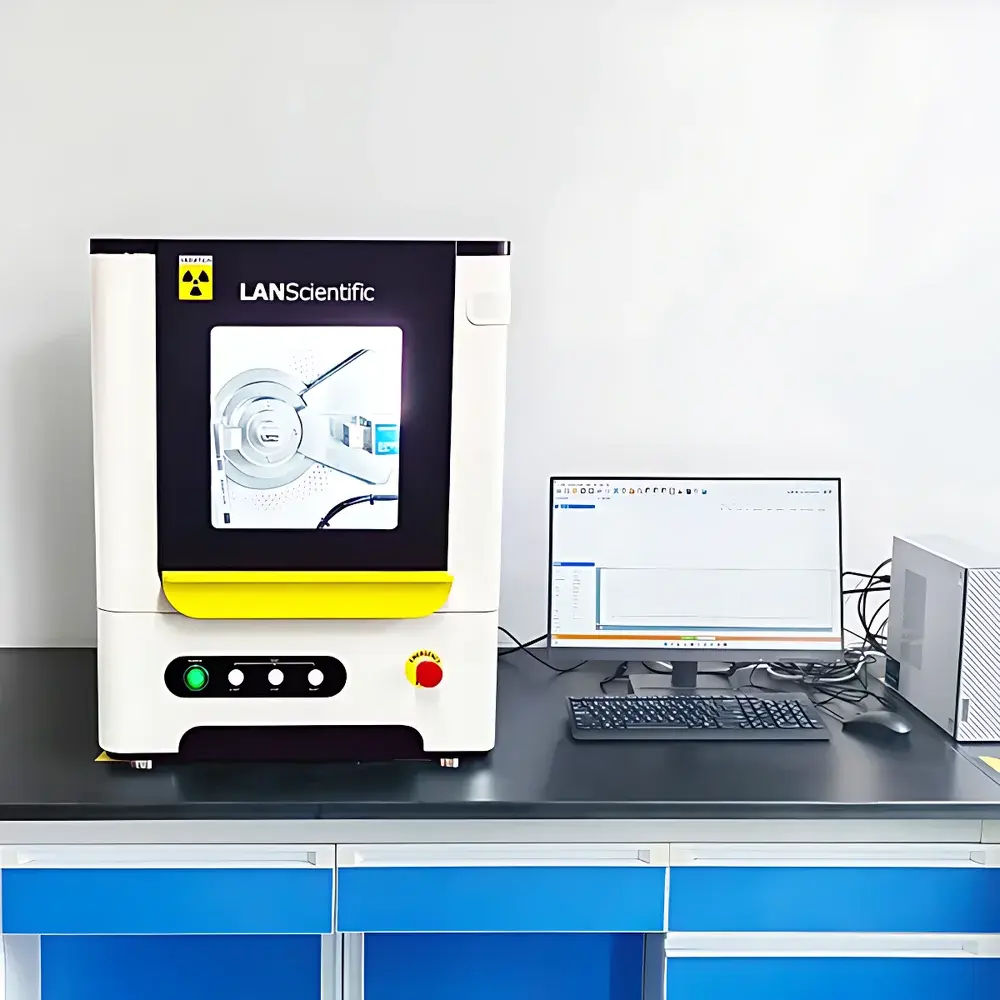
LANScientific FRINGE EV Desktop Powder X-ray Diffractometer
| Brand | LANScientific |
|---|---|
| Origin | Jiangsu, China |
| Manufacturer Type | Direct Manufacturer |
| Instrument Type | Powder X-ray Diffractometer |
| Geometry | Bragg–Brentano θ–2θ reflection |
| Detector | Digital Pulse Processing Counter (DPPC) |
| Maximum Count Rate | ≥1 × 10⁷ counts per second (CPS) |
| Sample Forms | Powders, bulk solids, thin films |
| Software | CrystalX™ automated phase identification & quantification suite |
| Compliance | Designed for GLP-compliant workflows |
| Safety | Interlocked sample chamber with auto-shutdown, real-time door status feedback, full enclosure during operation |
| Optical Path | Integrated fixed Soller slits, divergence slit, anti-scatter slit, receiving slit |
| Power Supply | High-voltage generator rated for kW-class operation (exact rating model-specific |
Overview
The LANScientific FRINGE EV is a benchtop powder X-ray diffractometer engineered for precision crystallographic analysis in resource-constrained or space-limited laboratory environments. It operates on the Bragg–Brentano θ–2θ reflection geometry, where monochromatic Cu Kα radiation (λ = 1.5418 Å) is directed onto a stationary or rotating sample stage centered on the goniometer. When incident X-rays satisfy Bragg’s law (nλ = 2d sinθ), constructive interference generates diffraction peaks at discrete 2θ angles. These signals are collected by a high-throughput Digital Pulse Processing Counter (DPPC) detector — eliminating the need for secondary monochromators while simultaneously enabling energy-dispersive spectral acquisition. Unlike conventional sealed-tube systems, the FRINGE EV integrates a kW-class X-ray source optimized for enhanced intensity and signal-to-noise ratio without requiring water cooling or external chiller infrastructure. Its compact footprint and air-spring assisted large-window lift door enable seamless integration into standard laboratory desks, mobile labs, or teaching facilities — all while maintaining mechanical rigidity and thermal stability critical for long-term measurement reproducibility.
Key Features
- Integrated fixed Soller slits: Eliminates moving alignment components, improving goniometer reliability and reducing maintenance intervals — essential for field-deployable or transportable lab applications.
- DPPC detector technology: Delivers ≥1 × 10⁷ CPS count rate with intrinsic energy discrimination, supporting concurrent XRD pattern acquisition and elemental fingerprinting via energy-dispersive X-ray spectroscopy (EDS).
- CrystalX™ software platform: Automates peak search, phase matching against ICDD PDF-4+ database, Rietveld refinement, semi-quantitative phase fraction calculation, crystallinity index estimation, and lattice parameter extraction — all with one-click initiation and configurable reporting templates.
- Full interlock safety architecture: Includes dual redundant door sensors, real-time chamber status display on touchscreen interface, and automatic high-voltage cutoff upon door actuation — compliant with IEC 61010-1 and EN 62471 requirements for Class 3B laser/X-ray equipment.
- Benchtop kW-source design: Engineered for stable output across extended duty cycles; compatible with optional voltage stabilization modules for regions with fluctuating grid supply.
Sample Compatibility & Compliance
The FRINGE EV accommodates standard 25 mm and 32 mm diameter sample holders for powders, as well as custom fixtures for flat bulk specimens and thin-film substrates (e.g., Si wafers, glass slides). Sample preparation follows ASTM E975-22 (Standard Practice for X-ray Diffraction Analysis of Metals and Alloys) and ISO 21377:2021 (X-ray diffraction — Quantitative phase analysis using the Rietveld method). The system supports GLP and GMP-aligned workflows through CrystalX™’s role-based user management, electronic signature capability, and immutable audit trail logging — fully traceable to FDA 21 CFR Part 11 Annex 11 and EU GMP Annex 11 requirements. All firmware and software updates are version-controlled and documented per ISO/IEC 17025:2017 clause 7.7.
Software & Data Management
CrystalX™ is a native Windows-based application built on .NET Framework with SQLite backend for local data persistence. It provides raw data export in industry-standard formats including XYE, CIF, CSV, and Bruker RAW v4. It supports batch processing of multiple scans, background subtraction using polynomial or iterative algorithms, peak deconvolution via pseudo-Voigt fitting, and customizable report generation (PDF, HTML, Excel). Raw diffraction patterns and processed results are stored with metadata (operator ID, timestamp, instrument serial, calibration log, environmental conditions) to ensure full data lineage. Optional network deployment enables centralized data archiving via secure SMB or SFTP protocols, with TLS 1.2 encryption for remote access.
Applications
The FRINGE EV serves routine and research-grade characterization across diverse sectors: identification and quantification of crystalline phases in metallurgical alloys (e.g., Fe–Cr–Ni oxides, intermetallic compounds); assessment of phase evolution during heat treatment or mechanical alloying; crystallinity evaluation of pharmaceutical active ingredients (APIs) per USP and ICH Q5A guidelines; mineralogical composition analysis in cementitious materials and geological samples; strain and microstructure analysis in semiconductor thin films using Williamson–Hall and Warren–Averbach methods; and forensic identification of unknown crystalline powders in regulatory or quality assurance settings.
FAQ
Is the FRINGE EV suitable for quantitative Rietveld analysis?
Yes — CrystalX™ includes embedded Rietveld refinement engine compatible with ICDD PDF-4+ and user-defined structural models (CIF input). Standard uncertainties for scale factors, lattice parameters, and phase fractions are reported per ISO 21377:2021 Annex B.
Does the system require external cooling or compressed air?
No — the kW-class X-ray tube uses passive conduction cooling integrated into the optical housing; no chiller, pump, or compressed air supply is required.
Can the instrument be installed in a mobile laboratory vehicle?
Yes — its shock-resistant goniometer mount, fixed-optics design, and low-vibration power supply make it qualified for ISO 14644-1 Class 8 cleanroom-mobile platforms and UN ECE R100-certified transport configurations.
What sample preparation accessories are available?
LANScientific offers zero-background silicon sample holders, capillary loading tools, grazing-incidence film stages, and programmable sample spinners — all calibrated and certified for traceable angular accuracy.
How is software validation performed for regulated environments?
CrystalX™ includes IQ/OQ documentation packages aligned with ASTM E2500-13 and GAMP 5 principles; installation qualification checklists, operational test scripts, and performance verification protocols are supplied with each system shipment.
Related Products




