
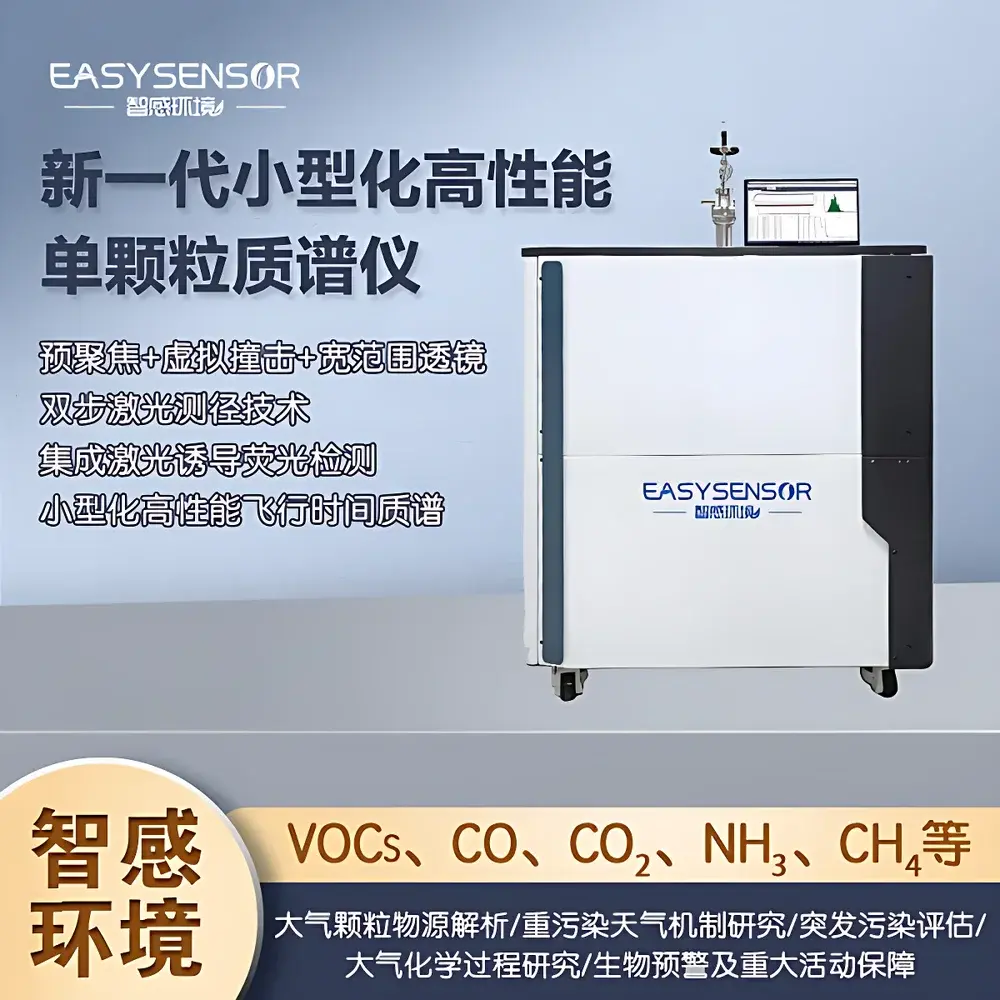
Easysensor ZG-SPAMS 1000 (01) Compact High-Performance Single-Particle Aerosol Time-of-Flight Mass Spectrometer
| Brand | Easysensor |
|---|---|
| Origin | Jiangsu, China |
| Manufacturer Type | Authorized Distributor |
| Country of Origin | China |
| Model | ZG-SPAMS 1000 (01) |
| Price | Upon Request |
| Particle Size Range | 0.15–9 μm (selectable modes: 0.15–5 μm or 0.3–9 μm) |
| Sample Flow Rate | 0.1–0.5 L/min |
| Particle Throughput | Up to 20,000 particles/sec |
| Laser Wavelengths | 405 nm (dual-step aerodynamic sizing), 266 nm (laser ionization), 355 nm (LIF excitation) |
| Mass Analyzer | Bipolar Time-of-Flight (TOF-MS) |
| Mass Resolution | ≥1000 (at Pb⁺, m/z 208) |
| Mass Range | 1–900 amu |
| Detection Limit | 0.001 particles/cm³ |
| Fluorescence Module | Integrated Laser-Induced Fluorescence (LIF) for biological particle pre-screening |
| Dimensions | 1160 × 780 × 560 mm |
| Weight | 140 kg |
Overview
The Easysensor ZG-SPAMS 1000 (01) is a compact, high-performance single-particle aerosol time-of-flight mass spectrometer engineered for real-time, in situ chemical and physical characterization of individual airborne particles. It operates on the principle of dual-laser single-particle analysis: first, two synchronized 405 nm lasers perform non-destructive, high-precision aerodynamic diameter measurement via dual-step light scattering; second, a pulsed 266 nm ultraviolet laser induces soft ionization of each particle in vacuum, followed by bipolar time-of-flight mass spectrometry for simultaneous positive- and negative-ion detection. This architecture enables unambiguous correlation of size, morphology (via scattering signature), fluorescence response, and molecular/elemental composition—without ensemble averaging or chemical derivatization. Designed for field-deployable operation, the instrument meets the analytical rigor required for regulatory-grade source apportionment, climate-relevant aerosol property quantification, and bioaerosol threat assessment under ISO/IEC 17025-aligned laboratory practices.
Key Features
- Real-time single-particle resolution: Measures size, fluorescence, and full mass spectra for >60 particles per second—enabling sub-minute temporal resolution in source apportionment.
- Adaptable aerodynamic inlet: Airborne lens system with virtual impactor and pre-focusing stage supports stable sampling across two configurable size ranges (0.15–5 μm or 0.3–9 μm) at flow rates of 0.1–0.5 L/min.
- Integrated LIF module: 355 nm excitation laser enables selective triggering and classification of fluorescent bioparticles (e.g., bacteria, fungal spores, pollen), reducing data burden and enhancing signal-to-noise ratio in complex ambient matrices.
- Bipolar TOF-MS architecture: Simultaneous acquisition of cationic and anionic fragments within 1–900 amu range, delivering high mass resolution (≥1000 FWHM at Pb⁺) and extended dynamic range via delayed extraction pulse control.
- Field-optimized mechanical design: Compact footprint (1160 × 780 × 560 mm) and 140 kg mass enable secure mounting in mobile platforms—including vans, aircraft, and stationary monitoring shelters—without compromising vacuum integrity or optical alignment stability.
- Robust high-concentration handling: Engineered to maintain quantitative accuracy at particle number concentrations up to 20,000 particles/sec, making it suitable for episodic pollution events such as dust storms, biomass burning plumes, and industrial fugitive emissions.
Sample Compatibility & Compliance
The ZG-SPAMS 1000 (01) accepts ambient air, ducted exhaust streams, and filtered chamber effluents without sample preparation. It is validated for direct analysis of ambient aerosols including mineral dust, sea salt, soot, secondary organic aerosols (SOA), heavy metal-containing particles (e.g., Pb, Zn, Cd), and biological particulates. The system complies with fundamental requirements of EPA OTM-47 (for real-time aerosol speciation), ISO 21501-4 (for particle sizing instrumentation), and ASTM D6245 (for indoor air quality particle characterization). Data acquisition and storage protocols support audit-ready traceability in GLP and GMP environments; raw spectral files include timestamped metadata (pressure, temperature, flow rate, laser energy) essential for QA/QC and regulatory reporting. While not FDA 21 CFR Part 11-certified out-of-the-box, the software architecture permits integration with validated electronic lab notebook (ELN) systems meeting Part 11 requirements.
Software & Data Management
Two-tiered software suite ensures both operational efficiency and deep scientific insight. The real-time online analysis module provides live source categorization (e.g., “aged sea salt”, “fresh biomass burning”, “metal-rich industrial”) using hierarchical clustering and reference spectral libraries. It outputs time-resolved concentration profiles, particle-type distribution heatmaps, and automated daily summary reports compliant with national environmental monitoring formats. The advanced research module handles datasets exceeding 10⁷ spectra, supporting ART-2a neural network training for custom class definition, multi-parameter correlation (e.g., nitrate/sulfate ratio vs. particle size), and visualization tools including 3D size–time–intensity plots, ion ratio scattergrams, and binned mass spectral overlays. All processed data export to standard formats (CSV, HDF5, mzML) for interoperability with Python-based atmospheric chemistry toolkits (e.g., PySpectra, Pika).
Applications
- Environmental Source Apportionment: Quantifies contributions of coal combustion, vehicular exhaust, crustal dust, marine aerosols, and secondary formation processes to PM₂.₅ and PM₁₀—supporting regional air quality management plans and transboundary pollution studies.
- Climate-Relevant Aerosol Characterization: Measures hygroscopic growth potential and cloud condensation nuclei (CCN)-active fraction via size-resolved volatility and composition mapping—critical for radiative forcing modeling in IPCC AR6 frameworks.
- Bioaerosol Surveillance: Detects and classifies viable and non-viable biological particles in public infrastructure (airports, hospitals, mass transit), enabling early-warning capability during pandemic threats or deliberate release scenarios.
- Industrial Hygiene Monitoring: Tracks nanoparticle emissions from battery manufacturing, semiconductor fabrication, and pharmaceutical spray-drying processes—supporting OSHA PEL compliance and occupational exposure assessments.
- Atmospheric Chemistry Research: Supports field campaigns in polar, marine, and high-altitude environments where traditional filter-based methods fail due to low mass loading or volatile losses.
FAQ
What particle size ranges can the ZG-SPAMS 1000 (01) measure?
It offers two selectable aerodynamic size channels: 0.15–5 μm (optimized for fine-mode urban aerosols) or 0.3–9 μm (suitable for coarse-mode dust, sea salt, and bioaerosols).
Does the system require calibration standards for quantitative analysis?
Yes—size calibration uses polystyrene latex (PSL) spheres; mass scale calibration employs internally generated cluster ions (e.g., NaCl, KCl) and certified reference materials (e.g., NIST SRM 1879b) for elemental sensitivity correction.
Can the instrument operate unattended for extended periods?
Fully autonomous operation is supported for up to 72 hours with continuous power, gas supply (N₂ purge), and thermal stabilization; remote diagnostics and spectral QC alerts are enabled via Ethernet-connected server interface.
Is the LIF module optional or integrated?
The 355 nm LIF subsystem is factory-integrated and hardware-synchronized with the sizing and ionization lasers—no field retrofitting or alignment is required.
How is data security and user access managed?
Role-based login (administrator, operator, analyst), encrypted local storage, and configurable audit logs meet ISO 27001-aligned data governance requirements for sensitive environmental and health monitoring applications.





