
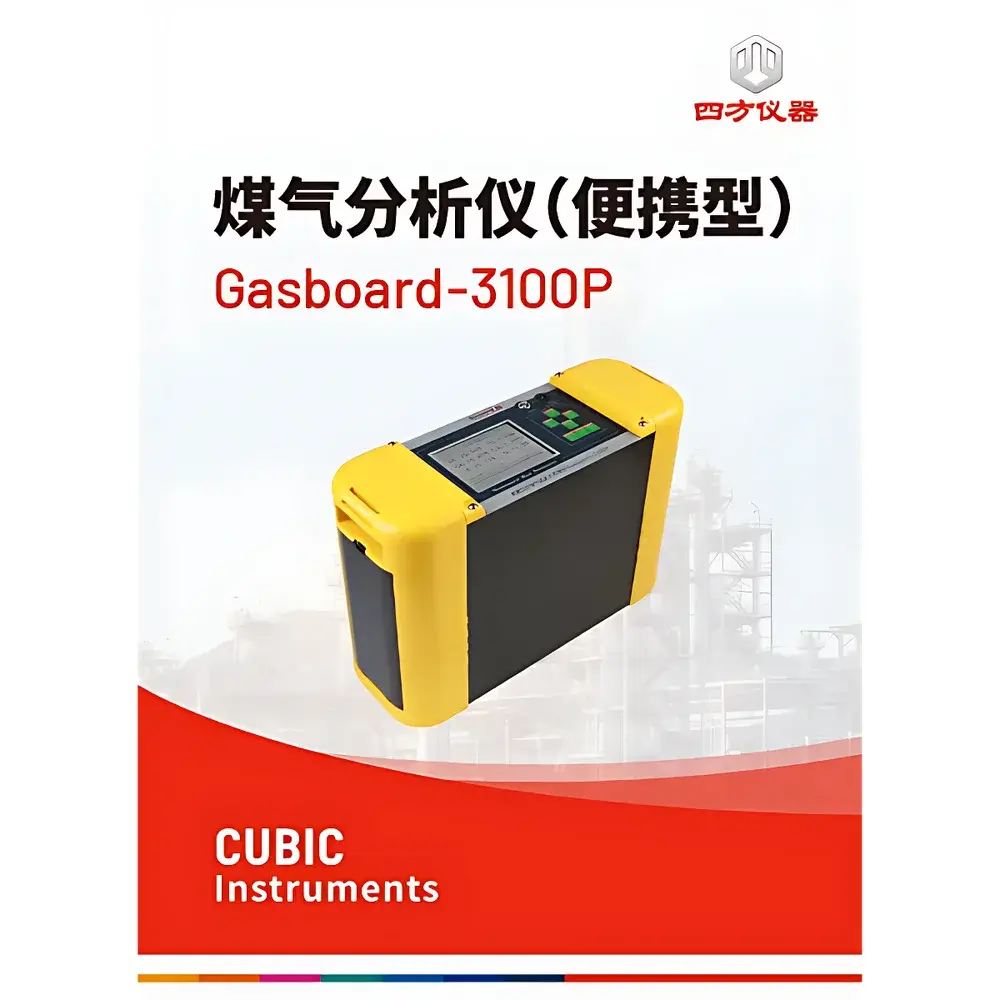
CUBIC Gasboard-3100P Portable Biogas and Syngas Analyzer
| Brand | CUBIC INSTRUMENTS |
|---|---|
| Origin | Hubei, China |
| Instrument Principle | NDIR (CO, CO₂, CH₄, C₂H₂, C₂H₄, CnHm), TCD (H₂), ECD (O₂) |
| Response Time | T₉₀ < 15 s (NDIR) |
| Measurement Ranges | CO/CO₂/CH₄/H₂: (0–100)%, O₂: (0–25)%, C₂H₂/C₂H₄/CnHm*: (0–10)% (optional) |
| Resolution | 0.01% |
| Repeatability | ≤1% FS |
| Linearity Error | ±1% FS (NDIR gases), ±2% FS (O₂, H₂) |
| Sample Flow Rate | 0.7–1.2 L/min |
| Inlet Pressure | 2–50 kPa |
| Dimensions (L×W×H) | 412 × 152 × 294 mm |
| Weight | 9 kg |
| Power | Rechargeable Li-ion battery, external 12.6 V charger |
| Communication | RS-232 |
| Thermal Value Units | kcal/m³ & MJ/m³ (switchable) |
| Self-Diagnostic Function | Yes |
| Sample Requirements | Dust-free, moisture-free, oil-free |
Overview
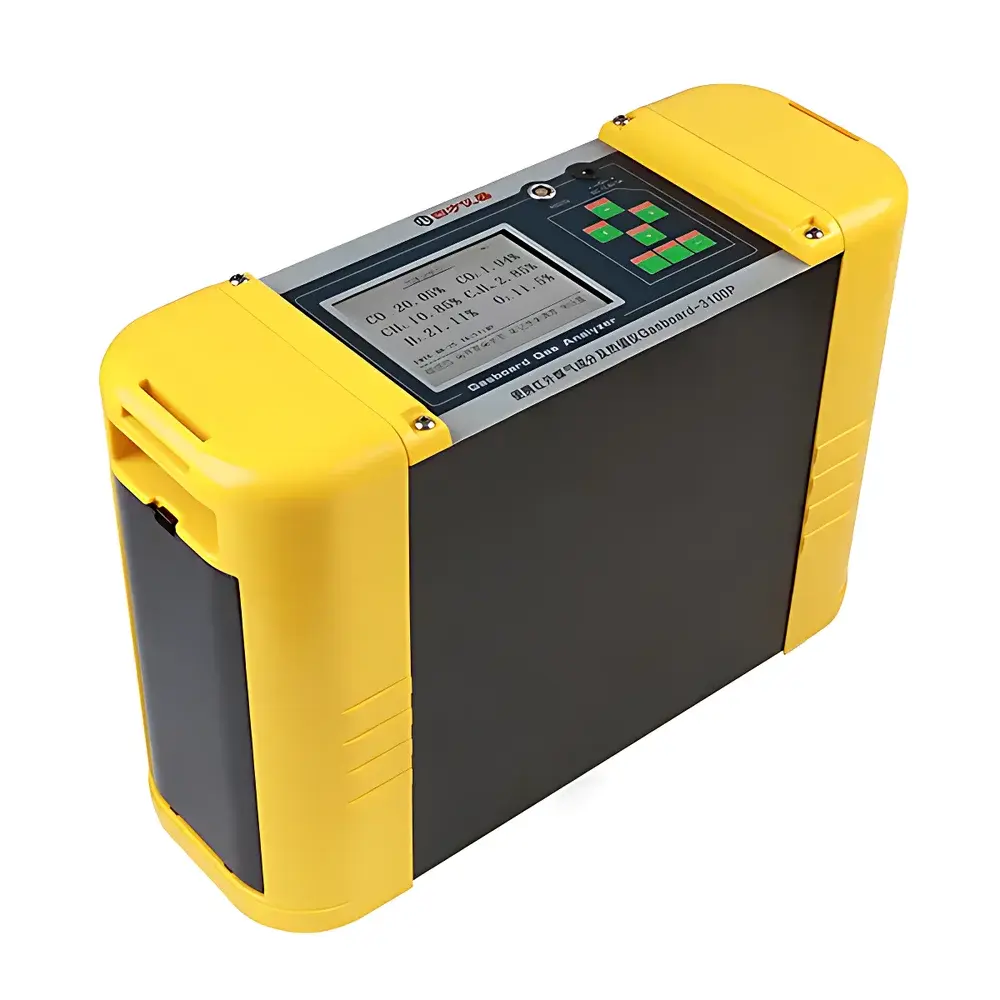
The CUBIC Gasboard-3100P Portable Biogas and Syngas Analyzer is an integrated, field-deployable gas analysis system engineered for real-time, multi-component quantification of complex fuel gases generated from biological cracking (e.g., anaerobic digestion, pyrolysis), coal gasification, and metallurgical processes. It employs a hybrid sensing architecture combining non-dispersive infrared (NDIR) spectroscopy for CO, CO₂, CH₄, C₂H₂, C₂H₄, and total non-methane hydrocarbons (CnHm), electrochemical detection (ECD) for O₂, and thermal conductivity detection (TCD) for H₂—ensuring orthogonal measurement principles that eliminate cross-sensitivity between analytes. Unlike conventional combustion-based calorimeters or GC-based systems, the Gasboard-3100P computes higher heating value (HHV) in situ using ASTM D3588-17 and ISO 6976-compliant algorithms, directly from measured volumetric concentrations and standardized thermodynamic constants. Its design targets environments where rapid, repeatable, and maintenance-light analysis is required under variable flow and pressure conditions—without reliance on consumables, carrier gases, or calibration standards during routine operation.
Key Features
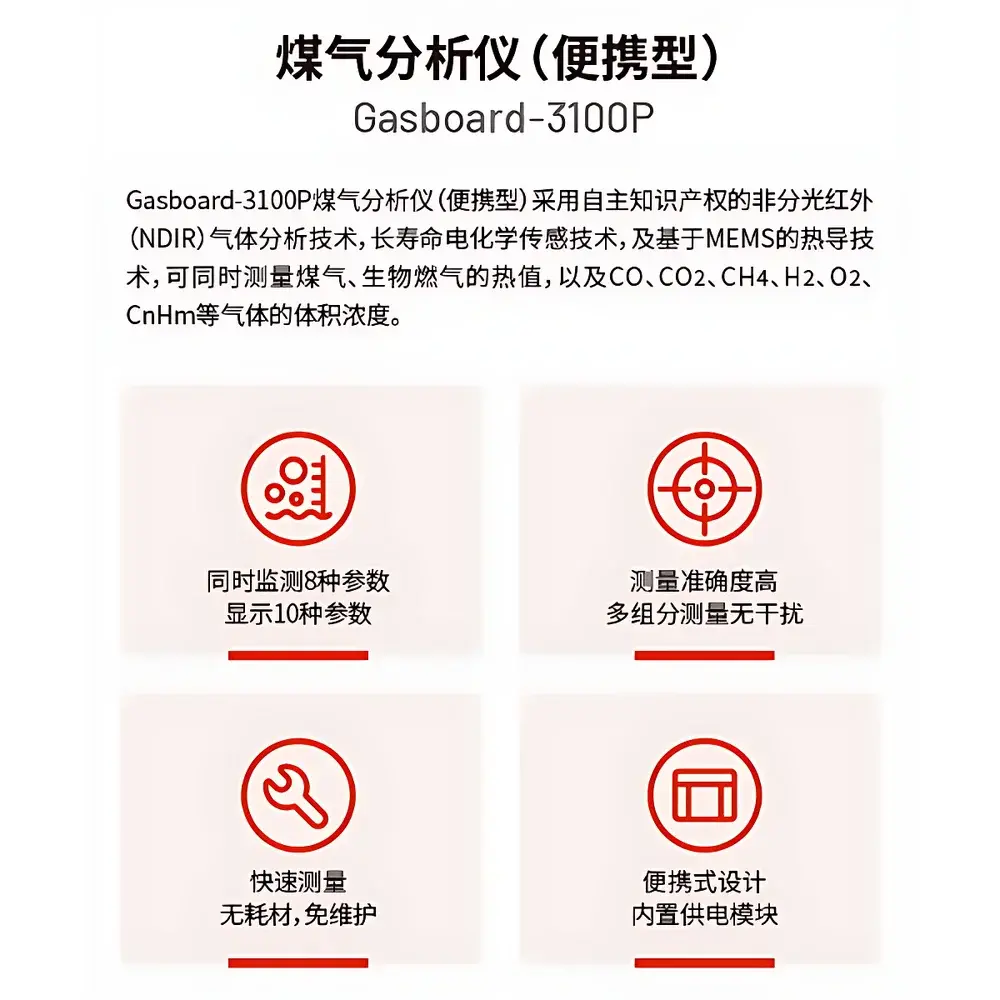
- Simultaneous quantification of up to eight gas components: CO, CO₂, CH₄, H₂, O₂, C₂H₂, C₂H₄, and CnHm (sum of C₂–C₆ hydrocarbons), with automatic HHV calculation per ISO 6976 Annex B.
- Cross-interference mitigation architecture: NDIR channels exhibit no spectral overlap between CH₄ and CnHm; TCD-based H₂ measurement remains unaffected by flow fluctuations (0.7–1.2 L/min); ECD O₂ sensor is immune to CO/CO₂ interference.
- Robust portable form factor (9 kg, 412 × 152 × 294 mm) with integrated sampling pump, enabling direct pipeline insertion, bag sampling (Tedlar®/aluminum foil), and mobile lab deployment.
- Intelligent power management: Soft-start circuitry prevents low-voltage operation; battery state-of-charge monitoring with audible alert at ≤15% capacity.
- No consumables or reagents required—eliminates recurring costs associated with wet chemical (Orsat), chromatographic (GC-TCD/FID), or catalytic bead methods.
- Onboard diagnostics: Real-time sensor health verification, zero/span drift alerts, and fault-code logging compliant with IEC 61508 functional safety guidelines.
Sample Compatibility & Compliance
The Gasboard-3100P accepts dry, particle-free, oil-free sample streams within 2–50 kPa inlet pressure and ≤40 °C temperature. It is validated for use with biogas (from AD digesters), syngas (from biomass gasification), coke oven gas, blast furnace gas, producer gas, and landfill gas. All sensors meet IP54 ingress protection for industrial ambient exposure. Data integrity complies with GLP/GMP traceability requirements: each measurement record includes timestamp, sensor ID, calibration epoch, and environmental metadata. Optional pre-conditioning modules (thermoelectric cooler + sintered metal filter) support high-humidity or particulate-laden samples without compromising NDIR optical path stability.
Software & Data Management
Measurements are stored internally (≥10,000 records) with searchable timestamps and customizable group tags. Data export is supported via RS-232 serial interface to SCADA, DCS, or LIMS platforms using ASCII-based MODBUS RTU protocol. Firmware supports remote configuration updates and audit-trail-enabled user access control (Level 1–3 permissions). All stored data include CRC-16 checksums and comply with FDA 21 CFR Part 11 requirements for electronic records when paired with validated host software—enabling full ALCOA+ (Attributable, Legible, Contemporaneous, Original, Accurate, Complete, Consistent, Enduring, Available) documentation.
Applications
- Real-time optimization of anaerobic digesters and thermal biomass cracking reactors through CH₄/CO₂ ratio trending and H₂ yield monitoring.
- In-line quality assurance of coke oven gas prior to blast furnace injection, ensuring compliance with EN 15403:2011 carbon balance limits.
- Thermal value verification of syngas feedstocks for Fischer–Tropsch synthesis or internal combustion engine fuel blending.
- Research-grade gas composition profiling in university combustion labs conducting laminar flame speed or ignition delay studies.
- Regulatory reporting for EPA Method 25A-equivalent CH₄ emissions monitoring in landfill gas recovery systems.
FAQ
What gas standards are used for factory calibration?
Factory calibration is performed using NIST-traceable certified reference gases (CRGs) for CO, CO₂, CH₄, H₂, and O₂ at three concentration levels across the full range; CnHm calibration uses propane as surrogate per ISO 8573-5.
Can the instrument measure hydrogen sulfide (H₂S)?
No—H₂S is not part of the standard configuration. A dedicated electrochemical H₂S module (Gasboard-3100P-H₂S) is available as a field-upgradable option.
Is the thermal value calculation compliant with international energy standards?
Yes—the HHV algorithm implements ISO 6976:2016 Annex B equations using ideal gas law corrections and component-specific enthalpy-of-combustion values from NIST Chemistry WebBook.
How often is recalibration required under continuous operation?
Zero and span checks are recommended every 30 days; full multi-point calibration is advised quarterly or after sensor replacement, following ISO 17025-accredited procedures.
Does the device support Modbus TCP/IP or only RS-232?
RS-232 is standard; optional Ethernet-to-RS232 converter modules enable Modbus TCP/IP integration with enterprise-level control systems.





