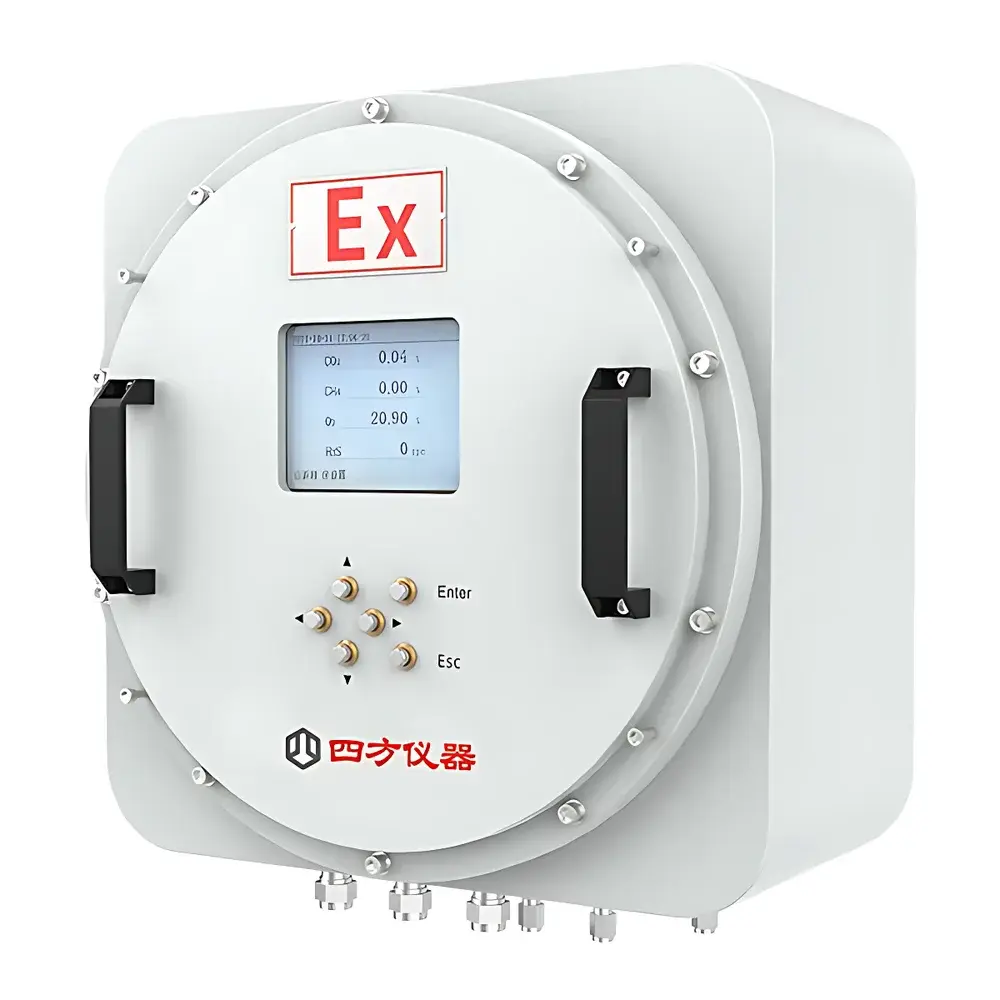
CUBIC Gasboard 3500 TDLAS-Based Explosive-Proof Industrial Gas Emission Analyzer
| Brand | CUBIC INSTRUMENTS |
|---|---|
| Origin | Hubei, China |
| Model | Gasboard 3500 |
| Measurement Principle | Tunable Diode Laser Absorption Spectroscopy (TDLAS) |
| Measured Gases | O₂, CO, CO₂, H₂S, CH₄ |
| Explosion Protection Rating | Ex db IIC T6 Gb / Ex tb IIIC T80°C Db |
| Response Time | <40 s |
| Sample Flow Rate | 0.7–1.2 L/min |
| Output Signals | RS-485 / RS-232 / 4–20 mA |
| Display | LCD |
| Power Supply | AC 220 V, 50 Hz |
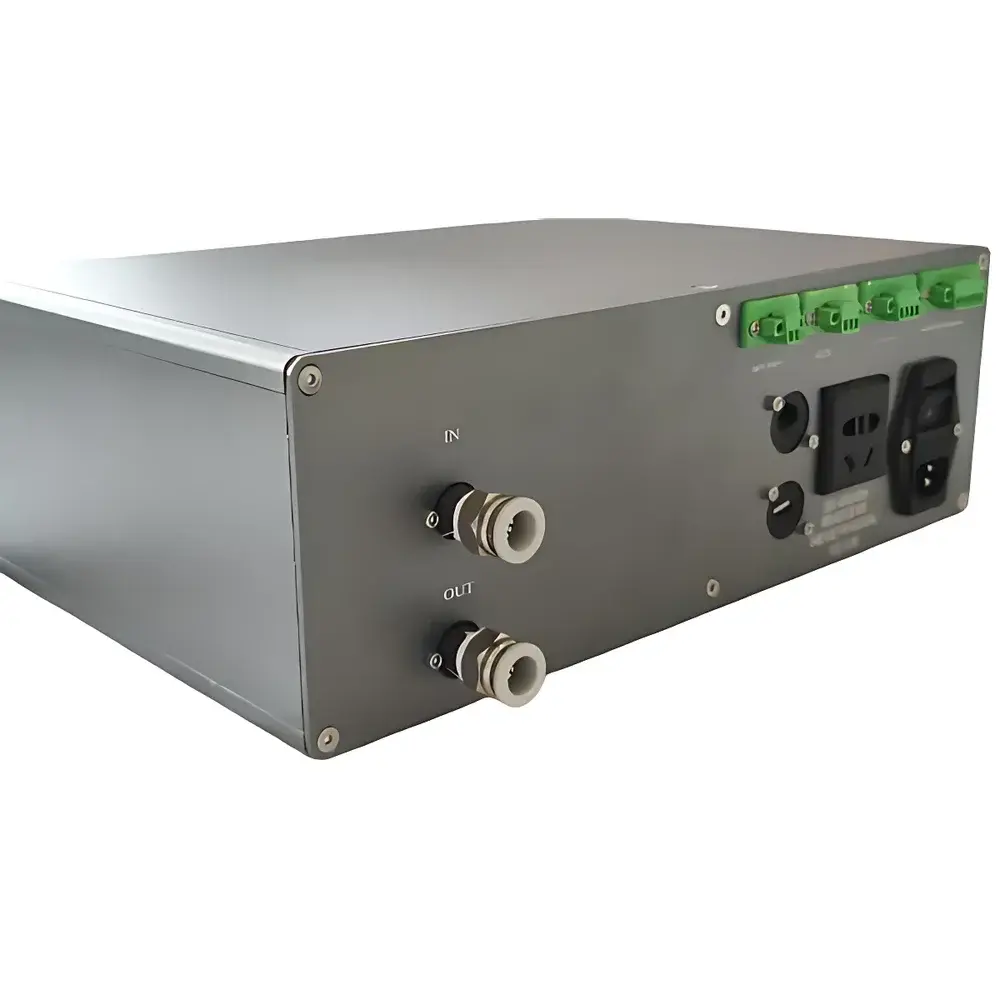
| Auto-Zero Function | Integrated air pump for in-situ zero calibration |
| Diagnostic Capability | Real-time sensor health monitoring |
| Preconditioning | Integrated front-end sample conditioning for wet, dusty, and oily gas streams |
Overview
The CUBIC Gasboard 3500 is a purpose-engineered, intrinsically robust tunable diode laser absorption spectroscopy (TDLAS) analyzer designed for continuous, real-time monitoring of key industrial gas species—including O₂, CO, CO₂, H₂S, and CH₄—in demanding petroleum, petrochemical, and natural gas infrastructure environments. Unlike conventional NDIR or electrochemical analyzers, the Gasboard 3500 leverages single-line, wavelength-scanned TDLAS to achieve high spectral selectivity, eliminating cross-sensitivity from water vapor, particulates, and background hydrocarbons commonly present in refinery off-gas, flare stacks, compressor stations, and LNG liquefaction trains. Its optical path is sealed and pressure-compensated, ensuring stable baseline performance under fluctuating process pressures and ambient temperatures. The system operates on direct absorption spectroscopy principles—measuring attenuation at precisely targeted rotational-vibrational absorption lines—delivering quantitative concentration data traceable to NIST-standard reference spectra. This architecture enables long-term drift stability (<1% F.S./month), minimal calibration frequency, and immunity to aging-related signal degradation typical of consumable sensor elements.
Key Features
- Explosion-proof certification compliant with IEC 60079-0, -1, and -31: Ex db IIC T6 Gb for gas atmospheres and Ex tb IIIC T80°C Db for combustible dust environments—validated for Zone 1/21 hazardous locations.
- Integrated front-end sample conditioning module featuring heated sampling line, cyclonic particulate separator, coalescing filter, and thermoelectric cooler—enabling reliable operation in gas streams containing up to 100% relative humidity and >10 mg/m³ total suspended particulates.
- Multi-gas simultaneous quantification via time-multiplexed laser scanning across five distinct near-infrared absorption bands (760 nm for O₂, 2.3 μm for CO, 2.0 μm for CO₂, 1.58 μm for H₂S, and 1.65 μm for CH₄).
- Onboard self-diagnostic suite continuously monitors laser drive current, photodetector responsivity, optical alignment status, and signal-to-noise ratio—generating actionable fault codes and maintenance alerts via Modbus RTU or HART-compatible protocols.
- Automatic zero calibration using built-in miniature diaphragm pump and ambient air intake—executed without external gas cylinders or manual intervention, supporting unattended 24/7 operation.
- Modular hardware architecture allows field-upgradable firmware and configurable measurement ranges per gas channel, supporting both ppm-level trace detection (e.g., H₂S in sour gas) and percent-level bulk composition analysis (e.g., CH₄ in biogas).
Sample Compatibility & Compliance
The Gasboard 3500 accommodates raw process gas streams directly extracted from pipelines, vents, flare headers, and storage tank breathing valves—provided inlet temperature remains within −20°C to +60°C and pressure does not exceed 1.2 bar(g). Its preconditioning subsystem removes liquid entrainment and submicron aerosols while maintaining gas-phase integrity for accurate TDLAS measurement. The analyzer meets EN 15267-3 (QAL1 certification framework for automated measuring systems), supports compliance with EPA Method 21 (leak detection), ISO 14064-1 (GHG inventory verification), and aligns with API RP 14C requirements for hydrocarbon release monitoring. All electrical interfaces conform to EMC Directive 2014/30/EU and Low Voltage Directive 2014/35/EU. Documentation includes full Declaration of Conformity, ATEX/IECEx test reports, and factory calibration certificates traceable to national metrology institutes.
Software & Data Management
Data acquisition and configuration are managed via CUBIC’s proprietary GasVision™ software, compatible with Windows-based engineering workstations. The software provides real-time waveform visualization of absorbance signals, multi-channel trend logging (1-second resolution, 30-day buffer), alarm event history with timestamped cause codes, and CSV export for integration into DCS/SCADA platforms (e.g., Siemens Desigo, Honeywell Experion, Emerson DeltaV) via OPC UA or Modbus TCP. Audit trails record all parameter changes, calibration events, and user logins—supporting GLP/GMP-aligned validation protocols and FDA 21 CFR Part 11 compliance when deployed with electronic signature modules. Remote firmware updates and diagnostic telemetry are supported over secure TLS-enabled Ethernet connections.
Applications
- Natural gas transmission: Continuous monitoring of H₂S and O₂ in pipeline gas to ensure compliance with GPA 2261 and ISO 8573-1 purity classes.
- Refinery fluid catalytic cracking (FCC) units: Real-time CO and CO₂ tracking in regenerator flue gas for combustion efficiency optimization and NOₓ precursor control.
- LNG liquefaction plants: CH₄ slip detection in boil-off gas (BOG) handling systems and inert gas blanketing verification during tank loading/unloading.
- Offshore platforms: Zone 1-certified deployment for flare gas composition analysis and fugitive emission quantification per OGMP 2.0 reporting standards.
- Landfill gas upgrading facilities: Simultaneous measurement of CH₄, CO₂, and H₂S to optimize membrane separation and amine scrubbing process setpoints.
FAQ
What gases can the Gasboard 3500 measure simultaneously, and how many channels are configurable?
The analyzer measures O₂, CO, CO₂, H₂S, and CH₄ concurrently using five independent TDLAS optical channels; each channel is factory-configured but may be re-ranged in-field for alternate gas species upon request and recalibration.
Does the system require periodic span calibration with certified gas standards?
Span calibration is recommended every 3–6 months depending on application severity; however, the auto-zero function and internal reference path enable extended operation between calibrations without compromising measurement integrity.
Can the Gasboard 3500 interface with a distributed control system (DCS) using analog outputs?
Yes—it provides isolated 4–20 mA outputs for each measured gas, fully scalable and linearized, with HART digital overlay support for enhanced diagnostics and configuration.
Is the instrument suitable for outdoor installation in extreme ambient conditions?
With its IP66-rated enclosure, integrated heater, and wide operating temperature range (−20°C to +60°C), the Gasboard 3500 is qualified for permanent outdoor mounting without additional sheltering.
How is measurement traceability maintained for regulatory reporting?
Each unit ships with a NIST-traceable calibration certificate; optional annual verification services include on-site linearity checks against certified reference materials and uncertainty budget documentation per ISO/IEC 17025.