
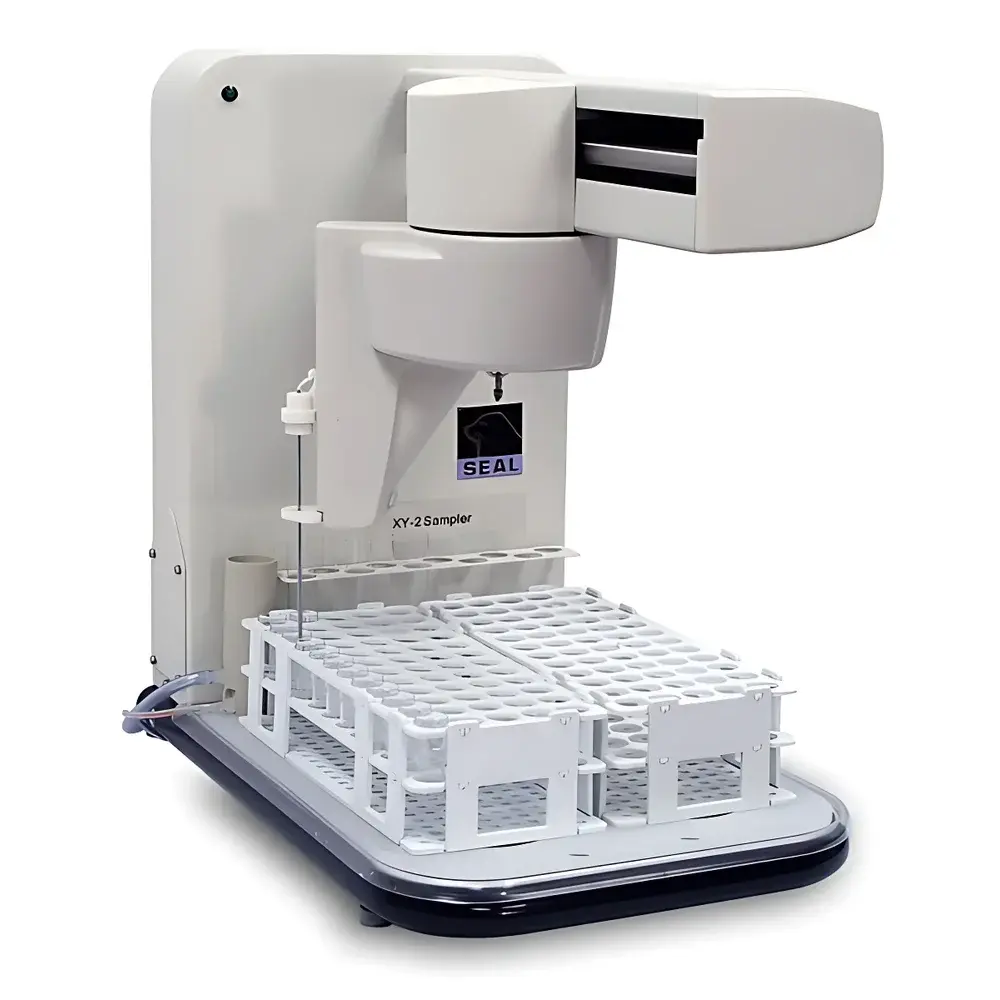
SEAL XY-2 / XY-3 Automated Sampler for Flow Injection Analysis Systems
| Brand | SEAL |
|---|---|
| Origin | Germany |
| Manufacturer Type | Authorized Distributor |
| Origin Category | Imported |
| Model | XY-2 / XY-3 |
| Product Category | Continuous Flow Analyzer (CFA) Sampler |
| Sample Positions | 270 / 180 / 120 |
| Max Sample Vessel Height | 150 mm |
| High-Profile Variant Compatibility | Standard 300 mL Laboratory Tubes |
| Interface | USB 2.0 |
| Optional Injector Dilutor | SEAL Injector Dilutor 3 (2.5 mL / 5 mL / 10 mL syringe volumes) |
| Software Control | AACE v5.x or later with variable-speed dilution protocol support |
Overview
The SEAL XY-2 and XY-3 Automated Samplers are precision-engineered peripheral modules designed exclusively for integration with continuous flow analysis (CFA) and flow injection analysis (FIA) platforms—particularly SEAL’s own QuikChem and AQ2+ analytical systems. These samplers operate on a robust carousel-based architecture, delivering high-throughput, low-carryover liquid handling for routine environmental, clinical, agricultural, and industrial water quality testing. Unlike generic lab autosamplers, the XY series is purpose-built to maintain hydraulic integrity across CFA manifolds: precise timing synchronization with peristaltic pump cycles, programmable aspiration depth control, and pressure-stable needle positioning ensure reproducible sample introduction without flow disruption or bubble entrainment. The system adheres to core principles of segmented flow methodology—where discrete sample zones are separated by air bubbles or carrier buffer—and supports both single- and dual-needle configurations to enable simultaneous sampling and reagent addition or internal standard spiking.
Key Features
- Modular carousel design with configurable sample capacity: 270-position (XY-3), 180-position (XY-2), or 120-position layouts—each accommodating standard 12–16 mm diameter vials or custom tube racks.
- Vertical clearance up to 150 mm enables direct aspiration from tall-format containers; the high-profile variant accepts common 300 mL laboratory test tubes without sample transfer—minimizing contamination risk and analyst handling time.
- Dual-needle option provides independent control over sample intake and auxiliary fluid delivery (e.g., internal standards, blank washes, or calibration spikes), supporting multi-channel method development.
- USB 2.0 interface ensures plug-and-play compatibility with Windows-based AACE software (v5.4+), enabling real-time status monitoring, method-triggered event logging, and firmware updates without external serial adapters.
- Integrated stepper-motor-driven Z-axis with optical end-stop detection guarantees repeatable needle immersion depth (±0.3 mm) across all vessel heights—critical for maintaining consistent aspiration volume and minimizing wall adhesion effects.
- Corrosion-resistant stainless-steel and PEEK fluid path components comply with ISO 8573-1 Class 3 compressed air purity requirements when used with optional pneumatic wash stations.
Sample Compatibility & Compliance
The XY-2/XY-3 accommodates a broad range of container formats—including polypropylene screw-cap vials (10–20 mL), borosilicate glass tubes (16 × 150 mm), and disposable plastic cuvettes—without mechanical adaptation. All sample contact surfaces meet USP Class VI biocompatibility standards. The system supports GLP/GMP workflows via AACE software audit trail functionality (21 CFR Part 11 compliant when deployed with electronic signature modules). Method validation documentation aligns with ASTM D3370 (Standard Practices for Sampling Water), ISO 5667-3 (Water quality — Sampling — Part 3: Guidance on preservation and handling of water samples), and EPA Method 300.0/300.1 for anion analysis.
Software & Data Management
Controlled exclusively through SEAL’s AACE (Automated Analytical Chemistry Environment) software suite, the sampler integrates natively into sequence-based method execution. AACE provides granular scheduling of sample order, replicate definition, calibration bracketing intervals, and conditional logic (e.g., auto-dilution trigger upon signal saturation). The USB interface supports timestamped event logs—including needle position, aspiration duration, and error codes—with export to CSV or LIMS-compatible XML schema. Audit trails record operator ID, method version, and parameter changes with immutable hash verification. Optional SEAL Injector Dilutor 3 adds automated dilution scripting: users define dilution factors, source reservoirs (e.g., stock standard, deionized water), and destination well mapping—all executed under synchronized pump timing.
Applications
These samplers are routinely deployed in accredited environmental laboratories performing nutrient analysis (NO₃⁻, NO₂⁻, NH₄⁺, PO₄³⁻), halide quantification (Cl⁻, F⁻), and metal speciation (e.g., Fe²⁺/Fe³⁺ via post-column derivatization). In food safety labs, they support AOAC 982.22 for nitrate/nitrite in cured meats and ISO 11292 for sulfite determination in wines. Clinical applications include serum creatinine and uric acid assays adapted to CFA format per CLSI EP10-A3 guidelines. The dual-needle capability further enables isotopic dilution workflows and kinetic enzyme assays requiring timed co-injection.
FAQ
What sample tube dimensions are supported without adapter use?
Standard operation supports tubes 12–16 mm in diameter and up to 150 mm in height. The high-profile configuration accommodates 300 mL tubes (typically 32 mm OD × 250 mm H) using factory-calibrated Z-axis extension.
Is the XY-2/XY-3 compatible with non-SEAL flow analyzers?
Yes—provided the host instrument supports TTL-level external start/stop triggering and accepts RS-232 or USB virtual COM port commands for positional addressing. Integration requires custom script mapping within the host software.
Can the Injector Dilutor 3 perform serial dilutions?
Yes. AACE software supports multi-step dilution protocols, including intermediate reservoir staging and iterative 1:10 dilution trees, with full traceability of each dilution step in the audit log.
What maintenance intervals are recommended for the syringe pump in the optional Injector Dilutor 3?
SEAL recommends syringe seal inspection every 500 cycles and piston lubrication every 2,000 cycles. Replacement kits (including fluoropolymer-coated pistons and PTFE-faced seals) are cataloged under part number ID3-MNT-KIT.
Does the sampler support barcode scanning for sample identification?
Not natively—but third-party USB HID barcode scanners can be configured via Windows device drivers to populate AACE sample ID fields using keyboard wedge emulation mode.
Related Products






