
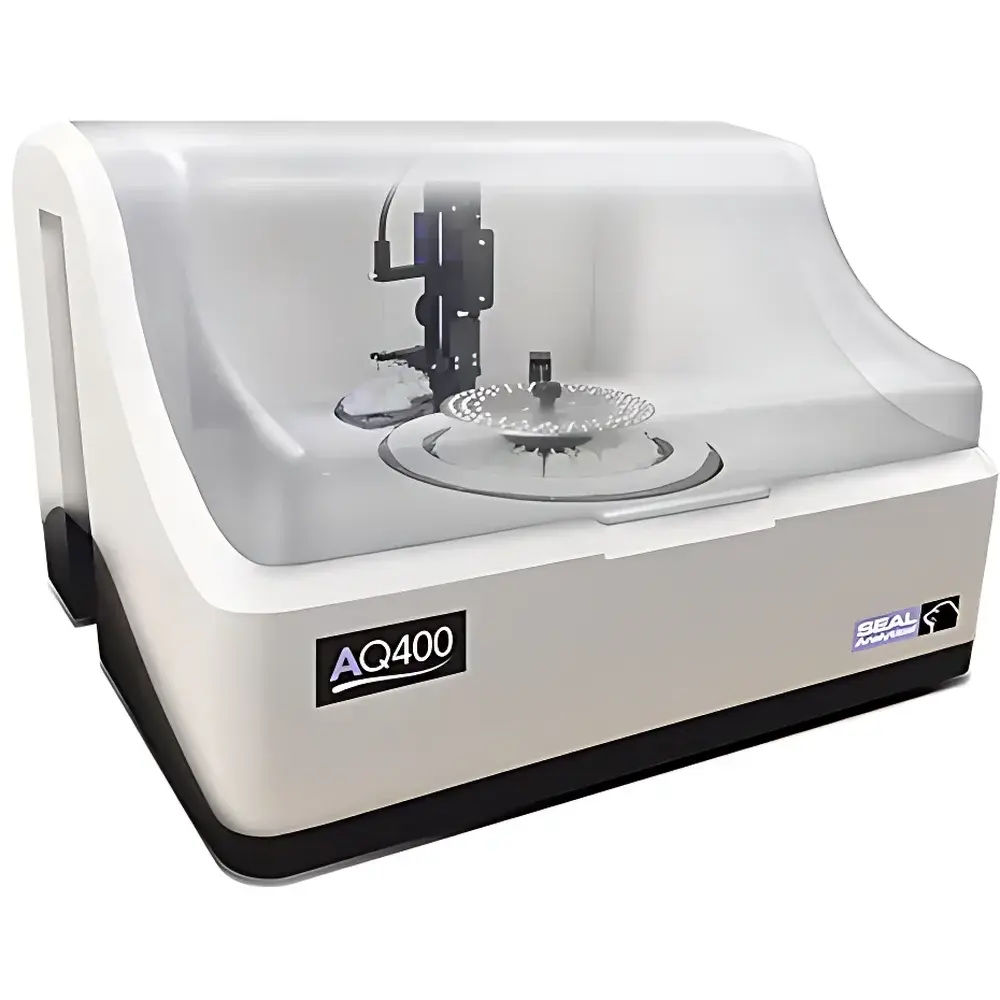
SEAL AQ400 Discrete Automated Chemistry Analyzer
| Brand | SEAL |
|---|---|
| Origin | Germany |
| Model | AQ400 |
| Product Type | Discrete Flow Analyzer |
| Wavelength Range | 350–880 nm |
| Sample Capacity | 80 or 120 positions |
| Reagent Positions | 26 (with refrigerated and ambient zones) |
| Cuvette Path Length | 10 mm (optional 20 mm) |
| Light Source | Quartz-halogen lamp |
| Detection Principle | Static photometric absorbance measurement using Hellma quartz flow cuvettes |
| Linear Range | 0.0001–3.500 AUFS |
| Resolution | 0.0001 AUFS |
| Reaction Temperature Control | 30–45 °C (±0.1 °C) |
| Sample Volume Precision | 0.5–500 µL (0.5 µL increments) |
| Reagent Dispensing | 10–600 µL (0.5 µL increments) |
| Max. Throughput | 200 samples/hour |
| Calibration | Up to 20-point multi-level calibration |
| Auto-dilution | Up to 100× pre- and post-analysis |
| Compliance | CE, UL, CSA |
| Power | 220 V, 50 Hz, 150 W |
| Dimensions (W×D×H) | 70 × 22 × 62 cm |
| Weight | 43 kg |
| Operating Environment | 5–40 °C, 5–95% RH |
Overview
The SEAL AQ400 Discrete Automated Chemistry Analyzer is a high-precision, fully automated platform engineered for environmental, wastewater, and soil testing laboratories requiring regulatory compliance, low detection limits, and robust reproducibility. Unlike continuous-flow or clinical-oriented analyzers, the AQ400 employs discrete analysis methodology—where each sample and reagent are metered into individual reaction wells, incubated under precisely controlled thermal conditions, and then transferred to a fixed-position, static quartz cuvette for photometric measurement. This architecture eliminates fluidic drift, optical path variability, and mechanical wear associated with moving cuvette carousels or flow cells. The system uses a quartz-halogen light source and a 9-position filter wheel (plus blank position) to select wavelengths across 350–880 nm, enabling standardized colorimetric and enzymatic methods per ASTM D1253, ISO 6777, ISO 15681, USP , and EPA Methods 353.2, 354.1, and 4500-NH₃ F. Its static measurement mode ensures optimal signal-to-noise ratio and long-term baseline stability—critical for trace-level quantification of nutrients, anions, and contaminants in complex matrices.
Key Features
- Fixed-path, static photometry using Hellma quartz cuvettes (10 mm standard; optional 20 mm) — eliminates positional error and surface degradation effects common in rotating or sliding cuvette systems
- Modular reagent carousel with 26 positions, including refrigerated and ambient zones, plus integrated reagent level sensors and expiration date tracking via QCPro™ software
- High-precision dual-syringe dispensing: sample volumes from 0.5–500 µL and reagents from 10–600 µL, both at 0.5 µL resolution
- Thermostatically controlled reaction zone (30–45 °C ±0.1 °C) with programmable incubation time up to 16 minutes — ensures complete reaction kinetics for nitrate reduction (via integrated Cd-coil), phosphate hydrolysis, and phenol coupling
- Automated in-situ regeneration of cadmium reduction coils — no manual disassembly or chemical replacement required
- True walk-away operation: supports overnight unattended runs, dynamic sample queue insertion, auto-standard curve generation, and intelligent over-range dilution (up to 100×)
- Integrated probe cleaning station with solvent rinse and air-dry cycles — prevents carryover between high-concentration and trace-level samples
- Comprehensive QCPro™ data integrity framework: configurable control limits, failure-triggered corrective actions, audit trail logging, and full 21 CFR Part 11 readiness (when deployed with validated IT infrastructure)
Sample Compatibility & Compliance
The AQ400 is validated for use with aqueous environmental matrices including raw and treated wastewater, surface and groundwater, leachates, soil extracts, and digested sludge supernatants. It accommodates sample vessels of 1.2 mL, 2 mL, and 5 mL capacity, with selectable 80- or 120-position sample racks. All wetted components—including sampling probes, reagent lines, reaction wells, and cuvettes—are chemically inert and compatible with acidic, alkaline, and chelating reagents used in standard methods. The system meets CE, UL, and CSA safety directives and supports GLP/GMP-aligned workflows through hardware-enforced method locking, electronic signature capability, and timestamped audit logs. Regulatory method adherence includes ISO 5667 series (water sampling), ISO 11929 (decision thresholds), and EPA SW-846 Chapter 3 (quality assurance for environmental testing).
Software & Data Management
AQ400 operates on SEAL’s proprietary ChemWell™ software, a Windows-based platform designed for method development, sequence scheduling, real-time monitoring, and compliance reporting. The interface supports drag-and-drop assay configuration, multi-parameter batch programming, and automatic validation of calibration curves (linear, quadratic, or cubic). All analytical data—including raw absorbance, calculated concentrations, QC flags, and instrument diagnostics—are stored in a relational database with field-level encryption. Export options include CSV, PDF, and XML formats compatible with LIMS integration via ODBC or HL7 interfaces. Audit trails capture user logins, method edits, result overrides, and maintenance events—fully traceable per FDA 21 CFR Part 11 Annex 11 requirements when paired with network authentication and electronic signature modules.
Applications
The AQ400 delivers validated performance across more than 40 standardized environmental parameters, including but not limited to: ammonia nitrogen (Nessler or salicylate), nitrate/nitrite (Cd-reduction + diazotization), total phosphorus (acid persulfate digestion + ascorbic acid reduction), orthophosphate, sulfate (turbidimetric or barium chloride), chloride (mercuric thiocyanate), cyanide (pyridine-barbituric acid), phenols (4-aminoantipyrine), alkalinity (acid titration endpoint detection), silica (molybdate blue), and total Kjeldahl nitrogen (post-digestion distillation integration). Its flexibility extends to custom assay development for emerging contaminants, redox-sensitive analytes, and kinetic enzyme assays—leveraging programmable incubation timing, multi-step reagent addition, and temperature-controlled reaction environments.
FAQ
How does discrete analysis differ from flow injection or segmented flow techniques?
Discrete analysis isolates each sample-reagent reaction in a dedicated well, eliminating cross-contamination and dispersion effects inherent in flowing streams. This yields superior precision (<1.0% RSD), lower detection limits, and compatibility with heterogeneous or particulate-laden samples.
Can the AQ400 perform digestion steps onboard?
No—the AQ400 is optimized for post-digestion colorimetric analysis. Sample digestion must be performed externally (e.g., block digesters or microwave systems) prior to loading. However, it fully supports automated dilution and standard addition for digested extracts.
Is method validation support available?
Yes—SEAL provides IQ/OQ documentation templates, certified reference material protocols, and application notes aligned with ISO/IEC 17025 and EPA guidance. On-site installation qualification and operational qualification services are offered globally.
What maintenance is required for routine operation?
Daily: probe rinse check, waste level verification, and cuvette inspection. Weekly: syringe lubrication and filter replacement. Quarterly: optical alignment verification and temperature sensor calibration—documented in built-in service logs.
Does the system support remote monitoring and troubleshooting?
Yes—ChemWell™ supports secure remote desktop access (via customer-approved VPN), live diagnostic dashboards, and predictive alerting for reagent depletion, temperature deviation, or aspiration failure.




