
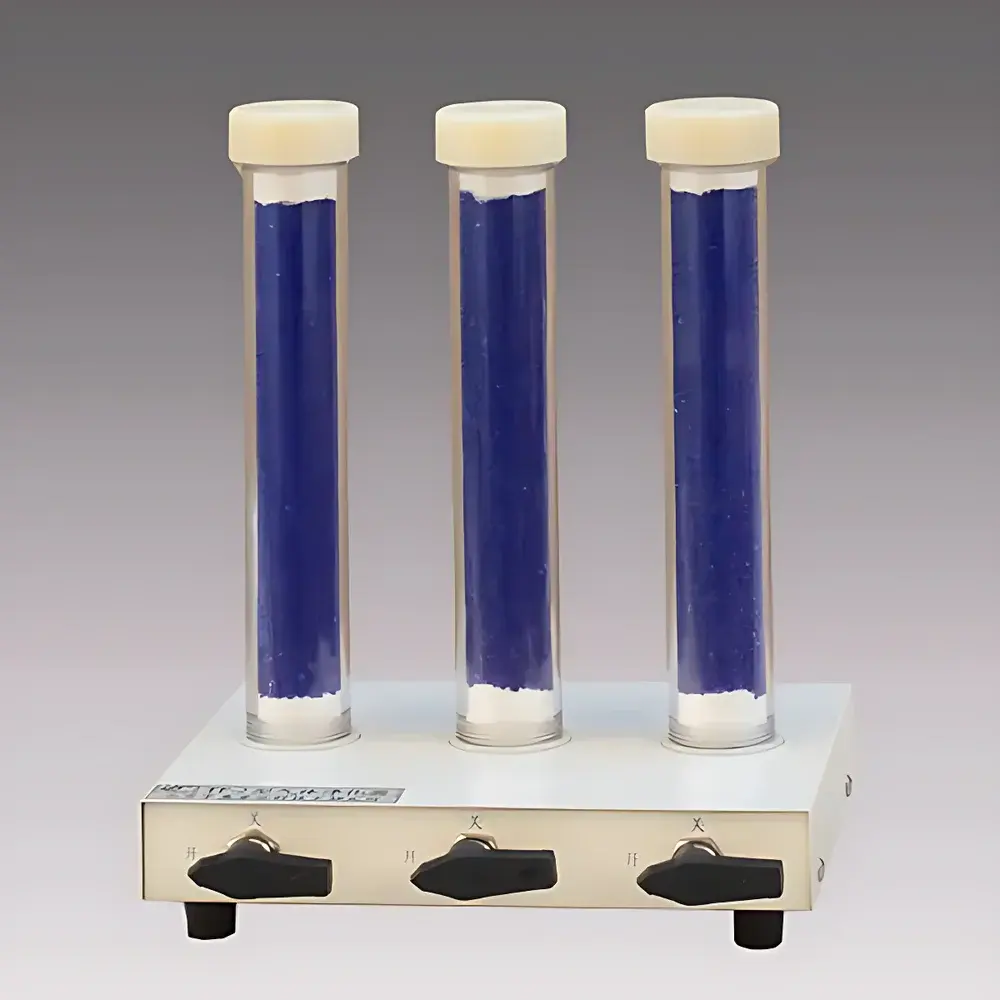
Zhonghuipu TF-2 Gas Purifier
| Brand | Zhonghuipu |
|---|---|
| Origin | Beijing, China |
| Manufacturer Type | Direct Manufacturer |
| Country of Origin | China |
| Model | TF-2 |
| Pricing | Available Upon Request |
Overview
The Zhonghuipu TF-2 Gas Purifier is a compact, modular benchtop gas purification system engineered for precision laboratory environments where high-purity carrier, auxiliary, and supply gases are critical. It operates on a multi-stage physical adsorption principle—leveraging selective sorbent media to remove trace contaminants—including moisture (H₂O), hydrocarbons (C₁–C₄), oxygen (O₂), carbon dioxide (CO₂), and sulfur compounds—from compressed gas streams. Designed specifically for compatibility with analytical instrumentation such as gas chromatographs (GC), elemental analyzers (e.g., CHNS/O), environmental monitoring systems, and food safety testing platforms, the TF-2 ensures stable baseline performance, extended column lifetime, and improved detection sensitivity by maintaining consistent gas purity across operational cycles.
Key Features
- Triple independent gas channels—each configurable with interchangeable sorbent cartridges for targeted impurity removal (e.g., molecular sieves + indicating silica gel for H₂O; activated carbon for hydrocarbons; copper-based scrubbers for O₂)
- Maximum operating pressure rating of 0.6 MPa (87 psi), validated per ISO 10522:2019 for gas handling components in analytical applications
- Low-sulfur internal sealing architecture: all wetted parts utilize low-extractable silicone O-rings compliant with ASTM F2234-21 specifications for ultra-high-purity gas systems
- Three manually operated stainless steel needle valves—precision-machined for repeatable flow control and leak-tight shut-off (tested to ≤1×10⁻⁹ mbar·L/s He leak rate per EN 15075-2)
- Modular cartridge design enables rapid media replacement without tools or system depressurization—minimizing instrument downtime during routine maintenance
- Front-panel visual indicators: color-changing silica gel (blue → pink) provides real-time moisture saturation feedback; optional pressure gauges available for inlet/outlet monitoring
Sample Compatibility & Compliance
The TF-2 supports inert and reactive gas types including helium (He), nitrogen (N₂), hydrogen (H₂), argon (Ar), and synthetic air—provided gas composition remains within ASME B31.3 process fluid limits. It is not intended for use with corrosive gases (e.g., Cl₂, NH₃, H₂S) or oxidizers exceeding Class 2.1 per UN GHS criteria. The unit meets CE marking requirements for electromagnetic compatibility (EMC Directive 2014/30/EU) and low-voltage safety (LVD Directive 2014/35/EU). While not certified to ISO/IEC 17025, its design aligns with GLP-compliant gas management practices outlined in OECD Series on Principles of Good Laboratory Practice (ENV/MC/CHEM(98)17) and supports audit-ready documentation when integrated into laboratory quality systems.
Software & Data Management
The TF-2 is a fully manual, hardware-only purification platform—no embedded firmware, microcontroller, or digital interface is present. This analog architecture eliminates software validation requirements under FDA 21 CFR Part 11 and simplifies qualification protocols (IQ/OQ/PQ) for regulated laboratories. Maintenance logs—including cartridge replacement dates, gas type, batch numbers, and observed breakthrough times—can be recorded externally using LIMS-integrated spreadsheets or paper-based SOP forms. Optional calibration certificates (traceable to NIST SRM 1633c for silica gel moisture capacity verification) are available upon request.
Applications
- Gas chromatography labs requiring ≥99.999% purity carrier gases to prevent column degradation and ghost peak formation
- Elemental analyzers (e.g., Thermo Scientific FlashSmart, Elementar vario EL cube) demanding sub-ppb O₂ and H₂O levels for accurate combustion efficiency and stoichiometric quantification
- Environmental air monitoring stations performing EPA Method TO-14/TO-15 analysis, where hydrocarbon interference must be suppressed below method detection limits
- Food and beverage testing facilities conducting residual solvent analysis (e.g., ICH Q2(R2)-aligned methods) where background VOC contamination compromises reproducibility
- Research laboratories developing novel catalysts or battery materials, where controlled gas atmospheres (e.g., purified N₂ glovebox feed) directly impact reaction kinetics and surface characterization fidelity
FAQ
What sorbent materials are pre-filled in the standard TF-2 cartridges?
Standard configurations include 4Å molecular sieve (for H₂O), indicating blue-to-pink silica gel (for visual moisture monitoring), and granular activated carbon (for C₁–C₄ hydrocarbons). Custom fill options (e.g., copper oxide for O₂ removal, soda lime for CO₂) are available upon specification.
Can the three channels be used simultaneously with different gases?
Yes—the TF-2 supports concurrent parallel purification of three separate gas streams (e.g., He carrier, H₂ detector gas, and N₂ make-up gas), each with independently selected sorbents and flow rates.
Is the TF-2 compatible with GC-MS systems?
Yes, provided inlet pressure and flow rate remain within manufacturer-specified limits for the mass spectrometer’s gas supply interface; users must verify compatibility with their specific GC-MS vendor’s gas purity recommendations (e.g., Agilent 8890/5977B requires <10 ppb H₂O and <1 ppb hydrocarbons).
How often should sorbent cartridges be replaced?
Replacement frequency depends on gas source quality, flow rate, and daily usage duration. Under typical lab conditions (200 mL/min, 8 h/day, compressed air feed), silica gel lasts ~3–6 months; molecular sieve and activated carbon typically require renewal every 6–12 months. Breakthrough testing via dew point meter or GC-TCD is recommended prior to scheduled changeout.
Does the TF-2 include pressure relief protection?
No—the unit does not integrate a built-in pressure relief valve. Users must install an external ASME-certified relief device upstream if operating above ambient pressure in closed-loop or high-backpressure configurations.



