
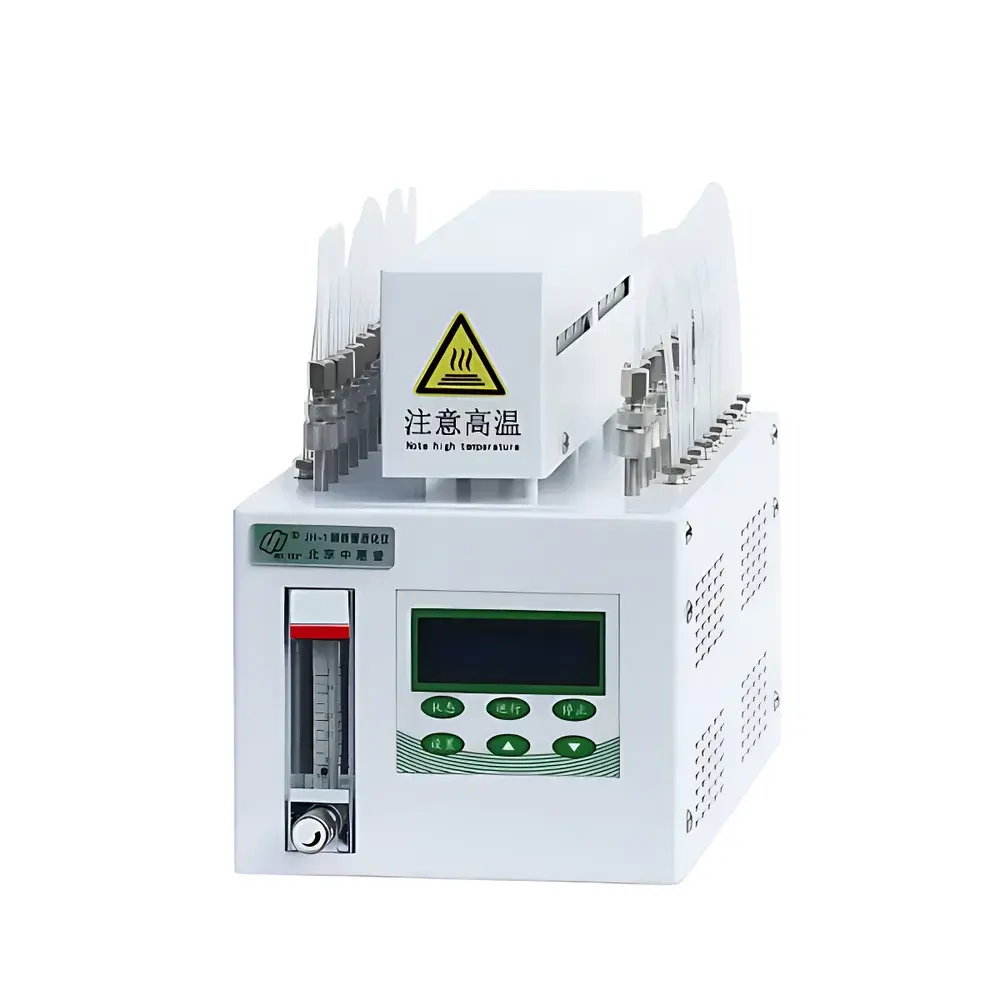
Zhonghuipu JH-1 Adsorption Tube Aging Instrument
| Brand | Zhonghuipu |
|---|---|
| Origin | Beijing, China |
| Manufacturer Type | Manufacturer |
| Country of Origin | Domestic (China) |
| Model | JH-1 |
| Price | Upon Request |
| Temperature Control Range | 40–380 °C |
| Gas Flow Rate | 10–1000 mL/min |
| Number of Adsorption Tubes Supported | 10 |
| Temperature Accuracy | ±1 °C |
| Aging Timer | Up to 99 h 59 min 59 s |
| Power Consumption | 500 W |
| Electrical Supply | 220 V, 50 Hz |
| Compatible Tube Dimensions | Outer diameter 6–6.5 mm, minimum length 89 mm (stainless steel, quartz, or borosilicate glass tubes) |
| Tube Compatibility | Tenax-TA, activated carbon, multi-sorbent composite tubes (domestic and imported) |
Overview
The Zhonghuipu JH-1 Adsorption Tube Aging Instrument is a precision-engineered thermal conditioning system designed for the controlled desorption and regeneration of sorbent-packed sampling tubes used in thermal desorption–gas chromatography (TD–GC) workflows. It operates on the principle of programmed thermal aging under inert gas purge—typically high-purity nitrogen—to remove residual volatiles, moisture, and contaminants from sorbent beds prior to analytical use. This process ensures baseline stability, minimizes carryover, and extends tube service life. The instrument features ten independent heating stations with uniform thermal distribution across all positions, enabling parallel conditioning of up to ten tubes per cycle while maintaining traceable, reproducible thermal profiles. Its architecture supports both routine QC validation and high-throughput laboratory environments where consistency in tube preparation directly impacts method robustness and regulatory compliance.
Key Features
- Ten individually heated aging stations with ±1 °C temperature accuracy and real-time digital display for precise thermal control between 40 °C and 380 °C.
- Adjustable inert gas flow regulation (10–1000 mL/min) via calibrated mass flow path, allowing optimization for different sorbent types (e.g., Tenax-TA, activated carbon, carbon molecular sieves, and multi-bed composites).
- PTFE-lined gas pathways and PTFE-sealed fittings throughout the manifold ensure zero extractables and prevent cross-contamination during aging cycles.
- Programmable timer with resolution down to 1 second and maximum duration of 99 hours, 59 minutes, 59 seconds—supporting extended conditioning protocols required for demanding applications such as EPA TO-17 or ISO 16017-1 compliant methods.
- Automated post-aging sequence: controlled cooling ramp, automatic gas shutoff, and integrated overtemperature protection circuitry for fail-safe operation.
- Compact benchtop design (220 V, 50 Hz, 500 W) with plug-and-play installation—requires only connection to a regulated nitrogen supply and standard AC outlet.
Sample Compatibility & Compliance
The JH-1 accommodates standard 6–6.5 mm OD adsorption tubes up to 120 mm in length, including stainless steel, quartz, and borosilicate glass formats. It is validated for use with widely adopted sorbents: Tenax-TA (for C6–C14 VOCs), coconut-based activated carbon (for low-boiling compounds), and layered multi-sorbent configurations (e.g., Carbopack B + Carbopack C + Carbosieve SIII) used in broad-spectrum environmental monitoring. The instrument’s thermal uniformity and inert gas delivery meet essential prerequisites for adherence to ASTM D6196, ISO 16017-1, and US EPA Method TO-17. When operated within documented SOPs—including calibration verification, gas purity certification (≥99.999% N2), and periodic leak testing—it supports GLP-compliant tube preparation and contributes to audit-ready data integrity in regulated laboratories.
Software & Data Management
The JH-1 is a standalone hardware platform without embedded software or network connectivity. All operational parameters—including setpoint temperature, gas flow rate, and aging duration—are configured manually via front-panel controls with LED readouts. While it does not generate electronic audit trails or export raw data logs, its deterministic analog control architecture ensures full traceability when paired with laboratory documentation practices: users record settings, batch IDs, tube serial numbers, and operator initials in bound logbooks or LIMS-integrated electronic notebooks. For labs requiring 21 CFR Part 11 compliance, integration with external time-stamped environmental monitoring systems (e.g., Vaisala or DeltaTrak) is recommended to capture ambient conditions during aging cycles.
Applications
- Pre-conditioning of sorbent tubes prior to field sampling in indoor air quality (IAQ), workplace exposure, and ambient air monitoring programs.
- Regeneration of spent tubes after thermal desorption analysis to restore sorbent capacity and reduce consumable costs.
- Method development support for optimizing aging temperature ramps and purge durations based on sorbent chemistry and target analyte volatility.
- QC/QA procedures for verifying tube cleanliness and absence of ghost peaks in blank runs per ISO/IEC 17025 requirements.
- Supporting accredited testing laboratories performing analyses under EN 16755, ISO 16000-6, or Chinese HJ 644–2013 standards.
FAQ
What tube materials are compatible with the JH-1?
Stainless steel, fused quartz, and borosilicate glass tubes with outer diameters of 6–6.5 mm and lengths ≥89 mm.
Does the instrument support helium or other carrier gases besides nitrogen?
Yes—any inert, dry, particle-free gas may be used; however, nitrogen is recommended for cost efficiency and safety.
Is calibration certification included with purchase?
No factory calibration certificate is supplied by default, but the unit includes provisions for user-performed temperature and flow verification using NIST-traceable reference standards.
Can the JH-1 be integrated with automated thermal desorbers?
It is functionally complementary—not electronically interfaced—with autosamplers such as Markes UNITY or Gerstel TDS; synchronization is manual via SOP coordination.
What maintenance is required for long-term reliability?
Annual inspection of PTFE seals, cleaning of heater block vents, and verification of gas line integrity using soap solution or electronic leak detector.





