
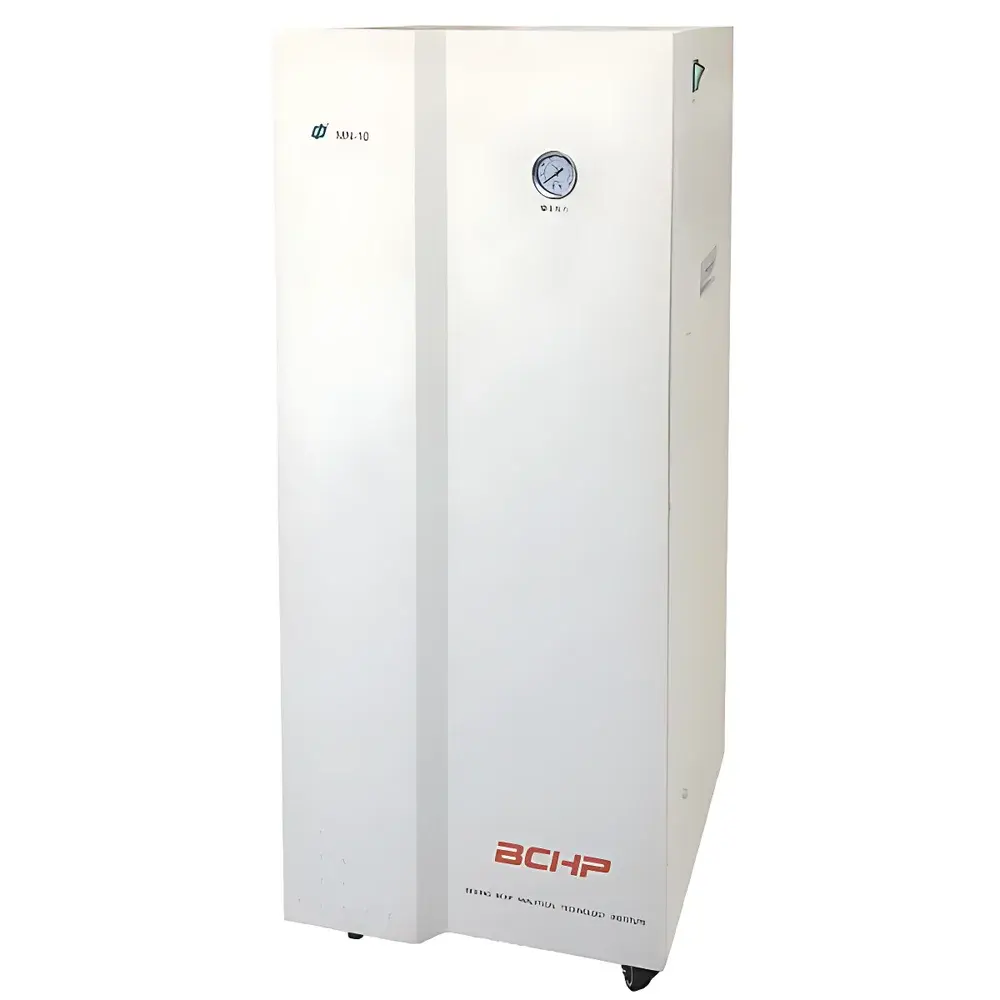
Zhonghuipu MN-10 Nitrogen Generator
| Brand | Zhonghuipu |
|---|---|
| Origin | Beijing, China |
| Manufacturer Type | Direct Manufacturer |
| Product Category | Domestic |
| Model | MN-10 |
| Instrument Type | Membrane-Based Nitrogen Generator |
| Nitrogen Production Principle | Hollow Fiber Membrane Separation |
| Output Flow Rate | 0–10 L/min |
| Output Pressure | 0–0.4 MPa |
| Nitrogen Purity | Up to 99.9% |
| Dew Point | < −55 °C |
| Particulate Filtration | ≤ 0.01 µm |
| Power Consumption | ≤ 650 W |
| Input Voltage | 220 V ±10% AC, 50 Hz |
| Operating Ambient | 1–35 °C, RH ≤ 85% |
| Dimensions (L×W×H) | 400 × 425 × 700 mm (excl. casters) |
| Net Weight | ~40 kg |
Overview
The Zhonghuipu MN-10 Nitrogen Generator is an engineered, self-contained membrane-based gas generation system designed for continuous, on-demand nitrogen supply in analytical laboratories, QC/QA environments, and research facilities. It utilizes hollow fiber membrane separation technology to extract high-purity nitrogen from compressed ambient air—eliminating dependency on high-pressure cylinders or liquid nitrogen dewars. The process relies on differential permeation rates of oxygen, water vapor, and carbon dioxide through polymeric membranes, allowing nitrogen to be selectively enriched with minimal pressure drop and zero chemical consumables. With a rated output capacity of up to 10 L/min at pressures up to 0.4 MPa (4 bar), the MN-10 delivers stable, dry nitrogen meeting ISO 8573-1 Class 2:2:2 (solid particles ≤ 0.01 µm, dew point < −55 °C, oil-free) specifications—making it suitable for sensitive applications including GC carrier gas, LC-MS purge gas, sample preparation atmospheres, and inert blanketing.
Key Features
- Hollow fiber membrane core: Integrated high-efficiency imported membrane module ensures consistent nitrogen purity up to 99.9% across the full flow range, with rapid start-up and no warm-up delay.
- Oil-free compression system: Equipped with a Thomas-branded, maintenance-free, brushless DC scroll compressor delivering clean, dry intake air—fully compliant with ISO 8573-1 Class 0 for oil contamination.
- Multi-stage filtration architecture: Includes pre-filtration (coalescing + activated carbon), membrane separation, and post-filtration via an SMC-certified 0.01 µm particulate filter—ensuring particulate-free, low-dew-point output.
- Intelligent microcontroller management: Embedded single-board controller regulates airflow, monitors compressor thermal load and motor temperature, and initiates automatic shutdown under overpressure, overheating, or prolonged idle conditions.
- Robust mechanical construction: Primary wetted components—including air path manifolds, buffer tanks, and gas lines—are fabricated from ASTM A240 304 stainless steel for corrosion resistance and long-term gas integrity.
- Acoustically optimized design: Dedicated compressor sound enclosure and vibration-damped mounting reduce operational noise to < 55 dB(A) at 1 m—enabling placement within shared laboratory spaces without acoustic interference.
Sample Compatibility & Compliance
The MN-10 is compatible with all standard nitrogen-dependent instrumentation requiring flow-stable, oil-free, low-humidity gas—including gas chromatographs (GC), gas chromatography–mass spectrometers (GC-MS), elemental analyzers, FTIR purge systems, and glovebox inerting setups. Its output meets critical regulatory requirements for analytical gas supply: ISO 8573-1:2010 (compressed air quality), ASTM D6352 (for GC carrier gas), and USP (for pharmaceutical inerting). While not intrinsically certified for hazardous locations, its safety valve (set at 0.45 MPa) and pressure-relief circuitry conform to EN 13445-3 mechanical integrity standards. The system supports GLP/GMP-aligned operation when paired with external audit-trail-capable logging software.
Software & Data Management
The MN-10 operates as a standalone hardware platform with no proprietary software dependency. All operational parameters—including real-time flow rate, outlet pressure, compressor duty cycle, and fault codes—are displayed on a backlit LCD interface. For integration into centralized lab infrastructure, analog 0–10 V or 4–20 mA output signals (optional) enable connection to building management systems (BMS) or SCADA platforms. While the unit does not include native 21 CFR Part 11-compliant electronic records, its digital I/O interface supports third-party data acquisition modules that provide timestamped, user-access-controlled logging—facilitating compliance with FDA-regulated workflows when validated per site-specific SOPs.
Applications
- Carrier gas supply for capillary GC and GC-MS systems requiring stable, ultra-dry nitrogen at 1–5 L/min
- Purge and trap, headspace, and thermal desorption systems where hydrocarbon-free, low-dew-point gas is mandatory
- Inert atmosphere generation for moisture-sensitive synthesis, catalyst handling, and battery material testing
- Blanketing of solvent storage vessels and reaction flasks to prevent oxidation or hydrolysis
- Calibration gas dilution systems requiring precise, repeatable nitrogen base gas
- Support gas for nitrogen laser systems and plasma etching tools in materials science labs
FAQ
What is the typical nitrogen purity stability across the 0–10 L/min flow range?
Nitrogen purity remains ≥ 99.5% at 10 L/min and increases to ≥ 99.9% below 5 L/min—verified by inline electrochemical oxygen sensors calibrated annually per ISO/IEC 17025 protocols.
Does the MN-10 require periodic membrane replacement?
The hollow fiber membrane module is rated for ≥ 15,000 hours of continuous operation under specified inlet air quality (ISO 8573-1 Class 3:3:3); replacement is recommended only after performance verification indicates >5% purity drift.
Can the unit operate unattended for extended periods?
Yes—designed for 7×24 operation with thermal overload protection, pressure safety cutoff, and automatic restart after power recovery; however, routine particulate filter replacement every 6 months is required for sustained ISO Class 2 compliance.
Is external cooling or ventilation required?
No dedicated exhaust ducting is needed, but ambient airflow around the rear heat exchanger must remain unobstructed; minimum clearance of 15 cm on all sides is advised for optimal thermal management.
What maintenance intervals are recommended for the Thomas compressor?
The sealed, oil-free Thomas compressor requires no scheduled lubrication or service; annual inspection of intake filters and validation of pressure decay rate (≤ 0.02 MPa/h at 0.4 MPa hold) constitute the full preventive maintenance protocol.
Related Products



