
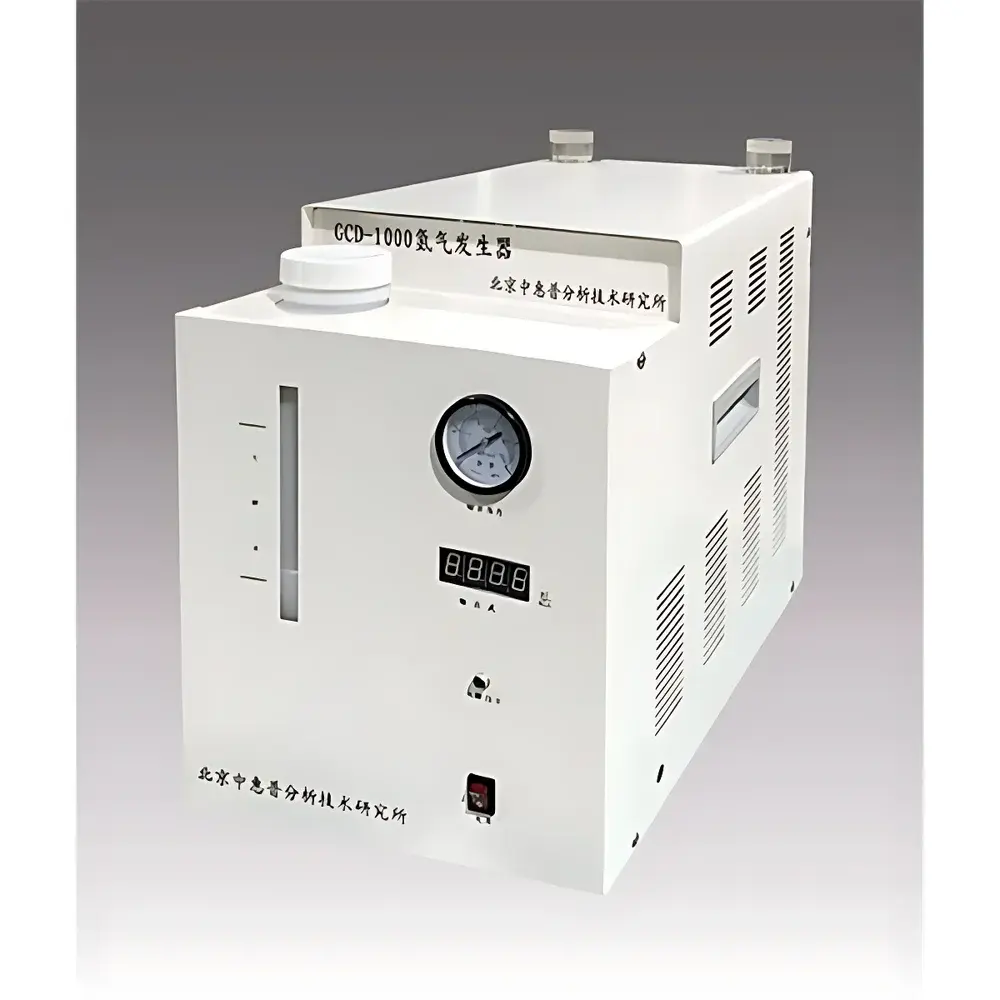
Zhonghuipu GCD-1000 Alkaline Electrolysis Hydrogen Generator
| Brand | Zhonghuipu |
|---|---|
| Origin | Beijing, China |
| Manufacturer Type | Direct Manufacturer |
| Country of Origin | China |
| Model | GCD-1000 |
| Hydrogen Generation Principle | Alkaline Electrolysis |
| Output Flow Rate | 0–1000 mL/min |
| Output Pressure | 0–0.4 MPa |
| Hydrogen Purity | 99.999% |
| Power Consumption | 400 W |
| Pressure Stability | < 0.001 MPa |
| Input Power | 220 V ±10%, 50 Hz |
| Operating Temperature | 1–40 °C |
| Relative Humidity | < 85% RH |
| Dimensions (W×D×H) | 460 × 370 × 360 mm |
| Net Weight | ~20 kg |
| Filtration | Dual stainless-steel filters with trace oxygen scavenger (pre-activated) |
| Sealing Material | Low-sulfur silicone rubber gaskets |
| Safety Features | Automatic anti-alkali-backflow protection, real-time pressure/flow monitoring |
Overview
The Zhonghuipu GCD-1000 is a benchtop alkaline electrolysis hydrogen generator engineered for continuous, on-demand production of high-purity hydrogen gas in analytical laboratory environments. It operates on the principle of water electrolysis in a concentrated potassium hydroxide (KOH) solution, where direct current decomposes deionized water into stoichiometric hydrogen and oxygen gases at nickel-plated electrodes. Oxygen is vented safely, while hydrogen passes through dual-stage purification—first via stainless-steel coalescing filters, then through a pre-activated trace oxygen scavenger—to achieve a certified purity of ≥99.999% (5.0 grade), meeting ISO 8573-1 Class 1 requirements for gaseous impurities (total hydrocarbons < 0.1 ppm, O₂ < 0.5 ppm, H₂O dew point ≤ −60 °C). Designed for integration with gas chromatography (GC), GC-MS, and hydrogen-fueled detectors (e.g., FID, HID), the GCD-1000 eliminates reliance on high-pressure cylinders, reducing logistical risk, storage footprint, and operational downtime associated with cylinder changeovers.
Key Features
- Auto-regulating pressure and flow control: Maintains stable output across the full 0–1000 mL/min range with dynamic response to downstream demand fluctuations; pressure stability held within ±0.001 MPa under steady-state conditions.
- Dual-stage gas purification: Two independent stainless-steel filter housings contain sintered metal elements and integrated low-sulfur oxygen removal media—no user activation or regeneration required.
- Low-sulfur sealing architecture: All internal wetted seals utilize specially formulated silicone rubber with sulfur content < 1 ppm, preventing sulfur-induced baseline drift or column contamination in sensitive GC applications.
- Integrated safety system: Real-time monitoring of electrolyte level, cell temperature, and backpressure triggers automatic shutdown and alkaline backflow prevention via solenoid-isolated electrolyte reservoir design.
- Compact footprint and low thermal load: 460 × 370 × 360 mm chassis accommodates standard lab benches; 400 W nominal power draw minimizes HVAC burden and supports operation on standard 220 V / 50 Hz circuits without dedicated line conditioning.
Sample Compatibility & Compliance
The GCD-1000 delivers hydrogen suitable for use with all mainstream GC detectors requiring ultra-high-purity fuel or carrier gas, including flame ionization (FID), helium ionization (HID), and pulsed discharge helium ionization (PDHID) detectors. Its output meets ASTM D7217–22 specifications for hydrogen used in gas chromatographic analysis and aligns with USP and EP 2.5.27 guidelines for instrumental gas quality. The unit complies with IEC 61010-1:2010 for electrical safety in laboratory equipment and incorporates fail-safe logic compatible with GLP/GMP audit requirements—including event-logged shutdowns and non-volatile memory for last-operating parameters.
Software & Data Management
While the GCD-1000 operates as a stand-alone instrument with analog front-panel indicators (digital pressure and flow meters), it features RS-232 and optional 4–20 mA analog outputs for integration into centralized lab monitoring systems (e.g., LabVantage, Thermo Fisher SampleManager). All operational events—including overpressure alerts, low-water warnings, and auto-shutdown triggers—are timestamped and stored in internal EEPROM for traceability. Optional firmware upgrade enables Modbus RTU protocol support, facilitating seamless interoperability with PLC-controlled gas distribution networks and enabling compliance with FDA 21 CFR Part 11 when paired with validated electronic log software.
Applications
- Primary hydrogen source for GC-FID and GC-HID systems in environmental, pharmaceutical, and petrochemical QA/QC laboratories.
- Carrier gas alternative to helium in capillary GC methods where hydrogen’s higher optimal linear velocity improves throughput without sacrificing resolution.
- Fuel gas supply for portable hydrogen-powered analyzers deployed in field-based emissions monitoring or process analytical technology (PAT) installations.
- Research-grade hydrogen feed for catalytic reaction screening, hydride generation atomic absorption (HG-AAS), and hydrogenation studies requiring consistent, low-impurity gas streams.
FAQ
What electrolyte is used, and how often does it require replacement?
The GCD-1000 employs a 25–30% w/w aqueous potassium hydroxide (KOH) solution. Under typical usage (8 h/day, 500 mL/min average flow), electrolyte replacement is recommended every 6–12 months based on conductivity monitoring—no scheduled maintenance is required between intervals.
Is external cooling or ventilation required?
No forced ventilation is needed; the unit is designed for natural convection cooling. Ambient operating temperature must remain between 1–40 °C with relative humidity < 85% non-condensing. Avoid placement adjacent to heat-generating instruments or in enclosed cabinets without airflow.
Can the GCD-1000 be used with GC systems requiring >0.4 MPa inlet pressure?
The maximum regulated output pressure is 0.4 MPa (4 bar). For GC configurations requiring higher inlet pressures (e.g., some microfluidic or backflush setups), an externally mounted, oil-free diaphragm booster pump compliant with ISO 8573-1 Class 0 must be installed downstream.
How is hydrogen purity verified and documented?
Each unit undergoes factory certification using calibrated gas chromatography with thermal conductivity detection (TCD) per ISO 10156. A Certificate of Conformance—including measured O₂, H₂O, CO, CO₂, and total hydrocarbon levels—is supplied with shipment and archived in the device’s EEPROM for audit retrieval.



