
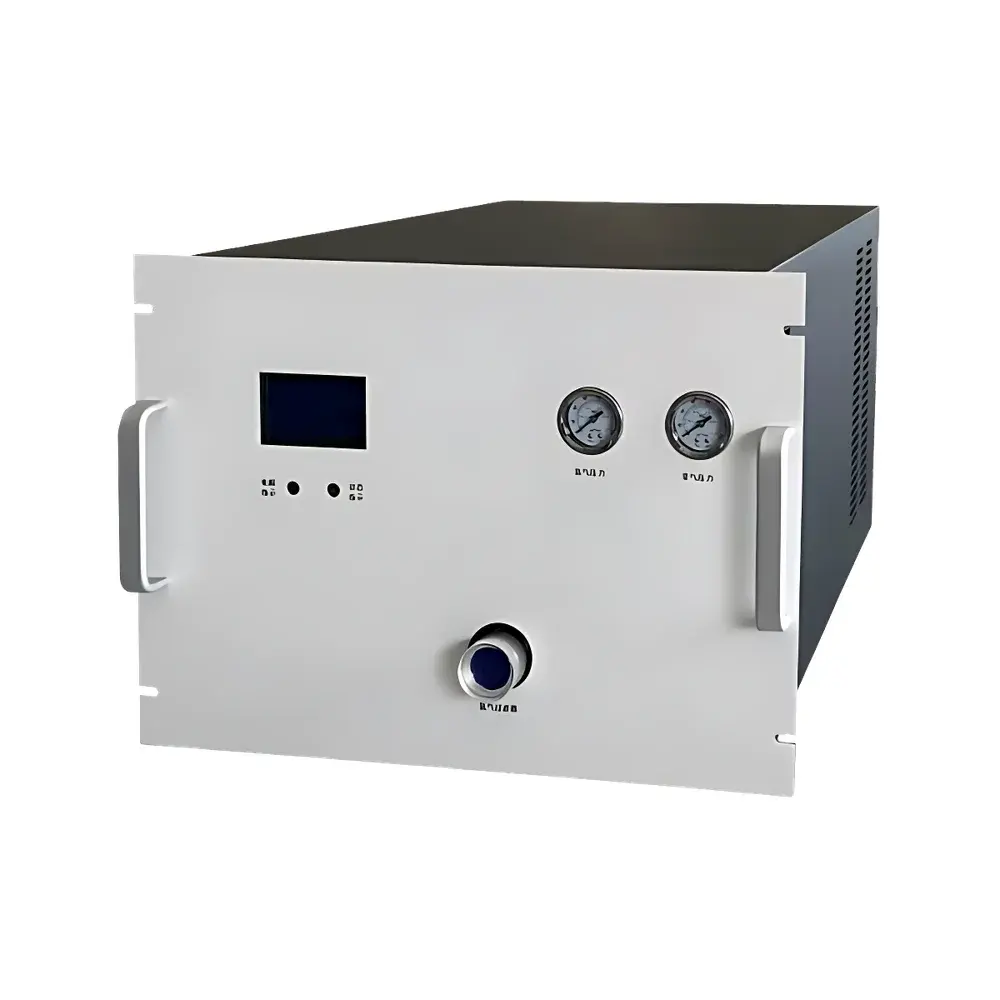
Zhonghui Pu HA6800 Rack-Mounted Hydrogen & Zero Air Integrated Gas Generator
| Brand | Zhonghui Pu |
|---|---|
| Model | HA6800 |
| Output H₂ Flow | 0–300/500 mL/min |
| H₂ Purity | 99.999% |
| H₂ Output Pressure | 0.4 MPa (4 bar) |
| H₂ Pressure Stability | < 0.001 MPa |
| Zero Air Flow | 0–1.5/3/5 L/min |
| Hydrocarbon Content in Zero Air | < 20 ppb |
| Zero Air Particle Filtration | < 0.01 µm |
| Zero Air Dew Point | −10 °C |
| Operating Ambient | 5–40 °C, ≤85% RH |
| Max Power Consumption | 900 W |
| Input Voltage | 220 V ±10% |
| Dimensions (L×W×H) | 600 × 430 × 355 mm |
| Net Weight | ~45 kg |
Overview
The Zhonghui Pu HA6800 is a rack-mounted, dual-output integrated gas generator engineered for laboratories requiring continuous, high-purity hydrogen and certified zero air in parallel—without reliance on high-pressure cylinders or external air compressors. It operates on two independent, physically separated gas generation modules: a PEM-free alkaline electrolytic hydrogen generator and a catalytic zero-air purification system. The hydrogen module employs transition-metal-catalyzed electrolysis with liquid-phase KOH-based electrolyte, enabling stable operation with standard deionized water and eliminating sensitivity to feed-water resistivity. The zero-air subsystem integrates an oil-free diaphragm compressor, high-temperature catalytic oxidation (using Pt/Pd-based catalysts), and dual-stage pressure-swing adsorption (PSA) drying—ensuring hydrocarbon removal to <20 ppb and particle filtration down to 0.01 µm. Designed for uninterrupted 7×24 operation, the HA6800 meets critical gas supply requirements for GC-FID, GC-MS, TO-14/TO-15 calibration, ambient air monitoring systems, and trace-level environmental analyzers where baseline stability and detector sensitivity are paramount.
Key Features
- Rack-mountable 19″ form factor (600 × 430 × 355 mm) optimized for integration into centralized laboratory utility cabinets or analytical instrument racks.
- Dual independent control architecture: microprocessor-based single-board controller manages H₂ electrolysis, auto-refill logic, leak detection, and shutdown protocols; separate thermal management and catalytic temperature regulation for zero-air oxidation chamber.
- Hydrogen safety suite: real-time H₂ leak sensing with automatic power cutoff, over-pressure relief valve, dry-run prevention via level-sensing electrolyte reservoir, and redundant pressure transducers.
- Zero-air catalytic furnace rated for >3 years of continuous service without catalyst replacement—validated under ISO 8573-1 Class 1 particulate and Class 2 moisture specifications.
- All wetted and high-pressure components—including electrolyzer cell housing, buffer tanks, and gas manifolds—fabricated from ASTM A240 304 stainless steel for corrosion resistance and long-term gas purity integrity.
- RS-232 serial interface compliant with Modbus RTU protocol for remote status monitoring, flow/pressure logging, and integration into LIMS or building management systems.
Sample Compatibility & Compliance
The HA6800 delivers gases compatible with regulatory-grade analytical workflows. Hydrogen output (99.999% purity, <0.1 ppm O₂/H₂O) satisfies ASTM D7217–22 requirements for fuel gas in flame ionization detection. Zero air meets EPA Method TO-14A and ISO 8573-1:2010 Class 1 (particles), Class 2 (water), and Class 2 (oil) specifications—validated by third-party testing for total hydrocarbons <20 ppb (as methane). The system supports GLP/GMP environments through configurable audit-trail logging (via optional software extension), event timestamping of all safety interventions, and deterministic pressure stabilization (<0.001 MPa drift over 24 h), ensuring repeatability across instrument qualification (IQ/OQ/PQ) protocols.
Software & Data Management
The embedded controller provides real-time display of operational parameters—including H₂ flow rate, zero-air dew point, catalytic bed temperature, electrolyte level, and system pressure—on a backlit monochrome LCD with Chinese/English toggle. All measurements are time-stamped and stored internally for up to 30 days. Via RS-232, users can export CSV-formatted logs for trend analysis or compliance reporting. Optional PC-based configuration software enables password-protected parameter adjustment (e.g., max H₂ flow setpoint, alarm thresholds), firmware updates, and diagnostic mode activation—fully compliant with FDA 21 CFR Part 11 requirements when deployed with electronic signature and audit trail modules.
Applications
- Gas chromatography: primary fuel source for FID detectors and makeup gas for ECD/NPD; carrier-grade zero air for detector air supply and calibration standards dilution.
- Ambient air quality monitoring: zero air for span calibration of NOₓ, SO₂, O₃, and CO analyzers per EN 14625 and US EPA 40 CFR Part 53.
- Calibration laboratories: generation of certified reference gas blends using dynamic dilution systems requiring ultra-low-hydrocarbon oxidant streams.
- Research facilities: stable, low-noise gas supply for laser spectroscopy, fuel cell testing, and catalytic reaction studies where cylinder-derived impurities compromise data fidelity.
- Pharmaceutical QC labs: compliant zero air for residual solvent analysis (ICH Q2) and elemental impurity testing (USP <232>/<233>) requiring documented gas purity history.
FAQ
What maintenance intervals are required for the HA6800?
Electrolyte top-up is automated; only annual inspection of PSA desiccant beds and catalytic furnace thermocouples is recommended. No routine catalyst or filter replacement is needed within the first 36 months of operation.
Can the HA6800 operate unattended for extended periods?
Yes—designed for continuous 7×24 operation with dual safety interlocks, thermal runaway protection, and self-diagnostic routines that trigger audible/visual alarms and graceful shutdown prior to fault escalation.
Is external cooling or ventilation required?
The unit exhausts <120 L/min of warm air at <45 °C; installation requires ≥10 cm rear clearance and passive ambient airflow—no dedicated HVAC ducting is necessary.
Does the system support variable flow demand from connected instruments?
Both H₂ and zero-air outputs feature proportional pressure-regulated flow control with response time <2 s to step changes—maintaining setpoint accuracy within ±2% across the full 0–100% range.
How is gas purity verified during commissioning?
Factory certification includes GC-TCD analysis for H₂ purity and GC-FID + FTIR verification for zero-air hydrocarbon content and dew point—traceable to NIST SRM 1648a and ISO 17025-accredited test reports supplied with each unit.



