
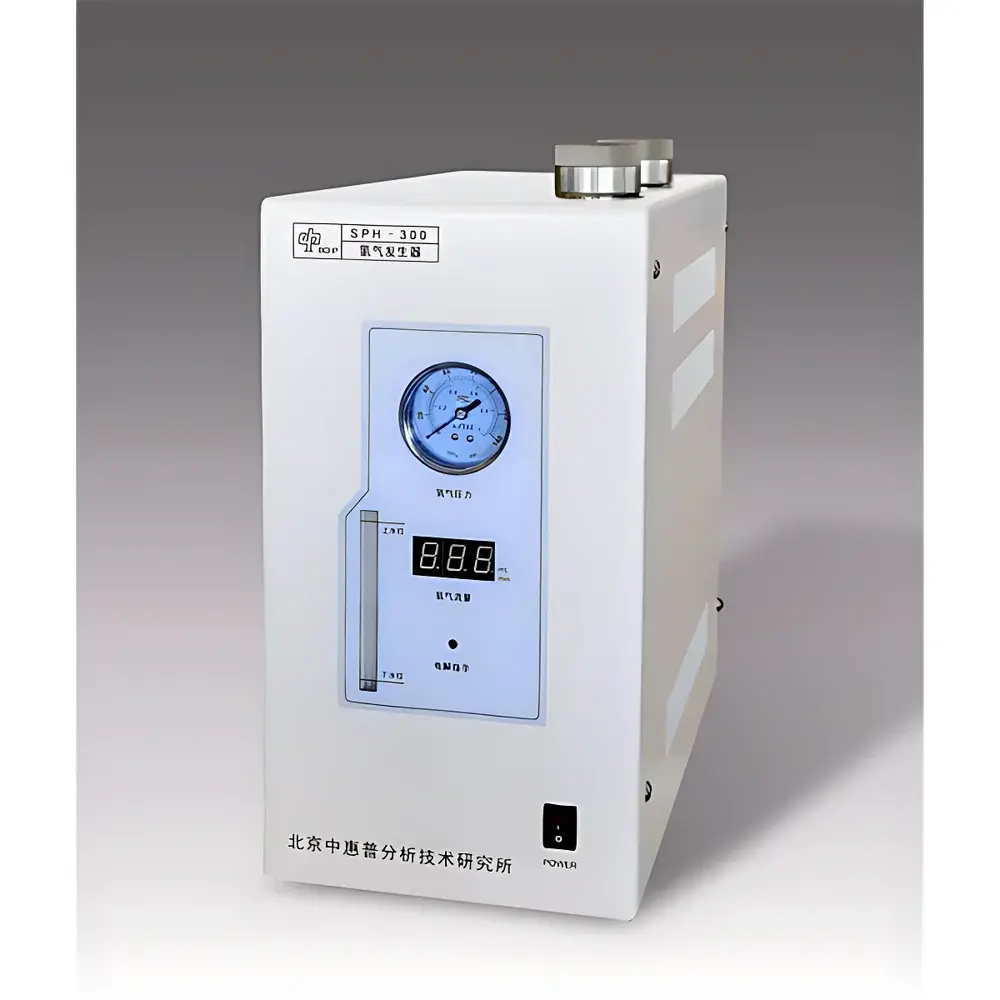
Zhonghui Pu SPH-300/500 High-Purity Hydrogen Generator
| Brand | Zhonghui Pu |
|---|---|
| Origin | Beijing, China |
| Manufacturer Type | Direct Manufacturer |
| Model | SPH-300/500 |
| Hydrogen Generation Principle | Alkaline Electrolysis |
| Output Flow Rate | 0–300 mL/min (SPH-300) / 0–500 mL/min (SPH-500) |
| Output Pressure | 0–0.4 MPa or 0–0.6 MPa (dual-range, switchable) |
| Hydrogen Purity | 99.999% |
| Pressure Stability | < 0.001 MPa |
| Power Supply | 220 V ±10%, 50 Hz |
| Power Consumption | 150 W (SPH-300) / 250 W (SPH-500) |
| Dimensions (W×D×H) | 370 × 330 × 180 mm |
| Net Weight | ~11 kg |
Overview
The Zhonghui Pu SPH-300/500 High-Purity Hydrogen Generator is an on-demand, membrane-separated alkaline electrolysis system engineered for continuous, reliable hydrogen supply in analytical laboratories. It replaces high-pressure gas cylinders by generating ultra-high-purity hydrogen (99.999%) directly from deionized water and potassium hydroxide (KOH) electrolyte—eliminating storage hazards, logistical constraints, and purity degradation associated with cylinder-based supply. The system operates on the principle of controlled electrochemical decomposition of water at nickel-coated electrodes under optimized current density and thermal management, ensuring stoichiometric H2 production with minimal oxygen crossover. Designed for integration with gas chromatography (GC), GC-MS, fuel cell testing, and hydrogenation reactors, it delivers stable flow and pressure across its two operational ranges—making it suitable for both low-flow detector fuel applications and higher-demand carrier gas configurations.
Key Features
- Auto-regulated constant-pressure and constant-flow operation: real-time feedback control maintains setpoint stability within ±0.001 MPa pressure deviation and ±1% flow accuracy across the full output range.
- Dual-range pressure selection: user-selectable 0–0.4 MPa (low-pressure mode) and 0–0.6 MPa (high-pressure mode) outputs, compatible with packed-column GC, capillary-column systems, and external hydrogen-consuming devices requiring backpressure regulation.
- Two-stage purification architecture: primary gas stream passes through dual stainless-steel sintered filters followed by a proprietary low-sulfur silicone O-ring-sealed catalytic oxygen scavenger—requiring no periodic activation or regeneration—ensuring consistent 99.999% H2 purity with total hydrocarbon content < 0.1 ppm and dew point ≤ –70 °C.
- Integrated safety subsystems: automatic alkali-backflow prevention valve, over-pressure cut-off, dry-run detection, and temperature-fused electrolyzer shutdown—all compliant with IEC 61010-1:2010 safety requirements for laboratory electrical equipment.
- Compact benchtop footprint (370 × 330 × 180 mm) and lightweight design (~11 kg) enable seamless placement inside fume hoods, GC instrument cabinets, or shared lab workstations without structural reinforcement.
Sample Compatibility & Compliance
The SPH-300/500 is compatible with all standard GC inlet types (split/splitless, PTV, on-column), flame ionization (FID), thermal conductivity (TCD), and pulsed discharge helium ionization (PDHID) detectors requiring ultra-high-purity hydrogen. Its output meets ASTM D7165-22 specifications for hydrogen used in hydrocarbon analysis and aligns with ISO 8573-1:2010 Class 1 compressed air quality equivalency for gaseous contaminants (particulates, moisture, oil). While not certified to FDA 21 CFR Part 11, the generator supports GLP/GMP workflows via manual logbook traceability; optional RS-232 interface enables external data capture for audit-ready records. All wetted materials—including electrolyte reservoir, diaphragm, and gas lines—are constructed from 316L stainless steel and fluoropolymer-compatible elastomers, ensuring long-term chemical resistance to KOH solution and preventing metal ion leaching.
Software & Data Management
The SPH-300/500 operates as a standalone hardware-controlled unit with no embedded firmware or proprietary software stack. All operational parameters—including real-time pressure, flow rate, electrolyzer temperature, and runtime hours—are displayed on a dual-line LCD interface with LED backlighting. For laboratories requiring centralized monitoring, analog 0–5 V DC outputs are provided for pressure and flow signals, enabling connection to SCADA systems, PLCs, or custom LabVIEW-based dashboards. No drivers, cloud services, or subscription-based platforms are required—ensuring full data sovereignty and eliminating vendor lock-in. Internal non-volatile memory retains last-set configuration after power cycling, supporting uninterrupted operation during scheduled maintenance windows.
Applications
- Carrier and fuel gas source for gas chromatography systems—particularly where cylinder logistics impede throughput or where baseline noise reduction is critical (e.g., trace VOC analysis, environmental monitoring).
- Hydrogen supply for portable fuel cell test benches and PEM electrolyzer characterization rigs requiring precise, low-oxygen feed gas.
- Reductive atmosphere generation in thermal desorption units, purge-and-trap concentrators, and catalytic microreactors.
- Calibration gas blending systems requiring stable, metered H2 addition into synthetic air or nitrogen matrices.
- Research-scale hydrogenation studies in organic synthesis labs where reproducible stoichiometric dosing and absence of stabilizing additives (e.g., nitrogen diluent) are essential.
FAQ
What type of water and electrolyte does the SPH-300/500 require?
Deionized water with resistivity ≥ 15 MΩ·cm and reagent-grade potassium hydroxide (KOH) pellets or 30 wt% aqueous solution. Tap water or distilled water is not acceptable due to ion-induced electrode passivation and membrane fouling.
How often must the electrolyte be replaced?
Under typical usage (8 hrs/day, 5 days/week), KOH replenishment is required every 6–8 months; full electrolyte replacement is recommended annually or after 2,000 operating hours—whichever occurs first.
Is the unit compatible with GC systems from Agilent, Thermo Fisher, and Shimadzu?
Yes—mechanical and pneumatic interfaces conform to standard 1/8″ compression fittings and CGA-350 inlet specifications. No adapter kits or third-party regulators are needed for direct integration.
Does the generator produce oxygen as a byproduct?
Yes—oxygen is generated at the anode and safely vented through a dedicated exhaust port. The unit must be operated in a well-ventilated area or connected to a lab exhaust manifold per local occupational health regulations (OSHA 1910.103, EN 14470-1).
Can output pressure be regulated externally?
No—pressure regulation is internal and fixed per selected range (0.4 or 0.6 MPa). External pressure-reducing valves are unnecessary and discouraged, as they may interfere with closed-loop control stability and void calibration integrity.



