
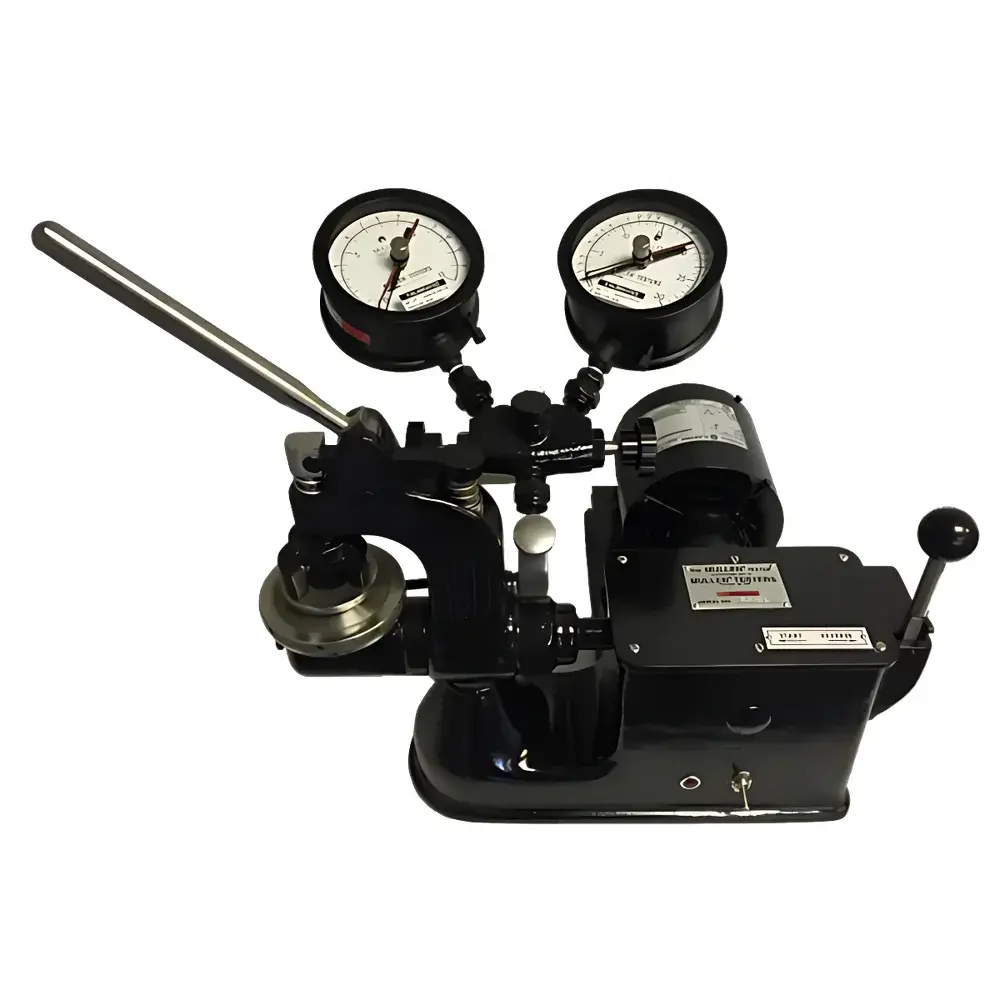
SDL Atlas Mullen Model C Bursting Strength Tester
| Brand | SDL Atlas |
|---|---|
| Origin | USA |
| Manufacturer Type | Manufacturer |
| Origin Category | Imported |
| Model | Model C |
| Pricing | Upon Request |
Overview
The SDL Atlas Mullen Model C Bursting Strength Tester is a precision-engineered mechanical instrument designed to determine the bursting strength of flexible sheet materials—including woven and nonwoven textiles, paper, paperboard, plastic films, foils, and composite packaging substrates—using the classical diaphragm-controlled hydraulic burst method. Based on the fundamental principle of applying uniformly increasing hydraulic pressure beneath a clamped circular specimen until rupture occurs, the Model C delivers repeatable, traceable, and standards-compliant results essential for quality assurance in R&D, production control, and regulatory compliance laboratories. Its robust cast-iron frame, calibrated brass diaphragm assembly, and manually actuated clamping lever ensure mechanical stability and operator consistency across test cycles. The instrument operates within a maximum rated pressure of 200 psi (1.38 MPa), with analog pressure indication via a high-accuracy Bourdon-tube gauge calibrated to NIST-traceable standards.
Key Features
- Hydraulic burst testing mechanism compliant with ASTM D3786/D3786M (Bursting Strength of Textiles – Diaphragm Method) and TAPPI T 403 (Bursting Strength of Paper and Paperboard)
- Manually operated lever clamp system enabling rapid specimen loading and secure, uniform clamping force without external power requirements
- Stainless steel test chamber and brass diaphragm assembly engineered for long-term dimensional stability and resistance to fluid degradation
- Full-scale analog pressure gauge (0–200 psi) with fine graduation (2 psi increments) and certified calibration documentation
- Fixed 1.25-inch (31.75 mm) test area aperture conforming to ISO 2758, ISO 2759, and GB/T 454 standard geometries
- Self-contained, benchtop footprint (approx. 14″ W × 12″ D × 16″ H) requiring no compressed air, vacuum, or software interface
Sample Compatibility & Compliance
The Model C accommodates flat, non-porous, and semi-porous sheet specimens up to 6.5 mm thickness, provided they exhibit sufficient tensile integrity to withstand initial diaphragm expansion without slippage or edge tearing. Compatible material classes include cotton, polyester, nylon, aramid, glass fiber, spunbonded polypropylene, medical-grade nonwovens, kraft paper, corrugated board liners, metallized PET film, and laminated barrier substrates. All test procedures align with mandatory regulatory frameworks: ASTM International standards (D3786, D774, D689), TAPPI methods (T 403, T 460), ISO specifications (ISO 2758, ISO 2759, ISO 13938-2), and relevant sections of FDA 21 CFR Part 11 where manual data recording is supplemented by controlled lab notebooks and audit trails. Instrument design supports GLP/GMP-aligned workflows through documented calibration intervals, operator training logs, and raw data retention per laboratory SOPs.
Software & Data Management
The Model C is a standalone mechanical tester with no embedded electronics or digital output capability. Data acquisition relies on direct visual reading of the analog pressure gauge at the moment of specimen rupture, recorded manually into laboratory notebooks or LIMS-compatible spreadsheets. While no proprietary software is included, SDL Atlas provides comprehensive documentation packages—including calibration certificates, operation manuals, maintenance schedules, and traceable reference material guidelines—to support integration into validated environments. For labs requiring electronic data capture, third-party USB pressure transducers (e.g., Omega PX409 series) may be mounted externally with appropriate mounting brackets and validated per IQ/OQ protocols. All calibration records comply with ISO/IEC 17025 requirements for accredited testing laboratories.
Applications
- Quality control of woven and knitted fabrics in apparel, technical textiles, and protective clothing manufacturing
- Burst resistance validation of surgical gowns, drapes, and isolation barriers per AAMI PB70 and ISO 13485
- Strength assessment of filtration media, geotextiles, and agricultural mulch films
- Comparative evaluation of coating adhesion and substrate integrity in laminated packaging structures
- Raw material qualification for paperboard used in pharmaceutical blister packaging and food cartons
- Historical benchmarking and method correlation studies against newer pneumatic or servo-hydraulic burst testers
FAQ
Does the Model C require electrical power or compressed air to operate?
No—the Model C is entirely mechanical and manually actuated. Only the hydraulic oil reservoir requires periodic replenishment; no external utilities are needed.
Is calibration certification included with shipment?
Yes—each unit ships with a NIST-traceable calibration certificate valid for 12 months from date of manufacture, covering both gauge linearity and diaphragm response.
Can the Model C test elastic or highly extensible fabrics?
It is not recommended for elastomeric materials exceeding 50% elongation at break, as uncontrolled stretching may cause premature slippage or non-central rupture; such samples are better assessed using ISO 13938-1 (ball burst method).
What maintenance is required for long-term accuracy?
Monthly inspection of hydraulic oil level and clarity, annual replacement of diaphragm seal kit (P/N MUL-DK-01), and biannual verification of gauge zero and full-scale accuracy using deadweight tester.
How does SDL Atlas support legacy Mullen users post-acquisition?
All original Mullen service parts, calibration tools, and technical bulletins remain available through SDL Atlas global distribution centers, with engineering support maintained at the Rock Hill, SC facility.
Related Products




