
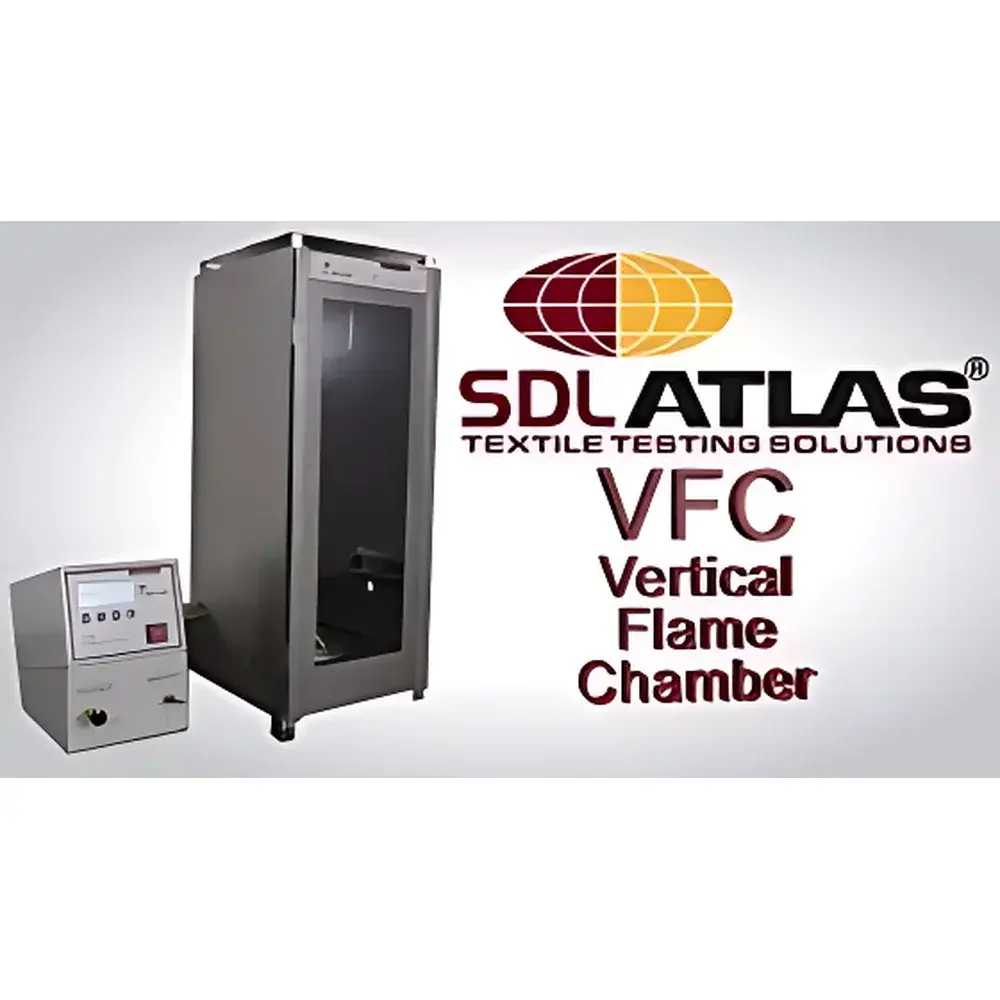
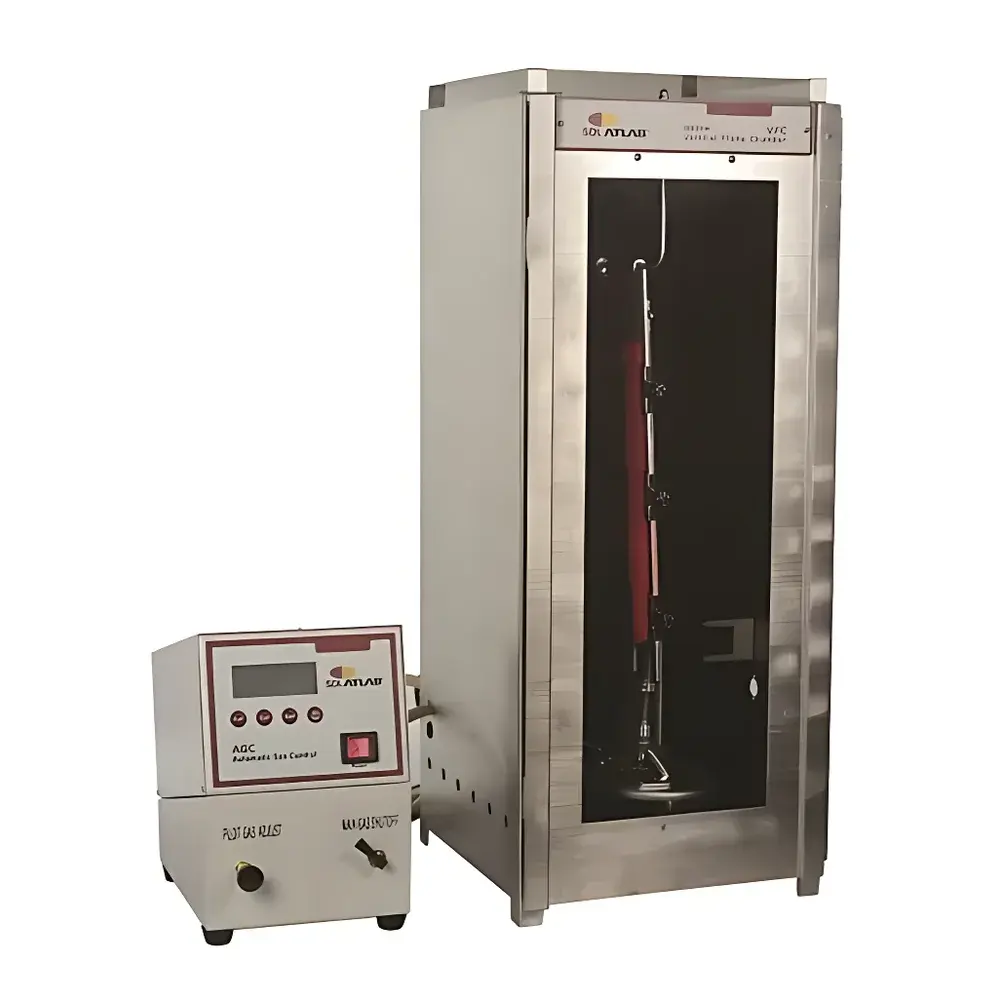
SDL Atlas M233M Vertical Flame Test Chamber
| Brand | SDL Atlas |
|---|---|
| Model | M233M |
| Test Orientation | Vertical |
| Construction | Stainless Steel Combustion Chamber with Tempered Glass Viewing Window |
| Burner Type | Standard ASTM/ISO-Compliant Bunsen Burner |
| Gas Control | Manual or Optional Electromagnetic Solenoid Valve with Auto-Ignition and Timer Control |
| Sample Holder | Interchangeable Fixtures per Standard (e.g., ASTM D6413, ISO 6941, GB/T 5455, NFPA 701) |
| Compliance | Designed for Textile and Home Furnishing Flammability Testing |
Overview
The SDL Atlas M233M Vertical Flame Test Chamber is an engineered solution for evaluating the vertical flame propagation behavior of textile materials—including children’s sleepwear, curtains, upholstery fabrics, and decorative home textiles—under standardized ignition conditions. It operates on the principle of controlled open-flame exposure in a vertically oriented specimen configuration, where flame spread rate, afterflame time, afterglow duration, and char length are quantified in accordance with internationally recognized flammability protocols. The chamber integrates a precision-machined stainless steel combustion enclosure, inert gas-compatible construction, and thermally stable viewing window to ensure operator safety and test repeatability. Its design conforms to fundamental requirements of vertical flame testing methodologies defined in ASTM D6413, ISO 6941, GB/T 5455, and NFPA 701, supporting both regulatory compliance verification and internal quality assurance workflows in textile R&D and production QA laboratories.
Key Features
- Robust 304 stainless steel combustion chamber with integrated ventilation exhaust port and flame-quenching baffle system to contain combustion byproducts and maintain consistent thermal environment.
- Tempered borosilicate glass observation window enabling real-time visual monitoring without compromising chamber integrity or operator safety.
- Standard Bunsen-type burner calibrated to deliver reproducible flame geometry and thermal flux per ASTM E136 and ISO 6941 specifications.
- Dual-mode gas control architecture: manual needle-valve regulator positioned externally for ergonomic operation, or optional electromagnetic solenoid valve with programmable ignition sequence, dwell time, and auto-shutoff logic.
- Modular sample holder assembly compatible with multiple standard fixtures—including ASTM D6413 clamp frames, ISO 6941 support rods, and GB/T 5455 vertical mounting plates—to accommodate varying specimen dimensions and conditioning requirements.
- Integrated flame timing circuitry with high-sensitivity optical sensor (optional) for automated detection of flame onset and extinction, reducing subjective interpretation and improving inter-laboratory reproducibility.
Sample Compatibility & Compliance
The M233M supports specimens up to 500 mm in height and 150 mm in width, accommodating single- or multi-layer woven, knitted, nonwoven, and laminated textile structures. Specimens must be preconditioned per relevant standards (e.g., ISO 139, ASTM D1776) prior to testing. The system is configured to meet essential safety and metrological requirements of ISO/IEC 17025-accredited laboratories, including traceable calibration documentation for burner alignment, gas flow rate (±2% accuracy), and specimen positioning tolerances. It facilitates full audit readiness for GLP-compliant reporting and supports integration into enterprise-level quality management systems aligned with ISO 9001 and IATF 16949 frameworks.
Software & Data Management
While the base M233M operates as a manually supervised instrument, the optional digital control module provides RS-232 or USB connectivity for data logging via PC-based software. This interface records ignition time, flame duration, char length measurements, and operator annotations with timestamped entries. All electronic records comply with ALCOA+ principles (Attributable, Legible, Contemporaneous, Original, Accurate, Complete, Consistent, Enduring, Available) and support 21 CFR Part 11-compliant user authentication, electronic signatures, and audit trail generation when deployed in regulated environments such as FDA-registered textile manufacturing facilities.
Applications
- Flammability screening of children’s sleepwear per CPSC 16 CFR Part 1615/1616 and ASTM F1506.
- Vertical flame resistance evaluation of drapery fabrics under NFPA 701 (small-scale method) and CAN/ULC-S109.
- Regulatory conformance testing for hotel and healthcare facility textiles mandated by local fire codes (e.g., UK Fire Safety Order 2005, German DIN 4102-1).
- Comparative research on flame-retardant finish efficacy across fiber types (cotton, polyester, modacrylic blends) and application methods (dip-pad, spray, coating).
- Pre-certification validation prior to third-party testing at accredited bodies such as UL, SGS, or TÜV Rheinland.
FAQ
What standards does the M233M support out-of-the-box?
The chamber is mechanically and dimensionally compliant with ASTM D6413, ISO 6941, GB/T 5455, and NFPA 701 Method 1. Fixture kits for each standard are available as configurable accessories.
Is gas flow calibration traceable to NIST or equivalent national metrology institutes?
Yes—calibration certificates for mass flow controllers and pressure regulators are supplied with optional digital modules, traceable to ISO/IEC 17025-accredited providers.
Can the M233M be integrated into a LIMS or ELN platform?
Via its serial/USB interface and structured ASCII output protocol, the instrument supports direct ingestion into most modern Laboratory Information Management Systems (LIMS) and Electronic Lab Notebooks (ELN) with custom driver configuration.
What maintenance intervals are recommended for long-term operational stability?
Burner tip cleaning every 20 tests, annual verification of gas line integrity and optical sensor response (if equipped), and biannual inspection of gasket sealing surfaces per manufacturer’s service manual.
Does SDL Atlas provide installation qualification (IQ) and operational qualification (OQ) documentation?
Yes—comprehensive IQ/OQ templates aligned with GxP expectations are included with the optional digital control package and may be executed onsite by certified field engineers.



