
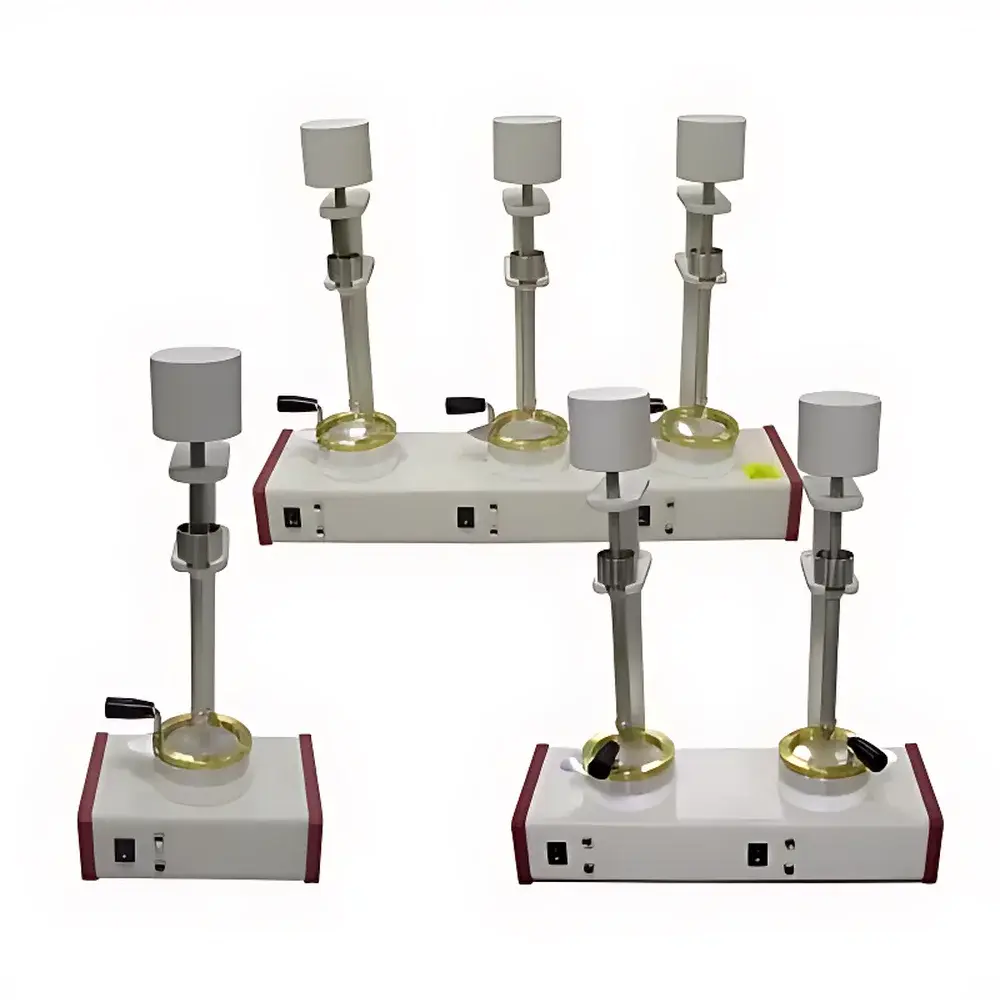
SDL Atlas F217A/B/C Rapid Grease Extraction Analyzer for Textile Fibers
| Brand | SDL Atlas |
|---|---|
| Origin | Guangdong, China |
| Manufacturer Type | Direct Manufacturer |
| Country of Origin | China |
| Model | F217A / F217B / F217C |
| Price Range | USD 7,000 – 14,000 |
| Extraction Heads | 1, 2, or 3 units configurable |
| Sample Forms | Wool, synthetic fibers, yarns, and woven/nonwoven fabrics |
| Primary Standard Compliance | EDANA ERT 155 (Acetone Extraction Method for Finishes in Nonwovens) |
| Extraction Tube Dimensions | 12 mm OD × 10 mm ID |
| Principle | Solvent-assisted permeation and controlled evaporation under regulated thermal and airflow conditions |
Overview
The SDL Atlas F217A/B/C Rapid Grease Extraction Analyzer is an engineered solution for quantitative determination of extractable lipidic and finishing agents—commonly referred to as “grease,” “oil,” or “spin finish”—in natural and synthetic textile fibers. Designed specifically for QC laboratories in spinning mills, nonwoven manufacturing facilities, and fiber R&D centers, the instrument operates on a validated solvent-permeation and low-temperature evaporation principle. Unlike traditional Soxhlet extraction, which relies on prolonged reflux cycles, the F217 series employs a gravity-driven, solvent-saturated wicking mechanism combined with precisely regulated air flow and thermal management to accelerate extraction kinetics while preserving sample integrity. This method delivers reproducible results within 60–90 minutes per sample, significantly reducing turnaround time without compromising analytical fidelity.
Key Features
- Modular extraction head configuration: Select between single-, dual-, or triple-head setups (F217A = 1 head, F217B = 2 heads, F217C = 3 heads) to match throughput requirements without over-investing in capacity.
- Dedicated acetone-compatible fluid path: All wetted components—including glass extraction tubes, PTFE gaskets, and stainless-steel manifolds—are chemically resistant to acetone, ensuring long-term reliability and minimizing cross-contamination risk.
- Standardized 12 mm OD × 10 mm ID extraction tube geometry: Ensures dimensional consistency required by EDANA ERT 155, supporting direct comparability across inter-laboratory studies and certification audits.
- Thermally stabilized evaporation chamber: Maintains uniform ambient temperature (±0.5 °C) during post-extraction drying, critical for accurate mass loss quantification of volatile finishes.
- Integrated balance interface: Compatible with METTLER TOLEDO, SARTORIUS, and other ISO/IEC 17025-compliant analytical balances via RS232 or USB, enabling automated mass recording at pre-defined intervals.
- Robust mechanical architecture: Constructed from anodized aluminum and corrosion-resistant stainless steel; designed for continuous operation in industrial lab environments with minimal maintenance.
Sample Compatibility & Compliance
The F217 series accommodates diverse textile substrates—including raw wool scoured or unscoured, polyester and nylon filament yarns, staple fiber blends, woven greige fabrics, and hydroentangled or spunbonded nonwovens. Sample preparation follows EDANA ERT 155 guidelines: specimens are conditioned at 20 ± 2 °C and 65 ± 2 % RH for ≥24 h prior to weighing. The method is explicitly validated for acetone-soluble finishes such as silicone emulsions, mineral oil derivatives, and fatty acid esters commonly applied during fiber drawing, texturing, and web bonding. Regulatory alignment extends to ISO 1833-1 (quantitative analysis of textile mixtures) and supports internal GLP documentation workflows. While not FDA-regulated, the system’s traceable mass measurements and operator-logged procedural steps meet baseline requirements for audit readiness under ISO/IEC 17025 accreditation.
Software & Data Management
The F217 analyzer operates as a standalone hardware platform with no proprietary software dependency. Data acquisition is performed externally via laboratory balance software or LIMS-integrated spreadsheets. Each extraction run requires manual entry of initial sample mass, final residue mass, and environmental conditioning data. To support compliance with 21 CFR Part 11 principles, users may implement electronic logbooks with digital signatures and version-controlled SOPs. SDL Atlas provides full technical documentation—including calibration checklists, preventive maintenance schedules, and EDANA ERT 155 implementation guides—in English, aligned with ISO/IEC 17025 clause 7.6 (traceability of measurements).
Applications
- Quantification of spin finish content in POY (partially oriented yarn) and FDY (fully drawn yarn) for process optimization in filament production lines.
- Verification of oil removal efficiency in wool scouring validation protocols.
- Batch release testing of nonwoven medical gowns and wipes where residual finish levels impact hydrophilicity or biocompatibility.
- Comparative evaluation of alternative lubricants in sustainable fiber development programs (e.g., bio-based esters vs. petrochemical oils).
- Root-cause analysis of weaving/knitting defects linked to inconsistent finish application or degradation.
FAQ
What solvent is required for F217 operation?
Acetone (ACS grade, ≥99.5 % purity) is the only validated solvent per EDANA ERT 155. Other solvents require method revalidation and are not supported under warranty.
Can the F217 be used for cotton or viscose fiber testing?
Yes—though not specified in EDANA ERT 155, the instrument’s physical extraction principle applies to any fiber type with acetone-soluble surface contaminants; users must establish in-house correlation curves and document precision metrics.
Is calibration certification included with shipment?
No certified calibration certificate is provided by default; however, SDL Atlas supplies NIST-traceable reference weights and a step-by-step verification protocol compatible with accredited metrology labs.
What maintenance is required for long-term stability?
Quarterly inspection of tube seals, annual replacement of PTFE gaskets, and biannual cleaning of the evaporation chamber with isopropanol are recommended. No routine recalibration of thermal or airflow subsystems is necessary.
Does the system support automated reporting?
The F217 does not include built-in reporting software. However, its deterministic workflow integrates seamlessly with Excel-based templates or LIMS platforms that accept CSV-formatted mass inputs and timestamped operator entries.





