
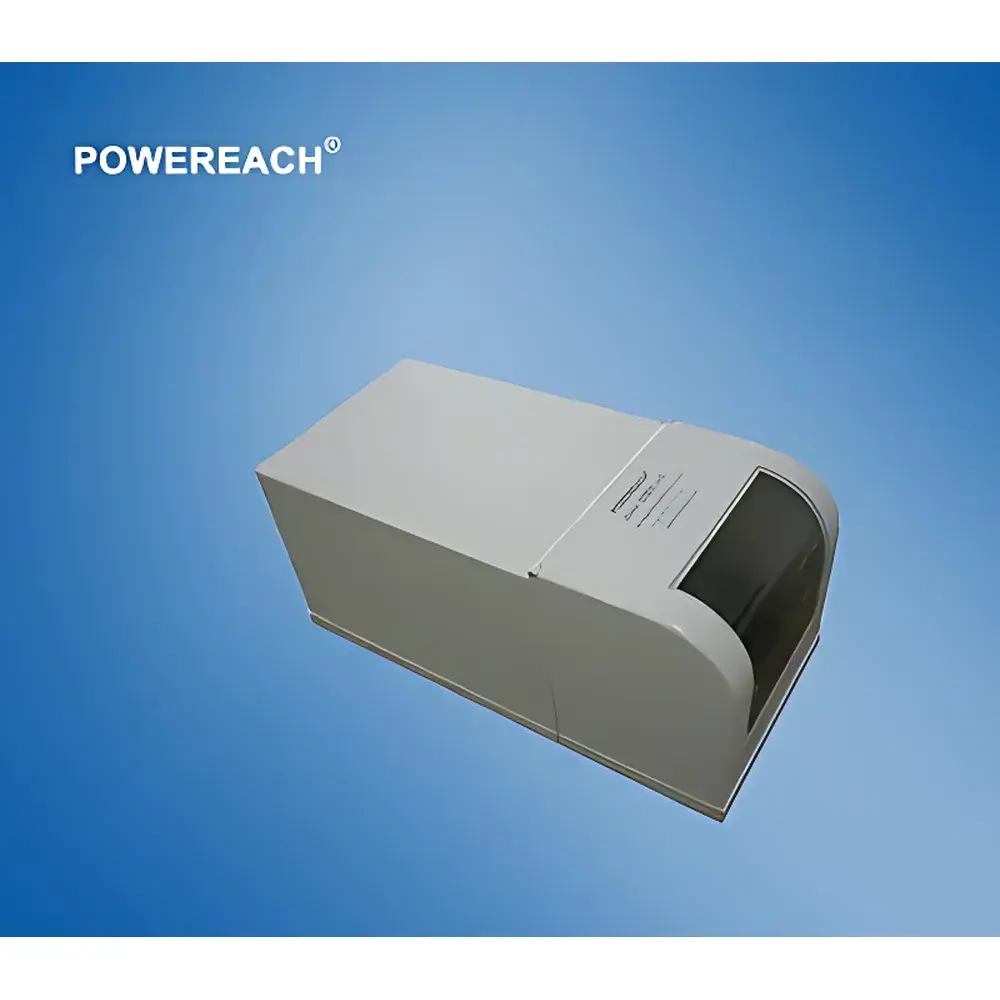
JS94HM Zeta Potential Analyzer (Microelectrophoresis Instrument)
| Origin | Shanghai, China |
|---|---|
| Manufacturer Type | Authorized Distributor |
| Origin Category | Domestic (China) |
| Model | JS94HM |
| Price Range | USD 7,000–14,000 |
| Zeta Potential Range | ±3000 mV |
| pH Range | 2.0–12.0 (extended operation up to 1.6–13.0) |
| Operating Temperature | 5–35 °C |
| pH Resolution | 0.1 |
| Temperature Resolution | 0.1 °C |
| Accuracy | ≤5% (system error) |
| Repeatability | ≤5% |
| Particle Size Applicability | 0.5–20 µm (aqueous dispersions) |
| Sample Volume per Measurement | 0.5 mL |
| Optical System | Semiconductor-based near-field illumination (blue/green wavelength), 1200× magnification |
| Voltage Control | Adjustable DC/low-frequency AC, polarity reversal time: 0.30–1.20 s (continuously tunable) |
| Data Acquisition | Dual-directional grayscale image capture, real-time thermal compensation via integrated Pt100 probe |
Overview
The JS94HM Zeta Potential Analyzer is a precision microelectrophoresis instrument engineered for direct measurement of electrophoretic mobility and subsequent calculation of zeta potential (ζ) at solid–liquid or liquid–liquid interfaces. It operates on the principle of laser-assisted video microscopy combined with controlled electrophoretic migration under precisely regulated electric fields. Unlike conventional capillary electrophoresis or electroacoustic methods, the JS94HM employs an open-cell, cup-type electrophoresis chamber with integrated electrodes—designed using validated microfluidic field modeling—to minimize edge effects, eliminate stagnant layer artifacts, and ensure high-fidelity particle trajectory tracking. This architecture enables robust ζ-potential determination across colloidal dispersions, emulsions, and suspensions within the 0.5–20 µm size range in aqueous media. The system supports full thermodynamic control (5–35 °C, ±0.1 °C resolution) and pH monitoring (2.0–12.0, ±0.1 resolution), making it suitable for mechanistic studies of interfacial charge regulation, isoelectric point (IEP) mapping, and surface modification kinetics.
Key Features
- Patented open-cup electrophoresis cell fabricated from 0.5 mm precision-ground optical glass, with embedded Ag/AgCl, Pt, and Ti alloy electrodes—surface-treated for long-term electrochemical stability and minimal polarization.
- Near-field semiconductor optical illumination (blue/green spectrum, <100 µW output) eliminates thermal convection artifacts while enhancing contrast for sub-micron particle visualization at 1200× effective magnification.
- Computer-controlled bidirectional image acquisition: four synchronized grayscale frames captured per measurement cycle, enabling robust vector-based mobility computation with automatic drift correction.
- Adjustable low-frequency voltage inversion (0.30–1.20 s period) suppresses electrode polarization and improves signal-to-noise ratio without compromising measurement speed—typical analysis duration: 3–10 seconds per sample.
- Integrated Pt100 temperature sensor provides continuous environmental feedback; real-time thermal compensation is applied during ζ-potential calculation per the Henry equation and Smoluchowski approximation.
- Minimal sample consumption: only 0.5 mL required per test; rapid cell rinsing and reconfiguration support high-throughput screening protocols.
Sample Compatibility & Compliance
The JS94HM is validated for use with aqueous colloidal systems including metal oxides (e.g., SiO₂, TiO₂, Al₂O₃), polymeric nanoparticles, liposomes, protein aggregates, and oil-in-water emulsions. It complies with foundational methodology standards referenced in ISO 13099-2:2012 (Colloidal systems — Methods for determining zeta-potential — Part 2: Optical methods) and aligns with ASTM D7825–14 guidelines for electrophoretic mobility characterization. While not pre-certified for GMP or FDA 21 CFR Part 11 environments, its data acquisition architecture supports audit-trail-ready operation when deployed with compliant laboratory information management systems (LIMS). All pH and temperature sensors meet IEC 60751 Class B tolerance specifications.
Software & Data Management
The instrument is operated via Windows-compatible software featuring automated calibration routines, batch processing workflows, and export-capable data tables (CSV, Excel, PDF). Raw image sequences, mobility vectors, and derived ζ-values are timestamped and stored with full metadata—including ambient temperature, pH, applied field strength, and inversion timing. Software includes built-in IEP calculation tools, mobility vs. pH trend fitting (with optional Savitzky–Golay smoothing), and comparative overlay functions for multi-sample analysis. Exported datasets retain traceability to measurement conditions, supporting GLP-aligned documentation requirements.
Applications
- Formulation science: Stabilizer selection and dosage optimization in pharmaceutical colloids, cosmetic emulsions, and agrochemical suspensions.
- Materials engineering: Surface charge profiling of nanocellulose, quantum dots, and MOF particles during functionalization reactions.
- Environmental analytics: Assessing clay–contaminant interaction mechanisms and coagulant efficiency in wastewater treatment slurry systems.
- Academic research: Teaching core principles of colloid chemistry, interfacial electrokinetics, and DLVO theory in undergraduate and graduate laboratories.
- Quality control: In-process verification of nanoparticle surface charge consistency in ISO 13485-regulated medical device manufacturing.
FAQ
What particle size range is supported by the JS94HM?
The instrument is optimized for particles between 0.5 µm and 20 µm in aqueous dispersion. Sub-micron resolution is enabled by high-contrast optical imaging, though accurate mobility quantification below 0.5 µm requires validation against reference standards.
Can the JS94HM measure zeta potential in non-aqueous media?
No—it is calibrated and validated exclusively for aqueous systems. Non-aqueous solvents introduce dielectric and conductivity mismatches that invalidate standard mobility-to-ζ conversion models.
Is the system compatible with Good Laboratory Practice (GLP) documentation requirements?
Yes—the software logs all critical parameters with timestamps and user IDs; raw images and processed results can be archived with checksum integrity verification, fulfilling core GLP data retention criteria.
Does the instrument require external pH or temperature controllers?
No—integrated high-resolution pH and Pt100 temperature probes provide closed-loop environmental monitoring; however, optimal reproducibility demands use on a vibration-isolated bench within a temperature-stabilized room (±1 °C).
How is electrode polarization mitigated during measurement?
Through programmable low-frequency field reversal (0.30–1.20 s period) and use of inert, surface-passivated noble-metal electrodes—reducing Faradaic side reactions and maintaining stable field distribution across repeated cycles.



