
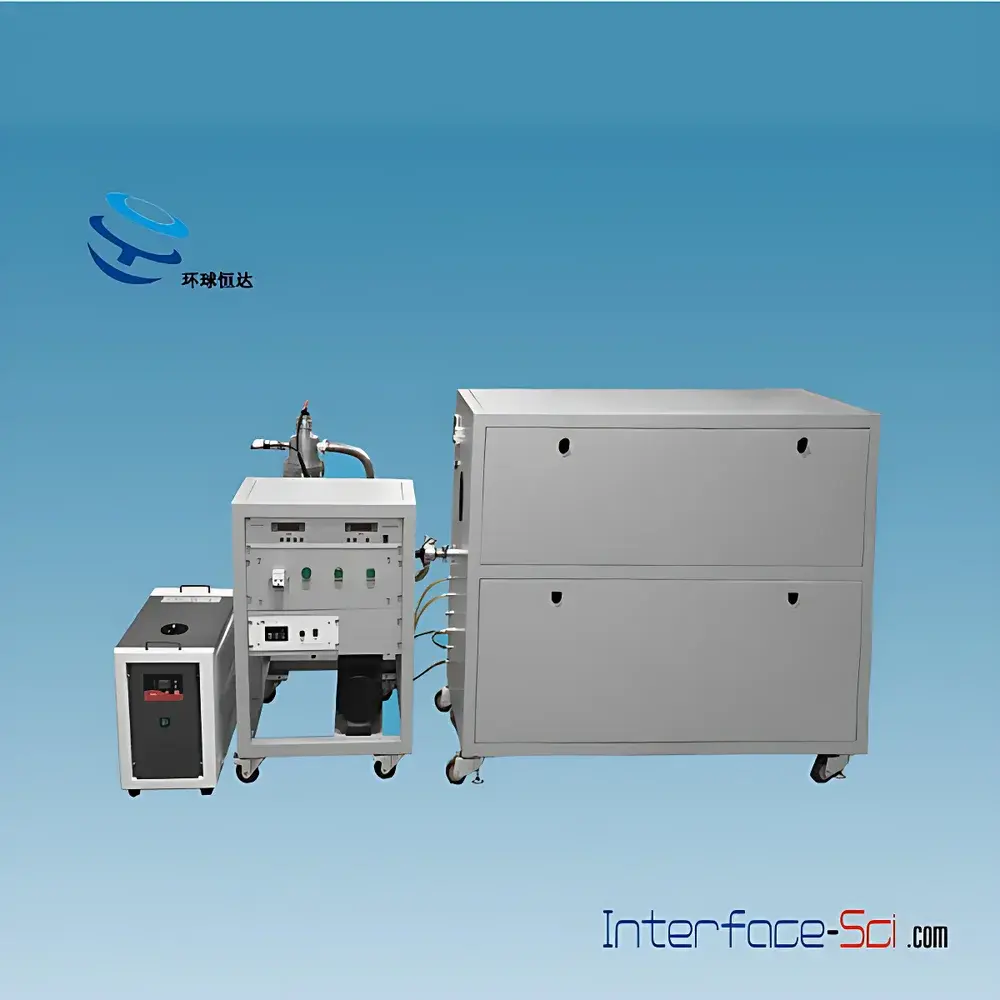
SCI-1700 High-Temperature Vacuum Contact Angle Measurement System
| Origin | Beijing, China |
|---|---|
| Manufacturer Type | Authorized Distributor |
| Origin Category | Domestic (PRC) |
| Model | SCI-1700 |
| Price Range | USD 14,000 – 28,500 |
| Instrument Class | High-Temperature Vacuum Contact Angle Analyzer |
| Form Factor | Benchtop Laboratory System |
| Contact Angle Range | 0–180° |
| Contact Angle Accuracy | ±1° (θ/2 method), ±0.1° (automated circle fitting) |
| Sample Stage Dimensions | 100 × 100 mm |
| Image Magnification | 55–320 pixels/mm |
| Surface/Interfacial Tension Range | 0.01–1000 mN/m |
| Surface/Interfacial Tension Accuracy | ±0.01 mN/m |
| Maximum Operating Temperature | 1600 °C (in inert atmosphere) |
| Vacuum Limit | ≤5×10⁻⁵ Pa (with turbo-molecular + backing pump configuration) |
| Heating Control | 40-segment programmable PID via B-type thermocouples (Pt/Rh) |
| Temperature Resolution | ±0.1 °C (<1000 °C), ±1 °C (≥1000 °C) |
| Cooling System | Closed-loop water chiller (5–35 °C, 10–20 L/min flow, 1.0–1.3 bar pressure, 1200 W cooling capacity) |
| Optical System | 300-mm working distance telecentric lens, 0.7–4.5× continuous zoom, industrial-grade low-light color CCD (1.3 MP) |
| Software Capabilities | Multi-method contact angle calculation (θ/2, tangent, circle/ellipse/curve fitting), time- and temperature-triggered image capture (min. interval: 0.1 s), left/right asymmetry analysis, automated averaging, GLP-compliant data logging with timestamped image–value pairing and Excel export |
Overview
The SCI-1700 High-Temperature Vacuum Contact Angle Measurement System is an engineered benchtop platform for quantitative interfacial characterization under extreme thermal and atmospheric conditions. It operates on the principle of video-based optical tensiometry—capturing high-resolution silhouette images of liquid droplets on solid substrates at elevated temperatures, then applying geometric algorithms to determine contact angles and derive surface/interfacial tension values via the Young–Laplace equation. Unlike ambient-condition systems, the SCI-1700 integrates a dual-mode high-vacuum and inert-gas-compatible furnace (rated to 1600 °C in Ar/N₂; 800 °C under ≤5×10⁻⁵ Pa vacuum), enabling direct observation of dynamic wetting behavior of molten metals, slags, and reactive ceramics during heating, holding, and cooling cycles. Its modular architecture supports real-time correlation between thermal history and interfacial evolution—critical for process development in metallurgy, ceramic sintering, active brazing, and high-temperature composite fabrication.
Key Features
- Integrated high-stability furnace with 40-segment programmable PID control, B-type Pt/Rh thermocouples, and ±0.1 °C resolution below 1000 °C—ensuring reproducible thermal profiles across repeated experiments.
- Dual-pump vacuum system comprising a turbo-molecular pump (base pressure ≤5×10⁻⁵ Pa) and oil-free backing pump, fully compatible with O₂-sensitive or reducing atmospheres when paired with gas dosing modules.
- Optimized optical train: 300-mm working distance telecentric lens with 0.7–4.5× continuous zoom, coupled to a 1.3 MP industrial color CCD optimized for low-light contrast at red-hot substrate temperatures.
- Automated imaging protocols: temperature-triggered capture (e.g., one frame per 5 °C increment) and time-triggered acquisition (minimum 0.1 s intervals), enabling synchronized kinetic analysis of spreading, retraction, or dewetting phenomena.
- Multi-algorithm contact angle engine supporting θ/2, tangent, circle, ellipse, and spline-based fitting—each validated against NIST-traceable reference standards—and capable of independent left/right angle computation to assess surface heterogeneity or anisotropic wetting.
- Water-cooled enclosure with closed-loop chiller (1200 W capacity, 5–35 °C setpoint range) maintaining thermal stability of optics and electronics during prolonged high-temperature operation.
Sample Compatibility & Compliance
The SCI-1700 accommodates flat, polished, or textured solid substrates up to 100 × 100 mm in dimension and ≤20 mm thickness—including refractory metals (Mo, W, Ta), oxide ceramics (Al₂O₃, ZrO₂), carbides (SiC, WC), and graphite-based composites. Molten test phases include Sn-Pb, Al-Si, Cu-Zn alloys, molten salts (e.g., LiF–CaF₂), and oxide melts (e.g., CaO–SiO₂ slags). The system conforms to ASTM C1409 (standard test method for wettability of refractory materials), ISO 19403-2 (contact angle measurement by optical methods), and supports audit-ready documentation required under GLP and GMP environments. All temperature, vacuum, and image metadata are time-stamped and cryptographically linked to raw images and calculated results—fully compliant with FDA 21 CFR Part 11 requirements for electronic records and signatures when deployed with validated software configuration.
Software & Data Management
The proprietary analysis suite provides full traceability from raw pixel data to final report. Each experiment generates a self-contained project file containing calibrated thermal logs, vacuum pressure traces, synchronized image sequences, and parameterized fitting results. Contact angle values are computed with uncertainty propagation based on pixel resolution (55–320 px/mm), droplet edge detection SNR, and user-selected baseline definition. Export options include CSV and Excel formats with column headers aligned to ISO/IEC 17025 reporting conventions. Batch processing allows statistical comparison across multiple samples or temperature points, while database indexing enables rapid retrieval by material ID, date, operator, or experimental condition. Software validation documentation—including IQ/OQ protocols and algorithm verification reports—is available upon request for regulated laboratory deployment.
Applications
- Wettability quantification of molten aluminum alloys on SiC-reinforced aluminum matrix composites during liquid-phase sintering.
- Dynamic contact angle evolution of Ag-Cu-Ti active braze alloys on monolithic AlN substrates under ultra-high vacuum—correlating interfacial reaction kinetics with joint strength.
- Surface energy estimation of yttria-stabilized zirconia (YSZ) electrolytes via Owens–Wendt analysis using diiodomethane/water droplets at 1000 °C in controlled pO₂.
- Spreading coefficient modeling for slag–metal systems in electric arc furnace steelmaking, using sessile drop measurements under CO/CO₂ atmospheres.
- Thermal hysteresis analysis of contact angle during heating/cooling cycles of TiAl alloys on graphite dies—informing hot-pressing mold release strategies.
FAQ
What is the maximum allowable operating temperature under high vacuum?
The furnace is rated for continuous operation up to 800 °C when evacuated to ≤5×10⁻⁵ Pa. Above this temperature, radiative heat loss and outgassing risks necessitate inert gas backfilling (e.g., Ar or N₂) to maintain thermal stability and optical clarity.
Can the system measure advancing and receding contact angles dynamically?
Yes—via sequential dispensing and retraction of micro-droplets using optional syringe pump integration, combined with time-triggered imaging at configurable intervals down to 0.1 seconds.
Is the software compliant with 21 CFR Part 11 for pharmaceutical or medical device R&D?
When installed with role-based access controls, electronic signature workflows, and audit trail activation enabled, the software meets core technical requirements of 21 CFR Part 11. Full validation support packages—including URS, FRS, and test scripts—are available for GxP-regulated users.
How is temperature uniformity verified within the furnace zone?
A three-point thermocouple mapping protocol (center + ±15 mm axial positions) is performed during factory calibration and recommended annually. Uniformity across the central 20 mm zone is maintained within ±3 °C at 1400 °C.
What maintenance is required for the vacuum system?
The mechanical backing pump requires oil replacement every 2000 hours; the turbo-molecular pump undergoes bearing inspection every 15,000 hours. A full vacuum integrity check (including leak rate verification via helium mass spectrometry) is advised semiannually.



