
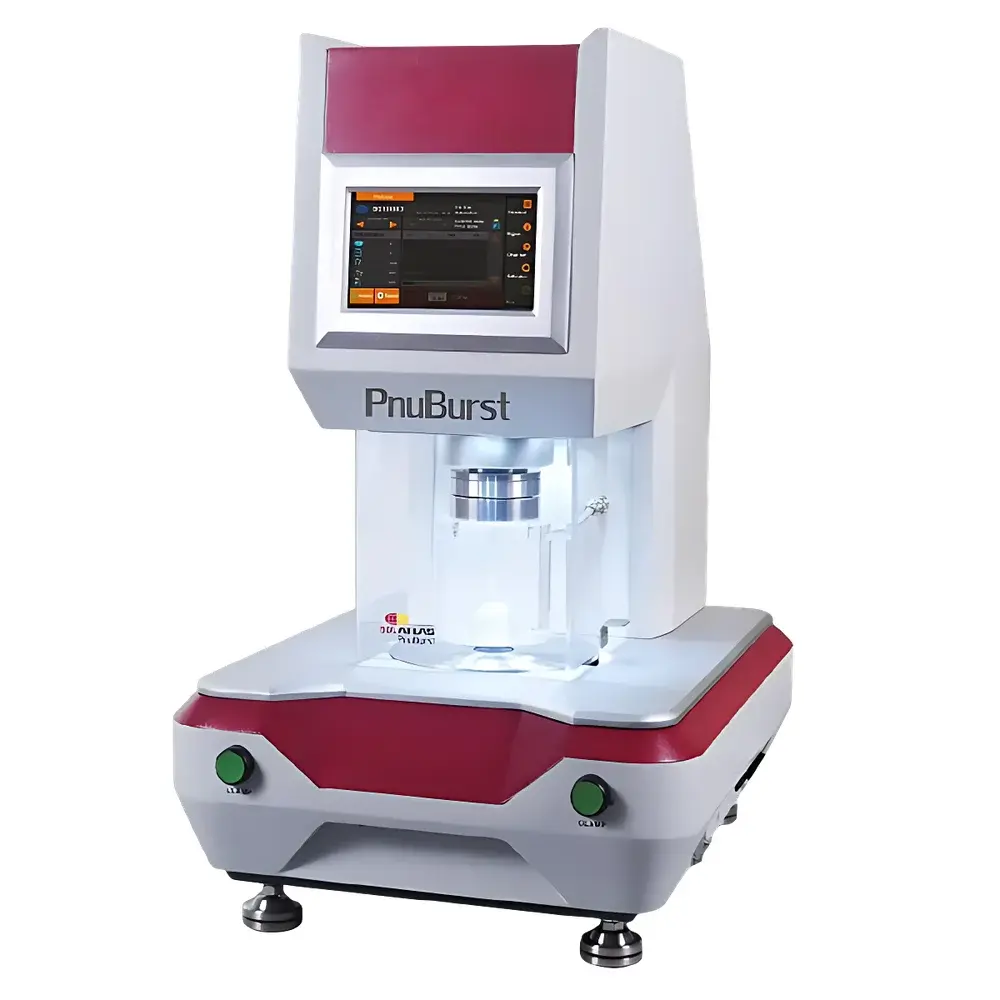
SDLATLAS M229P PnuBurst Pneumatic Burst Strength Tester
| Brand | SDLATLAS |
|---|---|
| Origin | Shenzhen, China |
| Manufacturer Type | Direct Manufacturer |
| Regional Category | Domestic (China) |
| Model | M229P |
| Price Range | USD 14,000 – 42,500 (FOB Shenzhen) |
| Maximum Burst Pressure | 1500 kPa (200 psi) |
| Sample Clamping Pressure | Adjustable per ISO 13938-1, ASTM D3786/D3787, BS EN ISO 13938, GB/T 7742.1 |
| Diaphragm Correction | Automatic pressure offset compensation |
| Displacement Measurement | Laser-based non-contact height sensing (resolution ≤ 0.01 mm) |
| Test Cup Sizes | Seven standardized diameters (e.g., 30.5 mm, 38.1 mm, 44.5 mm, 50.8 mm, 75 mm, 113 mm, 195 mm) |
| Cup & Ring Recognition | Auto-detection via embedded RFID or mechanical encoding |
| Software Compliance | Pre-loaded with M&S SFS 2017, ISO 13938-1/-2, ASTM D3786, ASTM D3787, BS EN ISO 13938, GB/T 7742.1, JIS L 1018, AATCC 135 |
| Language Support | English, Simplified Chinese, Spanish, Turkish |
| ElastiTest Module | Enables multi-cycle 3D biaxial extension analysis including expansion height/pressure setpoints, ramp rate, hold time, release rate, recovery time, and cycle count |
| Data Output | Burst strength (kPa), burst height (mm), time-to-burst (s), elastic recovery (%), energy absorption (J), and full force–displacement curves |
Overview
The SDLATLAS M229P PnuBurst Pneumatic Burst Strength Tester is an ISO/ASTM-compliant instrument engineered for precise, repeatable biaxial tensile evaluation of woven, knitted, nonwoven, and laminated textile fabrics. It operates on the pneumatic diaphragm bulge principle: a circular fabric specimen is clamped over a rigid test cup and subjected to controlled, incremental air pressure until rupture occurs. Unlike hydraulic or mechanical bursting systems, this design eliminates fluid contamination risk, ensures uniform stress distribution across the sample surface, and delivers high reproducibility under variable environmental conditions. The system meets the core physical measurement requirements of ISO 13938-1 (fabric bursting strength), ISO 13938-2 (bursting energy), ASTM D3786 (ball burst), and ASTM D3787 (biaxial stretch), while also supporting proprietary protocols such as Marks & Spencer’s SFS 2017 specification for garment durability validation.
Key Features
- Full-range pneumatic actuation with maximum regulated pressure up to 1500 kPa (200 psi), enabling testing of high-performance technical textiles including ballistic fabrics, geotextiles, and coated composites.
- Motorized, programmable clamping system with real-time pressure feedback—adjustable from 10 to 200 kPa to satisfy standard-specific clamping force requirements (e.g., 43.8 kPa ± 1 kPa per ISO 13938-1).
- Integrated laser displacement sensor providing non-contact, sub-0.01 mm resolution measurement of dome height during pressurization—critical for calculating bursting energy (J) and evaluating elastic-plastic transition behavior.
- Automated diaphragm correction algorithm that subtracts baseline membrane-only burst pressure prior to sample testing, ensuring net fabric-specific strength values per ISO 13938-1 Annex B.
- Seven interchangeable test cups (30.5 mm to 195 mm diameter) with auto-identification capability—prevents mismatch between cup size and clamping ring geometry, eliminating operator-induced misalignment errors.
- 10.1-inch full-color capacitive touchscreen controller with intuitive icon-driven navigation, offline operation capability, and onboard data storage for ≥10,000 test records.
Sample Compatibility & Compliance
The M229P accommodates flat, flexible textile specimens ranging from lightweight voiles (1000 g/m²). Its modular cup system supports all major international test geometries, including ASTM D3786 (1.25 in / 31.75 mm ball), ISO 13938-1 (30.5 mm cup), and GB/T 7742.1 (113 mm cup). All firmware and calibration routines are traceable to NIST-traceable pressure standards and certified by CNAS-accredited laboratories. The instrument complies with IEC 61000-6-2/6-3 (EMC), CE marking requirements, and incorporates hardware-level safeguards against over-pressurization and thermal runaway. For regulated environments, audit trail functionality—including user login logs, method version history, parameter change timestamps, and electronic signature support—is available upon request to meet GLP/GMP documentation expectations.
Software & Data Management
The embedded PnuBurst Control Suite provides full method configuration, real-time graphing (pressure vs. time, height vs. time), and automated report generation in PDF/CSV formats. Pre-installed test methods include ISO 13938-1, ASTM D3786, ASTM D3787, BS EN ISO 13938, JIS L 1018, AATCC 135, and Marks & Spencer SFS 2017. The optional ElastiTest software module extends functionality to dynamic cyclic loading: users define custom profiles specifying expansion setpoint (height or pressure), ramp rate (kPa/s or mm/s), dwell duration (0.1–999 s), decompression slope, recovery monitoring window, and up to 999 cycles. Raw datasets include synchronized pressure, displacement, and time stamps at ≥100 Hz sampling rate—enabling post-hoc derivation of modulus, hysteresis area, and permanent set metrics.
Applications
This instrument serves quality assurance laboratories in apparel manufacturing, automotive interior suppliers, medical textile producers (e.g., surgical drapes, implantable meshes), filtration media developers, and academic research groups studying fiber-matrix interactions under multiaxial strain. Typical use cases include validating seam integrity in performance sportswear, assessing delamination resistance in laminated PPE, quantifying fatigue life of elastic waistbands, benchmarking biodegradable nonwovens for hygiene products, and supporting R&D for smart textiles with integrated sensors or phase-change materials. Its ability to capture both peak burst parameters and full deformation trajectories makes it suitable for correlating mechanical performance with structural imaging (e.g., SEM, micro-CT) or rheological modeling.
FAQ
Does the M229P support FDA 21 CFR Part 11 compliance?
Yes—when configured with optional validated software and networked authentication modules, the system supports electronic signatures, role-based access control, and immutable audit trails required for regulated pharmaceutical or medical device textile testing.
Can test cups be calibrated independently?
Each test cup carries a unique identification code linked to its certified dimensional tolerance (±0.02 mm) and pressure-area coefficient; calibration certificates are supplied with every cup set.
Is third-party verification of burst pressure accuracy available?
SDLATLAS provides factory calibration against primary deadweight testers with uncertainty ≤0.15% FS; accredited third-party recalibration services are available globally through ISO/IEC 17025-certified partners.
What maintenance intervals are recommended?
Daily visual inspection of seals and cups; quarterly verification of pressure transducer linearity and laser alignment; annual full-system metrological recalibration recommended.
How does the system handle low-modulus elastomeric fabrics?
The ElastiTest module applies adaptive pressure ramping algorithms that dynamically adjust flow rate based on real-time fabric stiffness feedback—preventing premature rupture and enabling stable measurement of elongation >300%.
Related Products






