
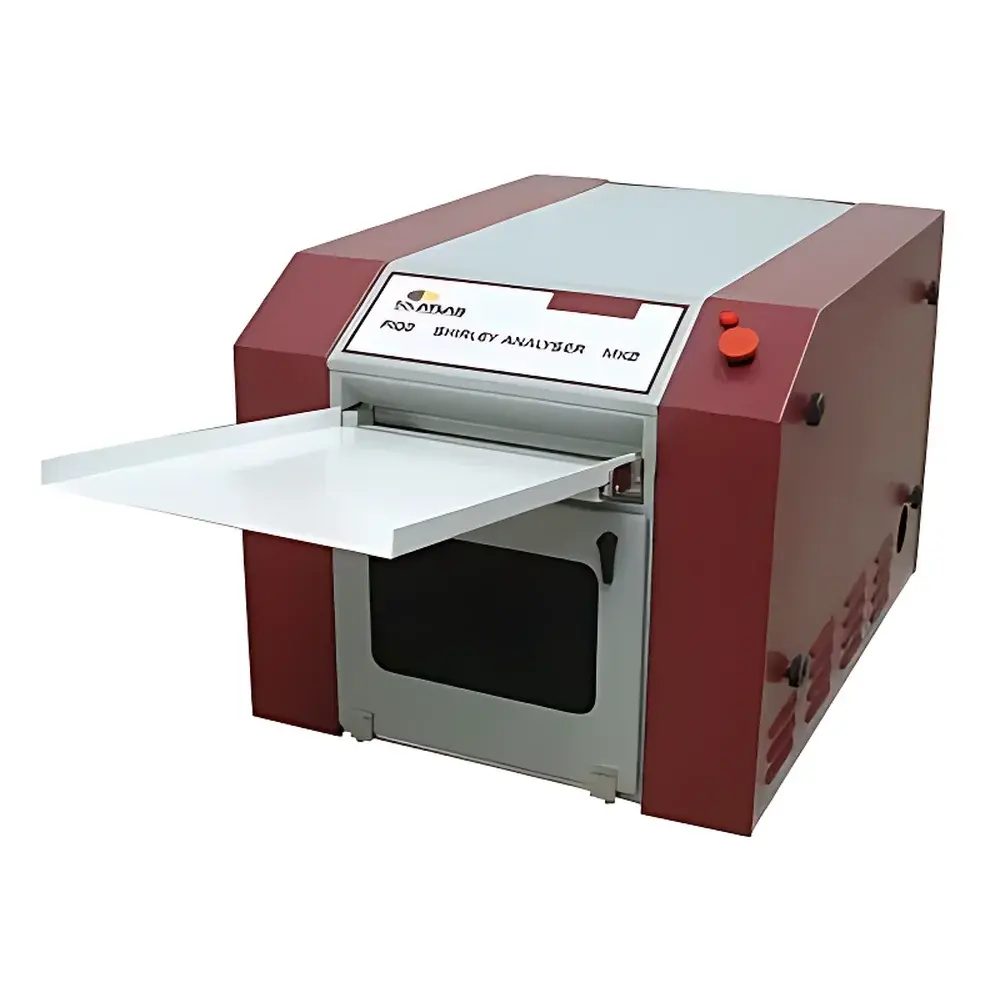
SDLATLAS F102/A MK2 Lint and Foreign Matter Analyzer
| Brand | SDLATLAS |
|---|---|
| Origin | Guangdong, China |
| Manufacturer Type | Direct Manufacturer |
| Country of Origin | China |
| Model | F102/A |
| Price Range | USD 14,000 – 70,000 |
Overview
The SDLATLAS F102/A MK2 Lint and Foreign Matter Analyzer is an industry-engineered instrument designed specifically for quantitative assessment of non-fibrous contaminants in raw and processed textile fibers. It operates on the principle of controlled pneumatic separation—utilizing calibrated airflow dynamics to differentially suspend and transport lint, dust, seed coat fragments, motes, and other extraneous particulates away from the fiber matrix. This physical separation method avoids chemical dissolution or thermal degradation, preserving fiber integrity while delivering repeatable, gravimetrically traceable results. The MK2 platform is available in two configuration variants: the Cotton-Grade MK2 (optimized for ginned cotton, carded sliver, and combed tops) and the Wool-Grade MK2 (configured for greasy wool, scoured wool, top, noil, and specialty animal fibers including cashmere and mohair). Both variants comply with foundational principles outlined in ISO 137:2015 (determination of fiber length and impurities), ASTM D1440–22 (standard test method for foreign matter in raw wool), and GB/T 6502–2015 (Chinese national standard for determination of foreign matter in raw cotton).
Key Features
- Modular dual-mode operation: switch between Cotton-Grade and Wool-Grade analytical protocols via software-selectable airflow profiles and sample chamber geometry adjustments
- High-reproducibility pneumatic separation system with digitally regulated blower assembly (±0.5% airflow stability over 8-hour continuous operation)
- Integrated precision balance interface supporting ASTM E4-compliant calibration; compatible with external analytical balances (0.0001 g resolution)
- Sample capacity up to 100 g per run—optimized for statistical representativeness in heterogeneous fiber lots
- Non-destructive analysis: fibers remain intact post-separation for downstream testing (e.g., fineness, strength, dye affinity)
- Robust stainless-steel construction with IP54-rated enclosure for laboratory and QC floor environments
- Compliance-ready audit trail: time-stamped event logging, user authentication, and parameter change history aligned with GLP documentation requirements
Sample Compatibility & Compliance
The MK2 accommodates a broad spectrum of natural and synthetic fiber forms—including raw cotton bales, scoured wool fleeces, worsted top, polyester filament tow, and blended yarn precursors. For specialty fibers such as cashmere, alpaca, and angora, the Wool-Grade configuration enables accurate estimation of dehairing efficiency (i.e., “yield rate” or “processing recovery”) by quantifying residual guard hair and skin debris. All test procedures are structured to support traceability under ISO/IEC 17025:2017 accreditation frameworks. Instrument validation documentation includes installation qualification (IQ), operational qualification (OQ), and performance qualification (PQ) templates aligned with textile mill QA workflows.
Software & Data Management
The MK2 is operated via Windows-based control software with multilingual UI (English, Spanish, Chinese). The application supports batch-level data aggregation, customizable report generation (PDF/CSV), and direct export to LIMS platforms via ODBC connectivity. Audit trail functionality records operator ID, date/time stamps, method version, environmental conditions (ambient temperature/humidity), and final mass values—meeting FDA 21 CFR Part 11 electronic record requirements when paired with validated digital signature modules. Raw separation images (optional camera module) and airflow pressure curves are archived alongside gravimetric outputs for root-cause analysis during process deviation investigations.
Applications
- Quantification of mote content in U.S. Pima and upland cotton per USDA AMS Classing Office specifications
- Determination of vegetable matter (VM) and burr content in Australian Merino wool prior to combing
- Validation of mechanical dehairing efficiency in cashmere processing lines
- Pre-test cleaning verification for AFIS and HVI fiber testing systems
- QC release testing of recycled PET fiber feedstock for non-polymeric contaminants
- Supporting R&D studies on ginning optimization, scouring efficacy, and blending homogeneity
FAQ
What standards does the MK2 comply with for cotton impurity testing?
The Cotton-Grade MK2 aligns with ISO 137:2015, ASTM D1440–22, and GB/T 6502–2015 for gravimetric foreign matter determination.
Can the same unit analyze both cotton and wool samples without hardware modification?
Yes—the MK2 features field-reconfigurable airflow nozzles, sample trays, and software-defined test sequences to accommodate both material classes.
Is the instrument suitable for GLP-regulated laboratories?
Yes—full audit trail, user access controls, and electronic signature readiness enable compliance with OECD GLP Principles and ISO/IEC 17025 documentation requirements.
Does the MK2 require compressed air or external vacuum sources?
No—it incorporates a self-contained, brushless DC blower system with integrated thermal management and pressure regulation.
How is calibration verified during routine use?
Daily verification uses NIST-traceable reference masses; annual full calibration follows SDLATLAS-certified service protocol with documented uncertainty budgets.




