
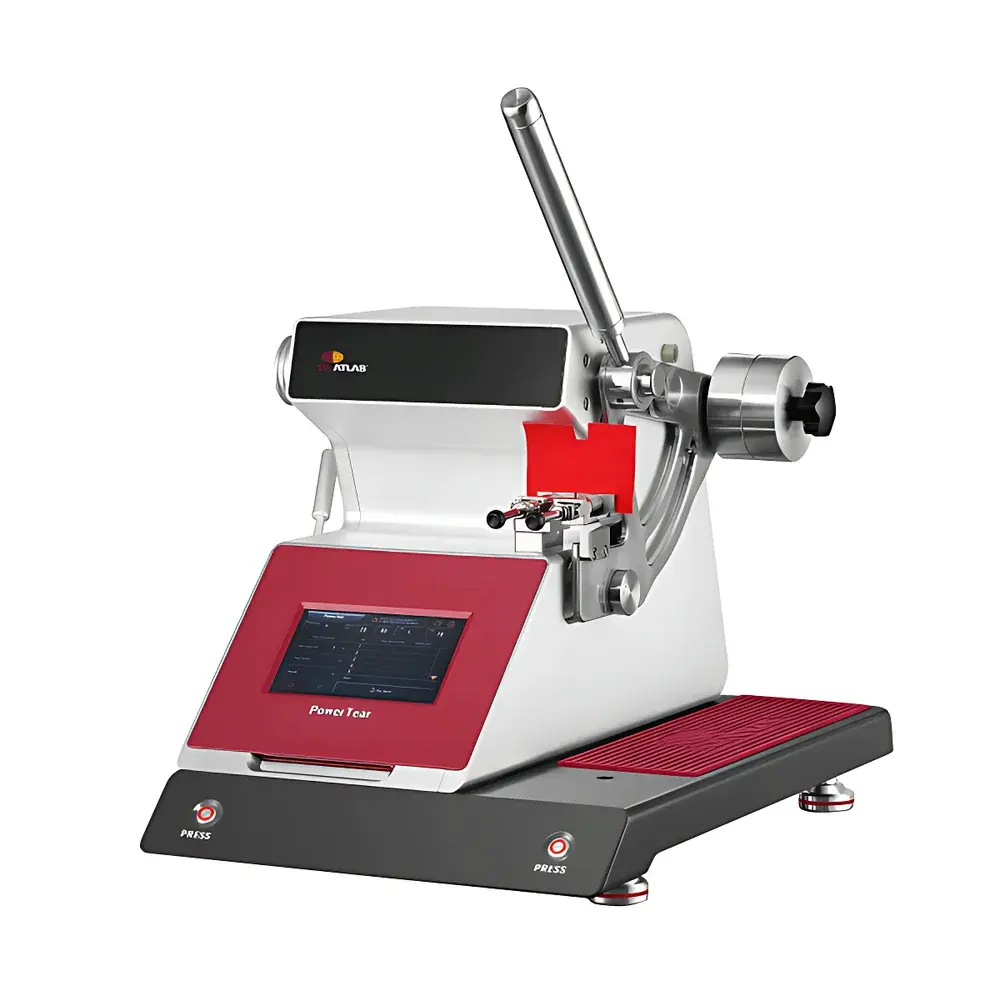
SDLATLAS PowerTear™ M008HE Elmendorf High-Capacity Tear Strength Tester
| Brand | SDLATLAS |
|---|---|
| Origin | Guangdong, China |
| Manufacturer Type | Manufacturer |
| Origin Category | Domestic |
| Model | M008HE |
| Pricing | Upon Request |
| Measurement Principle | Pendulum-type Elmendorf tear method (ISO 1974, ASTM D1424, TAPPI T414, GB/T 455) |
| Maximum Tear Force | 128 N (with optional E-type pendulum kit) |
| Force Units | mN, cN, N, g, kg, oz, lb |
| Data Storage Capacity | 100 test results (onboard microprocessor) |
| Display | Full-color capacitive touchscreen interface |
| Sample Clamping | Dual-lever quick-action fixture |
| Safety Features | Dual-button release mechanism, electromagnetic brake, large stabilized base |
| Calibration & Traceability | Adjustable pendulum zero-balance, center-of-gravity fine-tuning, certified calibration weights (8/16/32/64/128 N), acrylic weight storage rack |
| Connectivity | USB host port for PC connection and data export |
| Software | Windows-based data management suite with batch logging, sample annotation, result filtering, Excel-compatible report generation (CSV/XLSX), audit-ready metadata tagging |
Overview
The SDLATLAS PowerTear™ M008HE is a high-capacity Elmendorf-type pendulum tear strength tester engineered for precision, repeatability, and regulatory compliance in textile, paper, packaging, and nonwoven quality control laboratories. It operates on the standardized pendulum tear principle defined in ISO 1974, ASTM D1424, TAPPI T414, and GB/T 455 — where a pre-cut slit in a conditioned specimen is propagated under controlled gravitational energy from a calibrated swinging pendulum. The instrument measures the average force required to propagate the tear across a defined length, delivering quantitative tear resistance values essential for material specification, process validation, and incoming inspection. With a maximum measurable force of 128 N (achieved via optional E-series pendulum weights), the M008HE extends operational range beyond conventional Elmendorf testers—enabling robust evaluation of heavyweight technical textiles, laminated composites, geotextiles, and reinforced packaging substrates without mechanical overload or measurement saturation.
Key Features
- High-force capability: Standard E-type pendulum set (8/16/32/64 N) with optional 128 N upgrade—doubling the upper measurement limit of typical benchtop Elmendorf instruments.
- Dual-lever clamping system: Ensures rapid, consistent specimen alignment and secure fixation for both thin fabrics (e.g., spunbond polypropylene) and thick laminates (e.g., coated canvas or multi-ply nonwovens).
- Full-color capacitive touchscreen controller: Intuitive GUI with real-time parameter display—including active pendulum identification, sample ID, unit selection (mN/cN/N/g/kg/oz/lb), and instantaneous tear energy readout.
- Microprocessor-based embedded system: Stores up to 100 test records onboard with timestamp, pendulum ID, and user-defined identifiers; supports USB mass-storage mode for direct file transfer to Windows PCs.
- Enhanced metrological integrity: Precision-machined pendulum shaft with low-friction release bearing; adjustable center-of-gravity compensation mechanism; zero-balance calibration function for drift correction prior to each test series.
- Integrated safety architecture: Electromagnetic braking halts pendulum motion within <150 ms post-tear completion; dual-hand activation prevents accidental release; wide-base structural design minimizes vibration and tipping risk during high-energy tests.
Sample Compatibility & Compliance
The PowerTear™ M008HE accommodates specimens conforming to standard geometries per ISO 1974 (rectangular 63 mm × 75 mm, 3 mm initial cut) and ASTM D1424 (63 mm × 76 mm). It supports a broad material spectrum including woven and knitted textiles, paperboard, corrugated fiberboard, plastic films (LDPE, PET, BOPP), medical-grade nonwovens (SMS, meltblown), filtration media, and coated technical fabrics. All mechanical components comply with CE machinery directive requirements (2006/42/EC), and the control firmware adheres to IEC 61000-6-2/6-3 EMC standards. Test reports generated via the companion software include traceable metadata (operator ID, environmental conditions, calibration certificate numbers), supporting GLP/GMP documentation workflows and FDA 21 CFR Part 11 readiness when deployed with validated electronic signatures.
Software & Data Management
The included Windows application enables full lifecycle test data handling—from experimental setup to regulatory reporting. Users define batch IDs, enter descriptive annotations (e.g., “Lot #T-2245, Pre-wash condition, 23°C/50% RH”), assign sample categories, and apply pass/fail thresholds. The software permits selective inclusion or exclusion of outlier results based on operator review. Customizable report templates allow selection of statistical outputs (mean, SD, CV%, min/max), unit normalization, and graphical tear force distribution plots. Export formats include native .xlsx (Microsoft Excel), CSV for LIMS integration, and PDF with embedded digital signature fields. Audit trails log all data modifications, user logins, and calibration events—ensuring full ALCOA+ (Attributable, Legible, Contemporaneous, Original, Accurate, Complete, Consistent, Enduring, Available) compliance.
Applications
- Textile QC labs verifying tear resistance of apparel fabrics, industrial workwear, and military-spec ballistic textiles.
- Paper & packaging R&D validating edge-tear performance of linerboard, kraft paper, and flexible pouch laminates.
- Nonwoven manufacturers assessing delamination resistance in hygiene products (diapers, wipes) and medical barrier gowns.
- Automotive interiors testing seam integrity and fabric durability under simulated abrasion cycles.
- Academic research groups conducting comparative tear mechanics studies across fiber architectures and finishing treatments.
- Third-party certification bodies performing accredited testing per ISO/IEC 17025 requirements.
FAQ
What international standards does the PowerTear™ M008HE support?
It fully implements ISO 1974, ASTM D1424, TAPPI T414, and GB/T 455 for pendulum tear testing, with hardware and software traceable to NIST-traceable calibration references.
Can the instrument be used for both lightweight and heavyweight materials?
Yes—the modular E-type pendulum system (8–128 N) allows seamless transition between thin silk (tested at 8 N) and heavy-duty geotextiles (tested at 128 N) without recalibration or mechanical modification.
Is the onboard memory sufficient for routine lab use?
The 100-result buffer supports shift-based operation; however, continuous USB streaming or scheduled automated exports are recommended for high-throughput environments.
How is measurement accuracy maintained over time?
Through daily zero-balance verification, periodic pendulum center-of-gravity adjustment, and annual recalibration using certified reference weights stored in the integrated acrylic rack.
Does the software meet regulatory requirements for electronic records?
When configured with role-based access controls and digital signature validation, the reporting module satisfies FDA 21 CFR Part 11 and EU Annex 11 expectations for electronic data integrity.





