
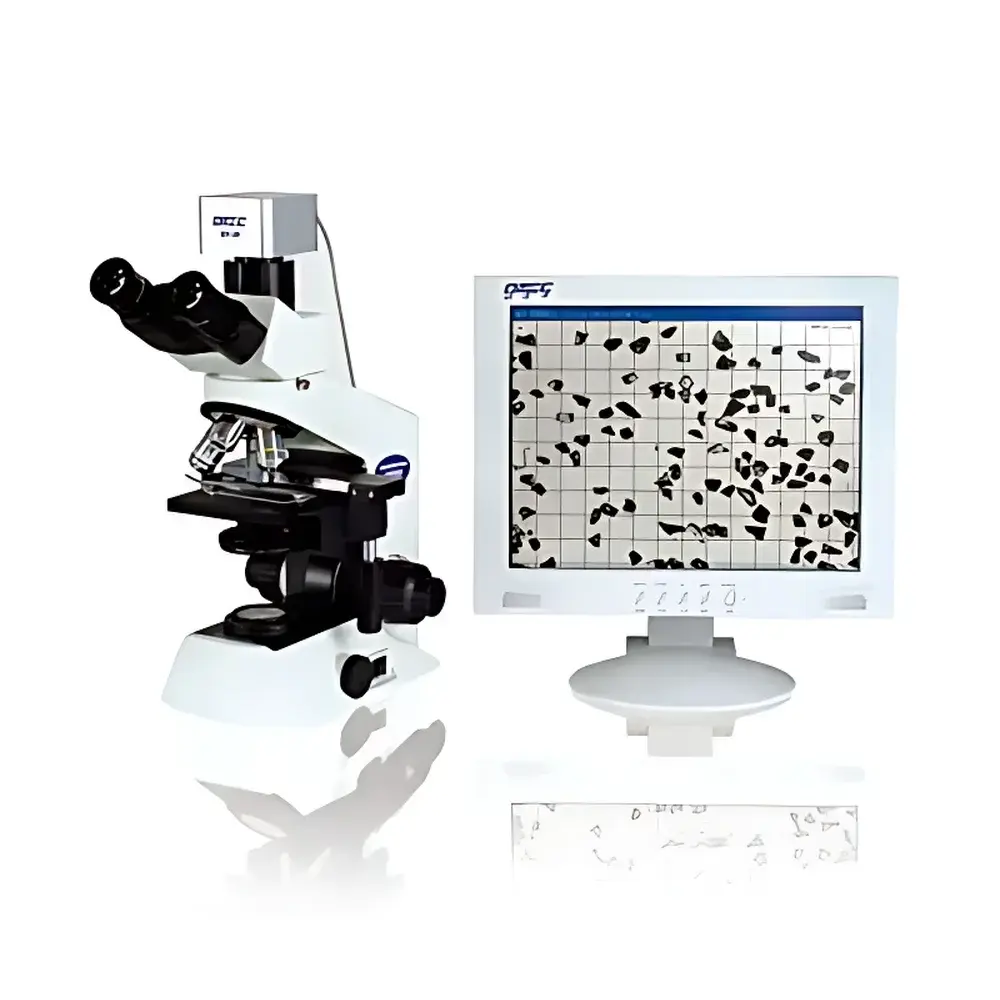
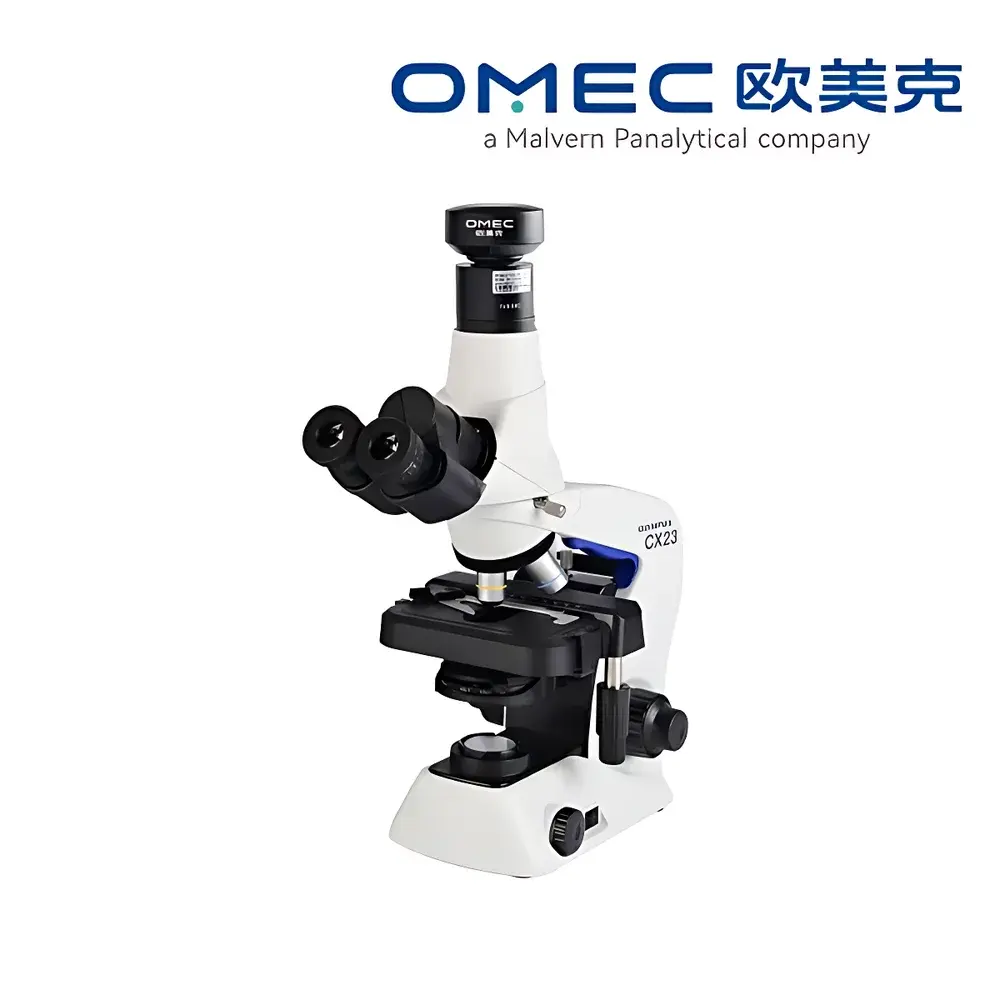
OMEC PIP8.1 Particle Image Analyzer
| Brand | OMEC |
|---|---|
| Origin | Guangdong, China |
| Manufacturer Type | Direct Manufacturer |
| Region Category | Domestic (China) |
| Model | PIP8.1 |
| Price | Upon Request |
| Measurement Range | 0.5–3000 µm |
| Repeatability Error | <3% |
| Output Data | Particle size distribution table & curve, D10/D50/D90, specific surface area, aspect ratio statistics, PPC (Particle Profile Classification), equivalent diameter based on area-equivalent circle and minimum bounding rectangle short axis |
Overview
The OMEC PIP8.1 Particle Image Analyzer is a high-resolution optical particle characterization system engineered for quantitative morphological and dimensional analysis of dry or dispersed particulate samples. Unlike ensemble-averaging techniques such as laser diffraction or dynamic light scattering, the PIP8.1 employs direct microscopic imaging coupled with advanced digital image processing to extract individual particle metrics—including size, shape, convexity, circularity, and aspect ratio—based on pixel-level segmentation and geometric equivalence principles (e.g., area-equivalent diameter, Feret short diameter, and minimum bounding rectangle dimensions). This approach provides traceable, visually verifiable data essential for method validation, outlier identification (e.g., agglomerates or oversized contaminants), and correlation with functional performance in applications ranging from abrasive grit grading to pharmaceutical excipient qualification. As specified in GB/T 6407–2008 (Chinese national standard for diamond micro-powder particle size measurement), the PIP8.1 serves as a reference-compliant instrument for regulatory-grade visual verification and orthogonal validation of bulk particle sizing methods.
Key Features
- Optical subsystem built around an Olympus biological microscope (Japan-sourced), delivering high-contrast, low-aberration magnification across multiple objective lenses (typically 2×, 5×, 10×, 20×, and 50×) to support multi-scale imaging within the 0.5–3000 µm dynamic range.
- 1.3-megapixel CMOS image sensor with 12-bit analog-to-digital conversion, enabling high-fidelity grayscale capture and robust noise suppression under variable illumination conditions (including coaxial brightfield and oblique darkfield modes).
- USB 2.0 interface ensures deterministic data transfer latency and full compatibility with Windows-based acquisition and analysis software—no proprietary drivers or legacy OS dependencies required.
- Single-particle image archiving capability: each segmented particle is saved with metadata (equivalent diameters, perimeter, convex hull area, solidity, and orientation angle), supporting retrospective reanalysis and audit-ready traceability.
- Real-time focus-assist algorithm with Z-stack preview function to minimize operator-induced depth-of-field bias during manual focusing—a critical factor in reproducible 2D projection-based sizing.
Sample Compatibility & Compliance
The PIP8.1 accommodates both dry powder deposition (via electrostatic or gravity settling on conductive stubs) and liquid-dispersed suspensions (using standard glass slides or flow cells compatible with ISO 13322-1:2014 for static image analysis). Sample preparation protocols are aligned with ASTM E2457–21 (Standard Practice for Characterization of Particles by Image Analysis) and support GLP-compliant workflows when integrated with version-controlled software and user-access logging. While not intrinsically certified to FDA 21 CFR Part 11, the system architecture permits implementation of electronic signature modules and audit-trail-enabled data export (CSV, TIFF, XML) suitable for regulated environments requiring documentation integrity.
Software & Data Management
The proprietary OMEC Particle Analysis Suite (v4.x) provides ISO/IEC 17025-aligned reporting templates, including cumulative distribution curves (log-normal and Rosin-Rammler fits), statistical summaries (D10, D50, D90, span, skewness), and shape parameter histograms (circularity vs. aspect ratio scatter plots). Raw image datasets are stored in lossless TIFF format; processed results are exportable to Excel, PDF, or LIMS-compatible ASCII formats. Software supports batch processing of up to 500 fields-of-view per session, with automated particle rejection filters (e.g., edge-touching, fragmented, or under-threshold contrast objects) to ensure metrological rigor.
Applications
- Quality control of superabrasives (e.g., diamond and cubic boron nitride powders) per GB/T 6407 and ISO 8503-2.
- Morphological screening of pigment dispersions in coatings and inks to correlate aspect ratio distribution with rheology and film formation behavior.
- Contamination analysis in battery cathode precursors, identifying metallic shards or fused agglomerates that may compromise cell safety.
- Regulatory support for USP and Ph. Eur. 2.9.31, where visual evidence of particle heterogeneity supplements laser diffraction data in drug product development.
- Research-grade quantification of sintering behavior in ceramic green bodies via time-series imaging of particle coalescence and neck growth.
FAQ
What sample preparation methods are recommended for optimal resolution at sub-5 µm sizes?
For particles below 5 µm, use ultrasonic dispersion in ethanol or isopropanol followed by drop-casting onto silanized glass slides to minimize aggregation and improve monolayer formation.
Can the PIP8.1 distinguish between touching or overlapping particles?
Yes—the software applies watershed segmentation with adjustable intensity gradient thresholds and optional shape-prior constraints to separate adhered particles; accuracy is validated using NIST-traceable latex sphere standards.
Is calibration traceable to national metrology institutes?
Calibration utilizes NIST SRM 1963 (10.0 µm polystyrene spheres) and OMEC-certified stage micrometers (±0.1 µm uncertainty); certificate of conformance accompanies each system shipment.
Does the system support automated stage scanning for large-area statistical sampling?
The PIP8.1 does not include motorized XY stage control as standard; however, third-party stages with RS-232 or USB TTL interfaces can be integrated via SDK for custom macro-driven grid acquisition.
How is repeatability error (<3%) experimentally determined?
Per ISO 13322-1 Annex B: six independent preparations of a certified reference material (CRM) are imaged and analyzed; relative standard deviation of D50 across runs defines the reported repeatability value.



