
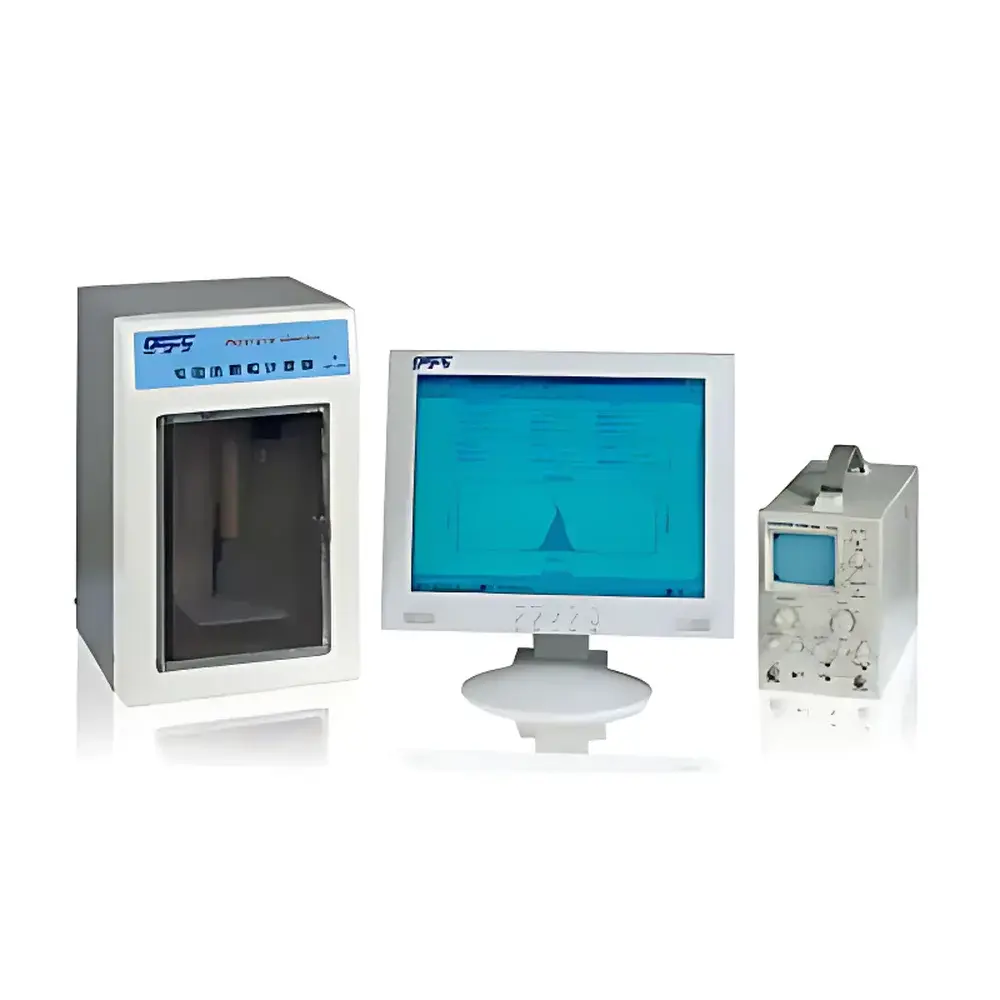
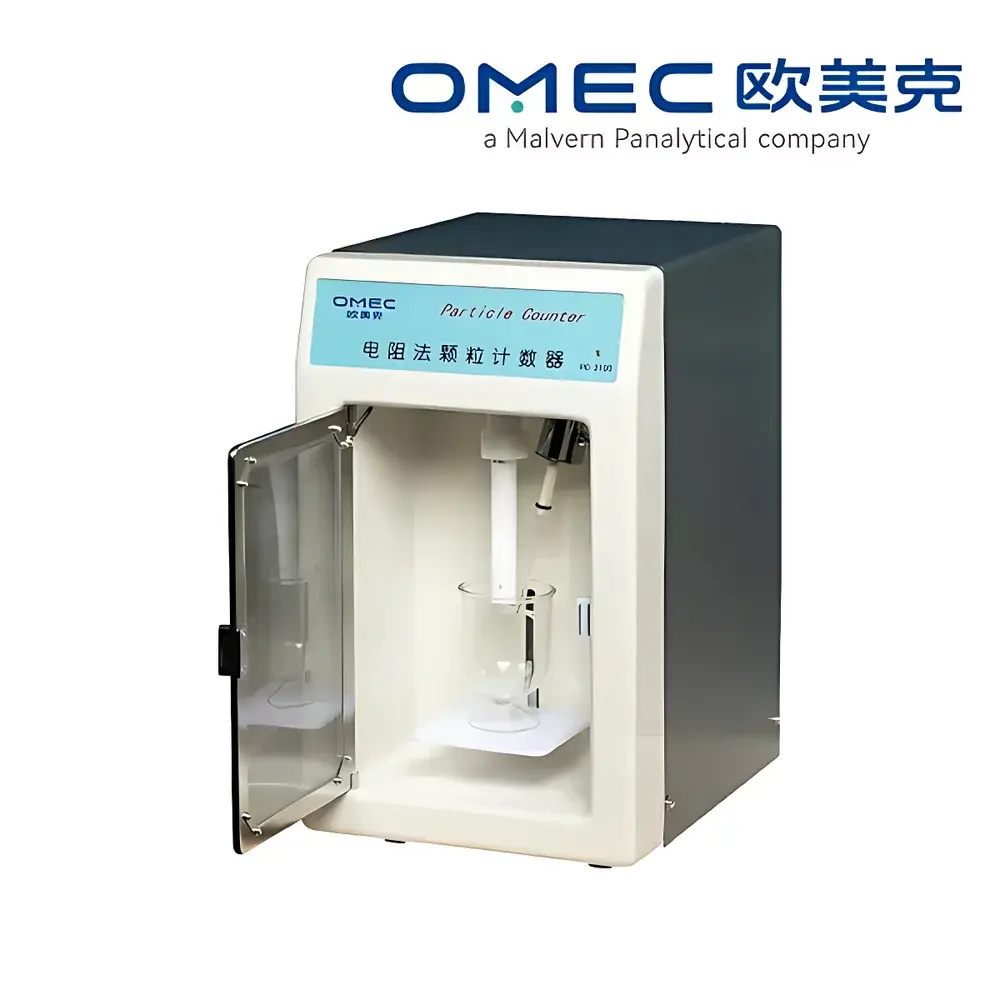
OMEC RC-2100 Coulter Principle Electrical Resistance Particle Counter / Particle Size Analyzer
| Brand | OMEC |
|---|---|
| Origin | Guangdong, China |
| Manufacturer Type | Direct Manufacturer |
| Instrument Type | Electrical Resistance (Coulter) Particle Counter |
| Measurement Principle | Coulter Principle (Electrical Sensing Zone) |
| Particle Size Range | 1–256 µm |
| Repeatability Error | <2% |
| Analysis Time | 15 seconds per sample |
| Channel Resolution | 8192 channels |
| Output Parameters | Particle size distribution table & curve, D10/D50/D90, mean diameter, median diameter, standard deviation, coefficient of variation, specific surface area, total particle count |
| Key Hardware Features | Discrete measurement cell + PC-based acquisition architecture, high-precision pulse peak detection circuitry, solid-state pressure sensor for vacuum control, optoelectronic liquid level sensing, automated aperture clearing function |
Overview
The OMEC RC-2100 Coulter Principle Electrical Resistance Particle Counter is a precision instrument engineered for high-resolution particle sizing and counting in liquid suspensions. It operates on the well-established Electrical Sensing Zone (ESZ) principle—commonly known as the Coulter principle—where particles suspended in an electrolyte solution pass one-by-one through a micro-aperture separating two electrodes. Each particle displaces a volume of conductive fluid proportional to its own volume, generating a transient electrical pulse whose amplitude is directly related to particle diameter. This single-particle, volumetric measurement enables true number-based distribution analysis with exceptional resolution—particularly critical for narrow-distribution powders or low-concentration particulate systems where statistical fidelity is paramount.
Unlike ensemble-scattering techniques (e.g., laser diffraction), the RC-2100 delivers absolute particle counts and unambiguous size assignment without optical assumptions or Mie theory dependencies. Its design prioritizes metrological integrity over throughput speed, making it especially suited for quality control laboratories validating raw material consistency, R&D teams characterizing abrasive micrograins or toner particles, and regulatory environments requiring traceable, audit-ready particle data.
Key Features
- 8192-channel pulse height analysis architecture ensures fine-grained resolution across the full 1–256 µm range, supporting accurate differentiation of sub-micron increments in polydisperse samples.
- Discrete modular design integrates a dedicated measurement cell, industrial-grade PC controller, and calibrated oscilloscope interface—enabling long-term stability, serviceability, and compatibility with legacy lab infrastructure.
- Advanced pulse peak detection circuitry minimizes signal distortion and baseline drift, preserving pulse fidelity even at high particle concentrations or low conductivity conditions.
- Solid-state pressure transducer replaces mercury manometers for vacuum generation and maintenance during aspiration—enhancing safety, repeatability, and compliance with modern laboratory environmental standards.
- Optoelectronic liquid level sensing system provides real-time, non-contact monitoring of electrolyte volume in the reservoir and sample chamber, eliminating mechanical float errors and improving volumetric accuracy for concentration calculations.
- Automated aperture clearing protocol activates upon detection of abnormal resistance rise or pulse dropout, applying controlled reverse pressure and fluid flush cycles to restore aperture integrity—reducing manual intervention and downtime.
Sample Compatibility & Compliance
The RC-2100 accommodates aqueous and non-aqueous suspensions compatible with standard Coulter electrolytes (e.g., isotonic saline, ammonium nitrate solutions). Sample preparation follows ASTM F2149–22 (Standard Guide for Coulter Counter Sizing of Particles in Liquids) and ISO 13322-1:2020 (Particle size analysis — Electrical sensing zone method — Part 1: Principles and calibration). The instrument supports GLP-compliant operation through user-accessible audit logs, operator ID tagging, and timestamped raw pulse data export. While not pre-certified for FDA 21 CFR Part 11, its data acquisition architecture permits integration with validated LIMS platforms via ASCII/CSV output and configurable metadata headers.
Software & Data Management
Acquisition and analysis are performed using OMEC’s proprietary Windows-based software suite, which records full pulse trains alongside calibrated channel assignments. Output includes ISO-standardized distribution tables (volume-, number-, and surface-area-weighted), cumulative curves, statistical descriptors (Dv10/Dv50/Dv90, span, coefficient of variation), specific surface area estimation (based on spherical equivalent assumption), and total particle count per unit volume. All results are exportable in CSV, PDF, and XML formats. Raw pulse files (.bin) retain full bit-depth resolution for retrospective reprocessing or third-party algorithm validation.
Applications
- Quality assurance of toner powders, photocopier developers, and electrostatic printing materials where D50 reproducibility and tail-end fines control directly impact image fidelity.
- Characterization of silicon carbide, aluminum oxide, and diamond abrasives used in precision lapping and polishing—where narrow distributions below 10 µm dictate surface finish performance.
- Monitoring of catalyst support particles, pharmaceutical excipients, and ceramic precursors where batch-to-batch count-based consistency affects reaction kinetics or tablet compaction behavior.
- Environmental and industrial hygiene labs quantifying low-abundance airborne particles collected in liquid impingers (e.g., asbestos analogs or engineered nanomaterials).
- Academic research in colloid science requiring absolute number distributions for nucleation/growth modeling or aggregation kinetics studies.
FAQ
What particle concentration range is optimal for accurate measurement with the RC-2100?
For statistically robust results, recommended concentrations yield 5,000–50,000 counted events per 15-second run. Excessive counts (>100,000) risk coincidence error; very low counts (<1,000) reduce confidence in distribution shape.
Can the RC-2100 measure non-spherical particles accurately?
Yes—the Coulter principle reports equivalent spherical diameter (ESD) based on displaced volume. Shape effects are inherently accounted for in the volumetric signal; no shape assumptions are required for size assignment.
Is calibration traceable to NIST or other national standards?
Calibration is performed using NIST-traceable polystyrene latex (PSL) reference standards (e.g., NIST SRM 1963, 1979), with documented uncertainty budgets available upon request.
Does the system support automated sample changers or integration with robotic liquid handlers?
The RC-2100 is designed as a benchtop standalone unit. While no native autosampler is included, its RS-232 and USB interfaces allow external triggering and status polling for custom automation integration.
How often does the aperture require cleaning or replacement?
With routine use and proper filtration (≤0.45 µm pre-filtration recommended), apertures typically last 3–6 months. The automated clearing function extends operational uptime; aperture replacement is a field-serviceable procedure requiring <10 minutes.



