
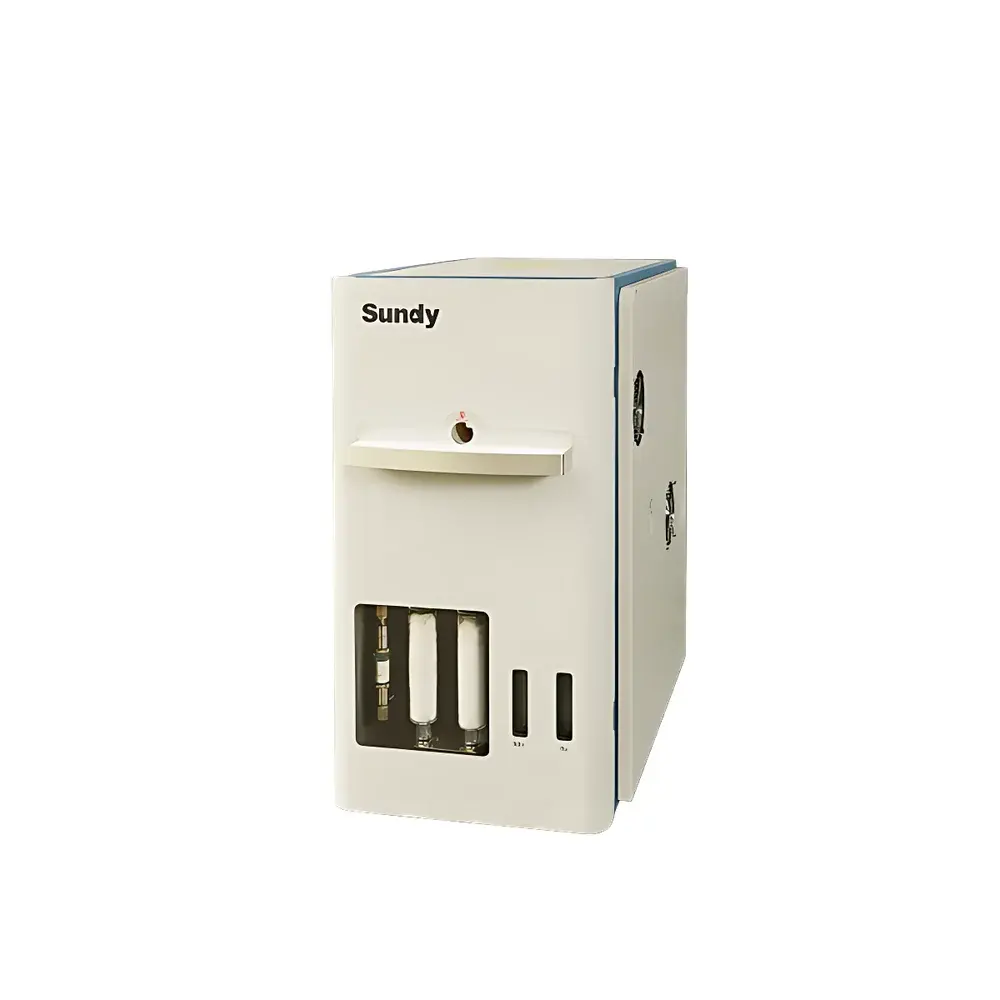
Sundhy SDIS401 Infrared Sulfur Determinator
| Brand | Sundhy |
|---|---|
| Model | SDIS401 |
| Measurement Principle | Ultraviolet-Fluorescence (UVF) with Infrared Detection |
| Standard Compliance | GB/T 25214–2010, ISO 19579:2006, ASTM D4239–2018 |
| Test Range | 0.01–50 wt% (extendable) |
| Analysis Time | ~120 s per sample |
| Combustion Temperature | 1250–1350 °C (recommended: 1300 °C) |
| Sample Mass | 200 mg (nominal) |
| Furnace Power | 4 kW |
| Dimensions (L×W×H) | 760 × 434 × 752 mm |
| Weight | ~80 kg |
| Power Supply | AC 220 V ±10%, 50 Hz ±1 Hz |
| Sample Capacity | 1 position (manual loading) |
| Detector Type | Low-drift infrared absorption cell |
| Gas Conditioning | Integrated desiccant and particulate filtration |
| Gas Path Design | Patented low-dead-volume, temperature-stabilized flow path |
Overview
The Sundhy SDIS401 Infrared Sulfur Determinator is a dedicated elemental analyzer engineered for precise, reproducible quantification of total sulfur content in solid and liquid samples across coal, petrochemical, cement, environmental, and materials science laboratories. It operates on the principle of high-temperature combustion followed by ultraviolet-fluorescence detection—optimized with an infrared absorption cell for enhanced selectivity and long-term baseline stability. Unlike conventional coulometric or barium sulfate gravimetric methods, the SDIS401 leverages UVF spectroscopy to detect SO₂ emission at 193 nm following complete oxidation of sulfur species in an oxygen-rich, controlled-temperature furnace environment (1250–1350 °C). This enables accurate determination of organic, inorganic, and sulfate-bound sulfur without matrix interference—critical for compliance with international standards including GB/T 25214–2010, ISO 19579:2006, and ASTM D4239–2018.
Key Features
- High-temperature combustion system with patented dual-wall gas curtain design ensures complete sample oxidation while preventing cross-contamination and gas leakage—enhancing safety and analytical integrity.
- Integrated reflux combustion tube with secondary oxidation zone promotes quantitative conversion of refractory sulfur compounds (e.g., pyritic sulfur in coal) into measurable SO₂.
- Low-drift infrared detection cell requires only one daily zero-point calibration, minimizing operator intervention and maximizing instrument uptime.
- Patented thermal-stabilized gas flow path eliminates baseline drift induced by ambient temperature fluctuations—critical for multi-hour unattended operation.
- Compact mechanical architecture with minimized dead volume (< 2.5 mL) reduces carryover between analyses and improves response time and repeatability (RSD < 0.8% at 1.5% S).
- Modular hardware interface supports seamless integration with the Sundhy SDCHN636 CHN Elemental Analyzer for synchronized C/H/N/S quantification within a single laboratory workflow.
Sample Compatibility & Compliance
The SDIS401 accommodates heterogeneous solid matrices—including bituminous and anthracite coals, coke, petroleum coke, fly ash, cement clinker, soil, rubber, and construction materials—as well as liquid fuels and combustion residues. Sample introduction is manual, supporting standardized 200 mg aliquots per test; no autosampler is included, preserving mechanical simplicity and serviceability. All measurement protocols adhere strictly to regulatory frameworks governing energy and environmental testing: GB/T 25214–2010 specifies infrared detection for coal sulfur analysis under Chinese national metrology requirements; ISO 19579:2006 defines performance criteria for solid mineral fuels; and ASTM D4239–2018 validates high-temperature combustion methodology for coal and coke. The system meets GLP documentation prerequisites through built-in audit trail logging (when paired with compliant PC software) and supports 21 CFR Part 11 readiness via optional electronic signature modules.
Software & Data Management
Instrument control and data acquisition are managed via Windows-based application software compatible with Windows 10/11 (64-bit). The interface provides real-time gas signal monitoring, automatic peak integration, calibration curve management (linear and quadratic), and QC flagging based on blank thresholds and recovery checks. Raw spectral traces, calibration logs, and user action timestamps are stored in encrypted SQLite databases with configurable backup intervals. Export formats include CSV, PDF reports (with customizable templates), and XML for LIMS integration. When configured with optional tablet computing hardware (e.g., industrial-grade Android or Windows tablets), the system supports touch-enabled operation with ergonomic rotating/telescoping mounts—enabling flexible benchtop positioning without sacrificing ergonomics or cable management.
Applications
- Quality assurance of commercial coal shipments per ISO 1928 and ASTM D3176 specifications.
- Monitoring sulfur emissions compliance in power plant feedstock characterization.
- Research-grade sulfur speciation studies in carbonaceous materials using sequential digestion-coupled analysis.
- Environmental assessment of contaminated soils and dredged sediments under EPA Method 5050B-equivalent workflows.
- Raw material certification in cement manufacturing where sulfate content affects setting behavior and durability.
- Refinery catalyst monitoring and petcoke quality control in downstream refining operations.
FAQ
What combustion temperature range is supported, and why is 1300 °C recommended?
The furnace operates from 1250 to 1350 °C; 1300 °C represents the optimal balance between complete oxidation of recalcitrant sulfur forms (e.g., FeS₂) and minimal quartz tube degradation over extended use.
Is the SDIS401 compliant with FDA 21 CFR Part 11 for regulated laboratories?
Out-of-the-box functionality supports ALCOA+ data integrity principles; full Part 11 compliance requires optional audit trail enablement, electronic signatures, and secure user authentication—available via software upgrade package.
Can the instrument be upgraded to support automated sample loading?
No—the SDIS401 is designed exclusively for manual sample introduction to maintain mechanical robustness, reduce maintenance frequency, and ensure compatibility with irregularly shaped or high-ash samples.
How often must the infrared detector be recalibrated?
Baseline drift correction is required once per working day; full span calibration with certified SO₂ reference gas is recommended weekly or after 50 analyses, whichever occurs first.
Does the system require external cooling water or compressed air?
No—cooling is passive/convective; combustion gas supply uses standard laboratory-grade oxygen (≥99.995%) delivered via pressure-regulated cylinder; no auxiliary gases or chillers are needed.




