
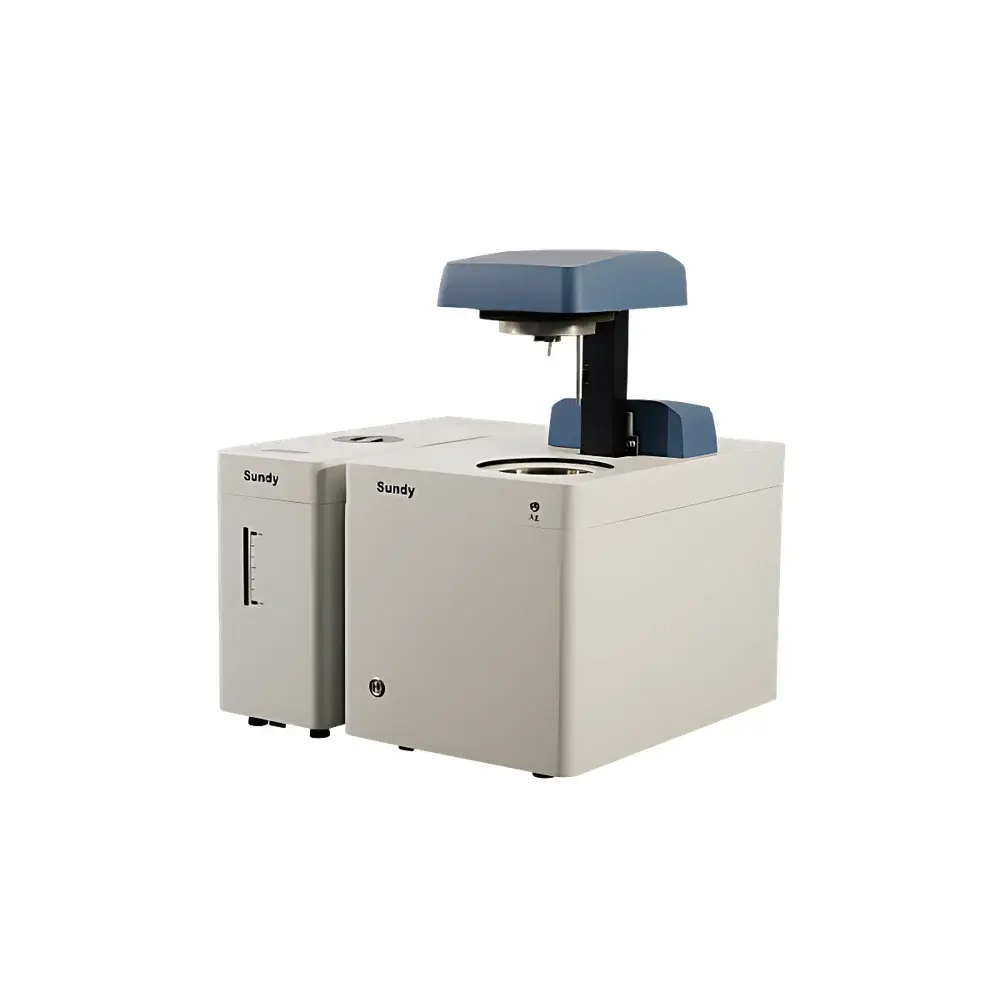
Sundy SDAC1600 / SDAC1600L / SDAC1200 Oxygen Bomb Calorimeter
| Brand | Sundy |
|---|---|
| Origin | Hunan, China |
| Instrument Type | Oxygen Bomb Calorimeter |
| Measurement Principle | Isoperibol (Constant-Temperature Jacket) Calorimetry |
| Compliance Standards | GB/T 213-2008, GB/T 384-1981, GB/T 30727-2014, ASTM D5865-2007, ISO 1928-2020, JC/T 1005-2006 |
| Single Test Duration (Rapid Mode) | <11 min |
| Temperature Resolution | 0.0001 °C |
| Heat Capacity Precision | ≤0.10% RSD |
| Heat Capacity Drift | ≤0.20% per year |
| Ignition Methods | SDAC1600 – Ignition Rod |
| Power Supply | AC 220 V ±10%, 50 Hz ±1 Hz |
| Max Power Consumption | 0.65 kW |
| Host Dimensions (SDAC1600) | 439 × 565 × 485 mm |
| (SDAC1200/SDAC1600L) | 390 × 565 × 485 mm |
| Water Bath Dimensions | 220 × 565 × 410 mm |
| Host Weight | ~50 kg |
| Water Bath Weight | ~25 kg |
Overview
The Sundy SDAC1600, SDAC1600L, and SDAC1200 are high-precision isoperibol oxygen bomb calorimeters engineered for rigorous determination of gross calorific value (GCV) in solid and liquid combustible materials. Based on the fundamental principle of oxygen bomb combustion calorimetry—where a precisely weighed sample is combusted under high-purity oxygen pressure inside a sealed stainless-steel bomb submerged in a thermally stabilized water jacket—the instruments deliver traceable, reproducible energy measurements compliant with international standard methodologies. The system employs a dual-temperature-control architecture: an outer jacket maintained at constant temperature via semiconductor-based Peltier elements (capable of both heating and cooling), and an inner bucket whose temperature is monitored with 0.0001 °C resolution using platinum resistance thermometers (PRTs). This design eliminates reliance on ambient cooling water or external refrigeration units, ensuring stable thermal equilibrium (<0.01 °C fluctuation during test cycle; <0.05 °C diurnal drift) independent of laboratory HVAC conditions.
Key Features
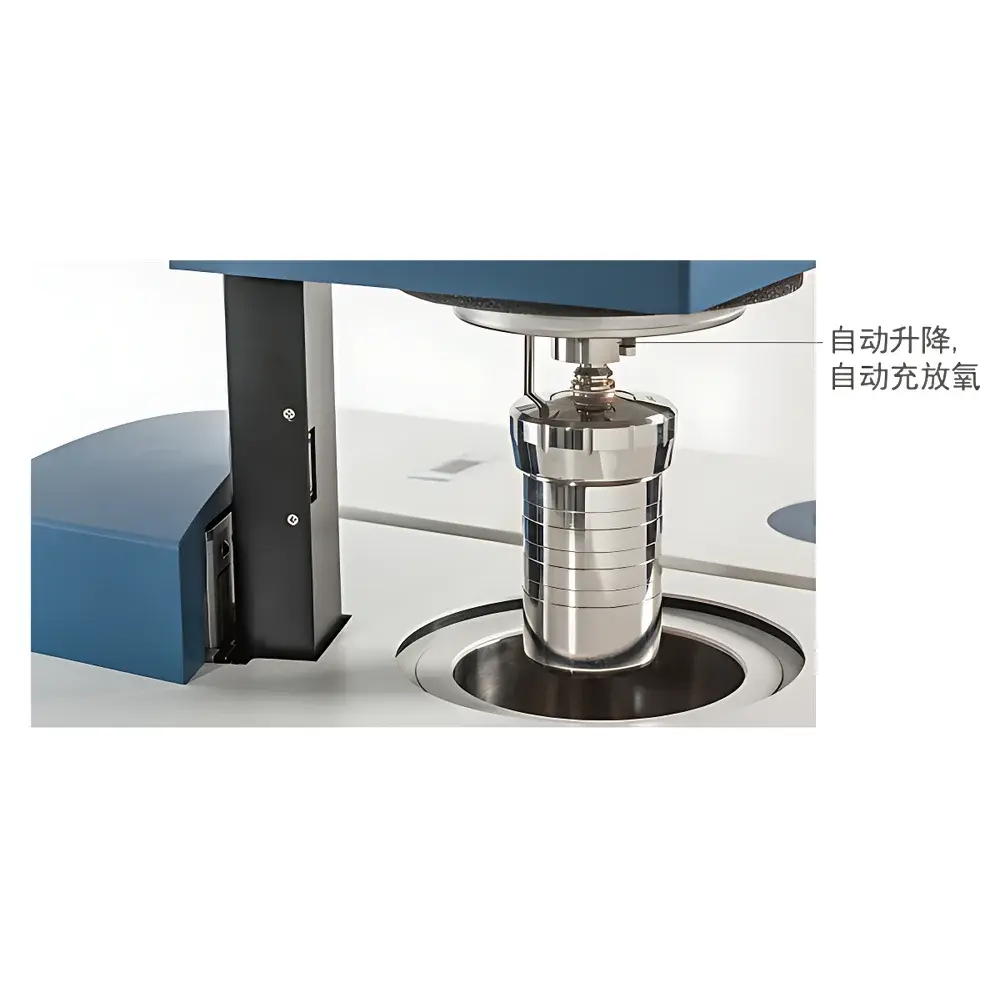
- Automated oxygen handling: Fully integrated oxygen charging (0–3.5 MPa), pressure verification, and exhaust—all performed without manual intervention.
- Motorized bomb lift mechanism: Enables precise, repeatable positioning of the bomb into and out of the inner bucket, minimizing mechanical stress and operator variability.
- Three ignition configurations: SDAC1200 uses traditional ignition wire; SDAC1600 employs robust ignition rod technology; SDAC1600L integrates non-contact laser ignition—eliminating consumables and enabling reliable ignition of low-energy or moisture-sensitive samples (e.g., biomass, waste-derived fuels).
- Patented helical-tube isothermal jacket: A thermally decoupled outer tank with distributed flow channels ensures uniform temperature distribution across all measurement zones, effectively isolating the inner bucket from drafts, vibration, and ambient thermal gradients.
- Self-diagnostic subsystems: Real-time monitoring of oxygen seal integrity, water level, stirrer function, temperature sensor continuity, and power stability—logging fault codes for preventive maintenance.
- Modular stainless-steel bomb and quick-release inner bucket: Designed for rapid cleaning, calibration verification, and long-term dimensional stability—compatible with certified benzoic acid standards and routine inter-laboratory comparison protocols.
Sample Compatibility & Compliance
The SDAC series accommodates a broad spectrum of heterogeneous, high-ash, or high-moisture samples—including coal, coke, petroleum products, cement raw meal (black feed), municipal solid waste (MSW), sewage sludge, and solid recovered fuel (SRF). Each model meets the metrological requirements of ISO/IEC 17025 for testing laboratories and supports full audit trails required under GLP and GMP frameworks. Data acquisition complies with FDA 21 CFR Part 11 when paired with validated software configurations, including electronic signatures, user access controls, and immutable test record archiving. All calibrations are traceable to NIM (National Institute of Metrology, China) or NIST SRM 39j benzoic acid reference material.
Software & Data Management
Control and analysis are executed via embedded firmware and optional PC-based software compliant with IEC 62443-3-3 cybersecurity guidelines. The interface provides real-time thermogram visualization, automatic baseline correction, and adaptive heat exchange compensation algorithms—not empirical curve-fitting or post-hoc data “correction.” Raw temperature vs. time datasets are stored in vendor-neutral CSV format with metadata headers (sample ID, operator, date/time, calibration constants, ambient conditions). Audit logs record every user action, parameter change, and system event with timestamp and login credential—enabling full forensic reconstruction of any test sequence. Export modules support LIMS integration via ASTM E1384-compliant XML schema.
Applications
- Quality control of commercial coal blends in power generation facilities.
- Energy content certification of alternative fuels per EN 14918 and ASTM D7582.
- Research-grade calorimetry for pyrolysis product characterization and combustion kinetics modeling.
- Regulatory compliance testing for hazardous waste classification under EPA Method 9040C.
- Calibration verification of continuous emission monitoring systems (CEMS) using certified fuel standards.
- Material-specific heat capacity profiling for thermal modeling in cement kiln optimization.
FAQ
What distinguishes the SDAC1600L’s laser ignition from conventional wire-based systems?
Laser ignition delivers spatially focused, controllable energy pulses—eliminating physical contact, reducing ash contamination risk, and enabling consistent ignition of challenging matrices such as wet biomass or low-volatility coals without auxiliary additives.
How is thermal drift minimized during extended batch testing?
The semiconductor-controlled outer jacket maintains temperature stability within ±0.01 °C over multi-hour sequences; combined with independent inner-bucket water circulation and zero-crossing stirrer synchronization, this ensures inter-test repeatability ≤0.10% RSD.
Does the system support remote diagnostics and firmware updates?
Yes—via secure TLS 1.2 encrypted Ethernet connection, with role-based access control and signed firmware validation to prevent unauthorized modifications.
Can the calorimeter be integrated into an automated sample preparation line?
Standard RS-232 and Modbus TCP interfaces enable bidirectional communication with robotic samplers and auto-grinding stations, supporting unattended 24/7 operation under validated SOPs.
Is validation documentation provided for regulatory submissions?
Each unit ships with Factory Acceptance Test (FAT) reports, IQ/OQ documentation templates, and a full traceability matrix linking hardware components, sensor calibrations, and software version history—aligned with ISO/IEC 17025 Clause 6.4.



