
Hengpin HP612Q Microsphere Mechanical Strength Tester
| Brand | Hengpin (Ji’nan) |
|---|---|
| Origin | Shandong, China |
| Manufacturer Type | Direct Manufacturer |
| Regional Classification | Domestic (PRC) |
| Model | HP612Q |
| Price Range | USD 1,400 – 2,800 |
| Force Range Options | 50 N / 100 N / 500 N / 1000 N |
| Resolution | 0.1 N |
| Accuracy | ±0.5% FS |
| Test Speed | 1–300 mm/min |
| Upper Platen | 10 mm diameter ultra-hard tungsten carbide indenter |
| Parallelism between Platens | < 0.025 mm |
| Lower Platen Diameter | 120 mm |
| Dimensions (W×D×H) | 430 × 350 × 710 mm |
| Weight | 45 kg |
| Power Supply | 220 V AC, 50 Hz |
| Standard Accessories | Main unit, microsphere compression fixtures, thermal mini-printer |
| Optional | Lenovo PC, inkjet printer, PC-based control & analysis software |
Overview
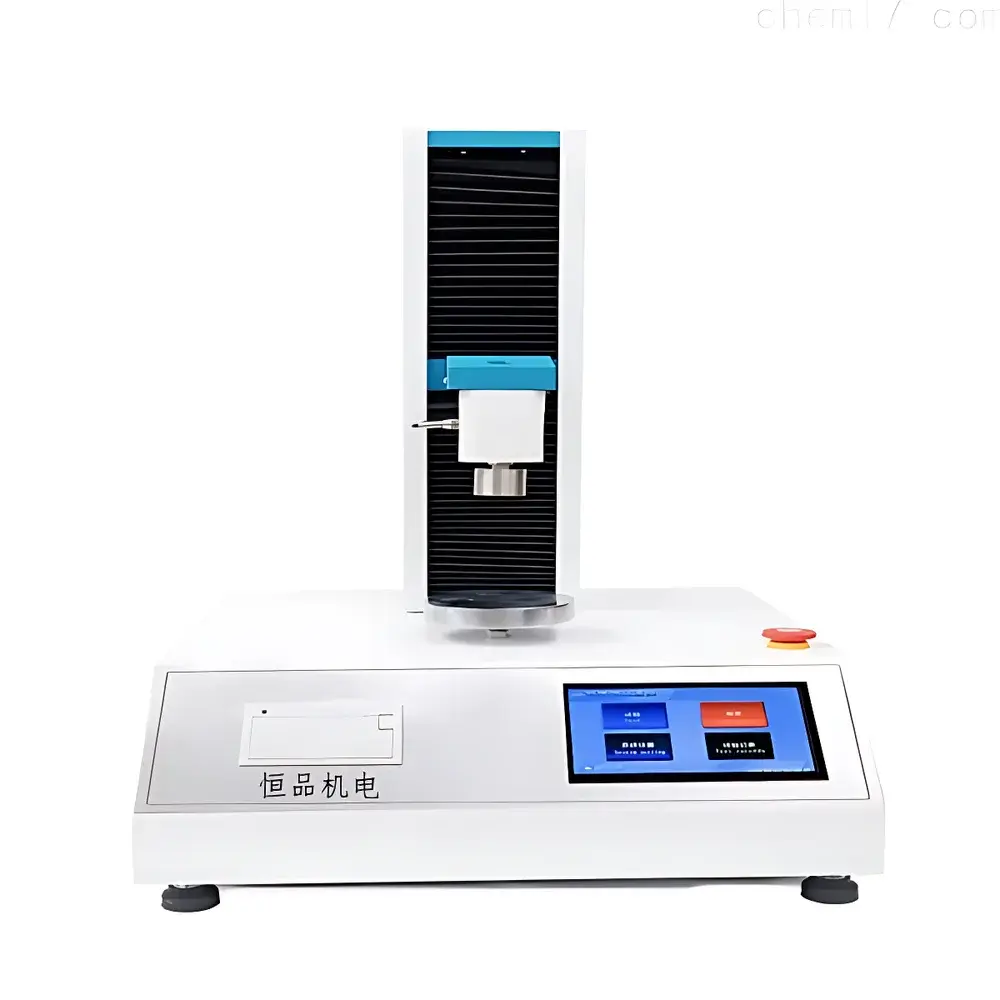
The Hengpin HP612Q Microsphere Mechanical Strength Tester is a dedicated uniaxial compression testing system engineered for quantitative mechanical characterization of spherical and quasi-spherical micron- to sub-millimeter-scale particulates. It operates on the principle of controlled quasi-static axial compression—applying precisely regulated force through a hardened cylindrical indenter onto individual microspheres or microcapsules seated on a flat, rigid lower platen. The system captures real-time load-displacement response curves, enabling determination of critical mechanical parameters including fracture onset force (burst strength), deformation modulus, yield threshold, and post-yield behavior. Designed specifically for high-value functional microcarriers used in chromatography, drug delivery, diagnostics, and advanced materials, the HP612Q meets the increasing demand for traceable, repeatable, and standardized mechanical evaluation under GLP-aligned laboratory conditions.
Key Features
- High-resolution force measurement with ±0.5% full-scale accuracy and 0.1 N resolution across selectable ranges (50 N to 1000 N), ensuring sensitivity for both fragile hydrogel microparticles and robust polymer or silica microspheres.
- Digitally controlled electromechanical drive system with precision gearmotor and ball-screw actuation, enabling smooth, low-noise displacement at speeds from 1 to 300 mm/min—optimized for brittle fracture detection and viscoelastic creep assessment.
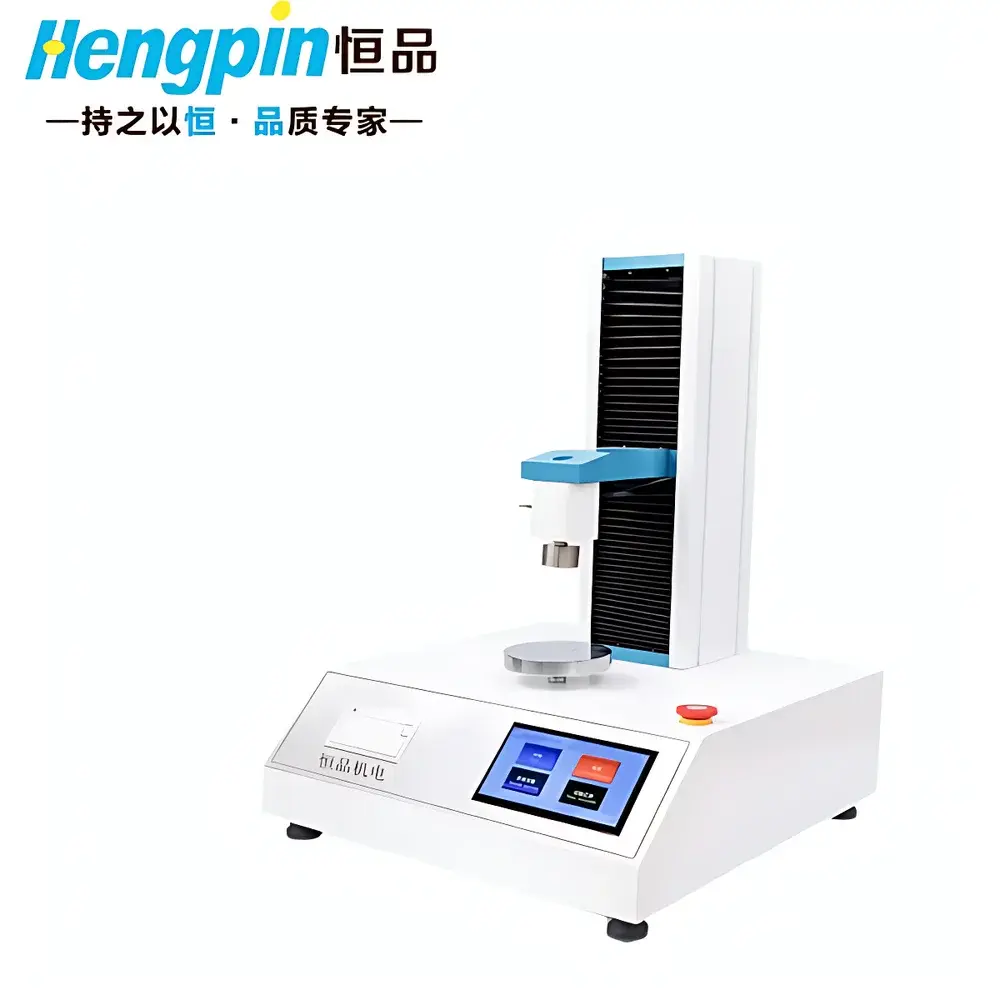
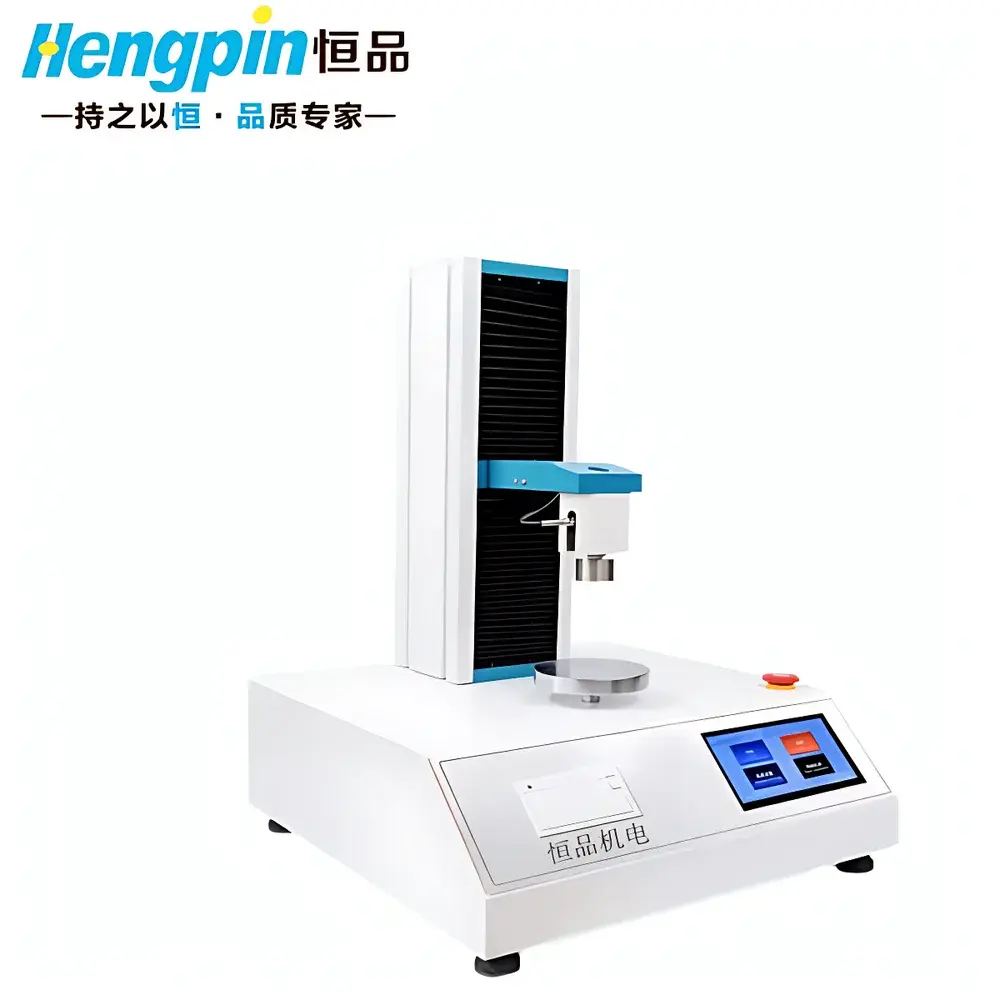
- Integrated 7-inch industrial touchscreen HMI with real-time graphical display of force vs. displacement curves, instantaneous test speed, displacement, and peak force capture—no external hardware required for basic operation.
- Ultra-flat, parallel platens (parallelism < 0.025 mm) and a 10 mm-diameter tungsten carbide upper indenter guarantee uniform stress distribution and minimize edge effects during single-particle compression.
- Onboard data logging and automatic storage of maximum force, total displacement, and time-stamped test metadata; thermal mini-printer included for immediate hard-copy reporting of individual tests.
Sample Compatibility & Compliance
The HP612Q accommodates discrete microspheres ranging from 20 µm to 1.2 mm in diameter—including silica-based HPLC/UHPLC packing materials, polymeric chromatographic beads, conductive metal-coated microspheres, optical light-diffusing particles, alginate or chitosan hydrogel microcapsules, and embolization microspheres (e.g., PVA, tris-acryl gelatin). Its mechanical design supports ASTM D6988 (Standard Test Method for Determination of Burst Strength of Microcapsules), ISO 13322-2 (Particle Size Analysis — Image Analysis Methods), and aligns with USP <1059> guidance on mechanical testing of pharmaceutical microcarriers. While not FDA-cleared as a medical device, its architecture supports 21 CFR Part 11-compliant data integrity when paired with validated PC software and audit-trail-enabled workflows.
Software & Data Management
The optional PC-based control suite provides synchronized acquisition of force, displacement, and time data at ≥100 Hz sampling rate. All raw curves and metadata are stored in vendor-neutral CSV format with embedded calibration traceability. Software features include batch statistical analysis (n ≥ 100 tests), Weibull distribution fitting for strength reliability modeling, customizable report templates (A4 PDF export), and user-level access control. Audit trails record operator ID, timestamp, parameter changes, and result modifications—supporting GMP/GLP documentation requirements. Data files retain native units and are compatible with MATLAB, Python (Pandas), and JMP for secondary statistical modeling.
Applications
- Chromatography: Quantifying crush resistance of silica, polymer, or hybrid monolithic microspheres under column packing pressure to predict bed stability and backpressure profiles.
- Pharmaceutical Development: Evaluating mechanical robustness of embolic microspheres during catheter injection and vascular navigation—correlating burst strength with clinical occlusion efficacy.
- Controlled Release: Assessing shell integrity of pH-responsive or enzymatically degradable microcapsules under simulated physiological compression loads.
- Biomedical Materials: Benchmarking compressive modulus and failure strain of alginate, hyaluronic acid, or gelatin-based hydrogel microparticles for injectable tissue scaffolds.
- Electronics & Optics: Measuring indentation resistance of conductive silver-coated spheres and light-scattering polystyrene microspheres used in conductive adhesives and diffuser films.
FAQ
What sample sizes can the HP612Q accommodate?
The system is optimized for individual particles between 20 µm and 1.2 mm in diameter. Smaller particles require vacuum-assisted handling tools; larger specimens (>1.2 mm) may exceed optimal contact geometry and are not recommended.
Is calibration traceable to national standards?
Yes—each unit ships with a factory calibration certificate referencing CNAS-accredited force standards (equivalent to NIST traceability); annual recalibration using certified deadweight kits is recommended.
Can the HP612Q perform cyclic or creep testing?
No—it is designed exclusively for monotonic compression to first failure. For time-dependent mechanical analysis, a dynamic mechanical analyzer (DMA) or universal testing machine with closed-loop strain control is required.
Does the system comply with ISO/IEC 17025 requirements?
The hardware and firmware support method validation per ISO/IEC 17025:2017 Annex A (uncertainty estimation, equipment qualification), provided users implement documented SOPs, environmental controls, and periodic performance verification.
What maintenance is required?
Routine maintenance includes monthly lubrication of the lead screw, quarterly verification of platen parallelism using optical flats, and annual sensor linearity check with calibrated reference loads.



