
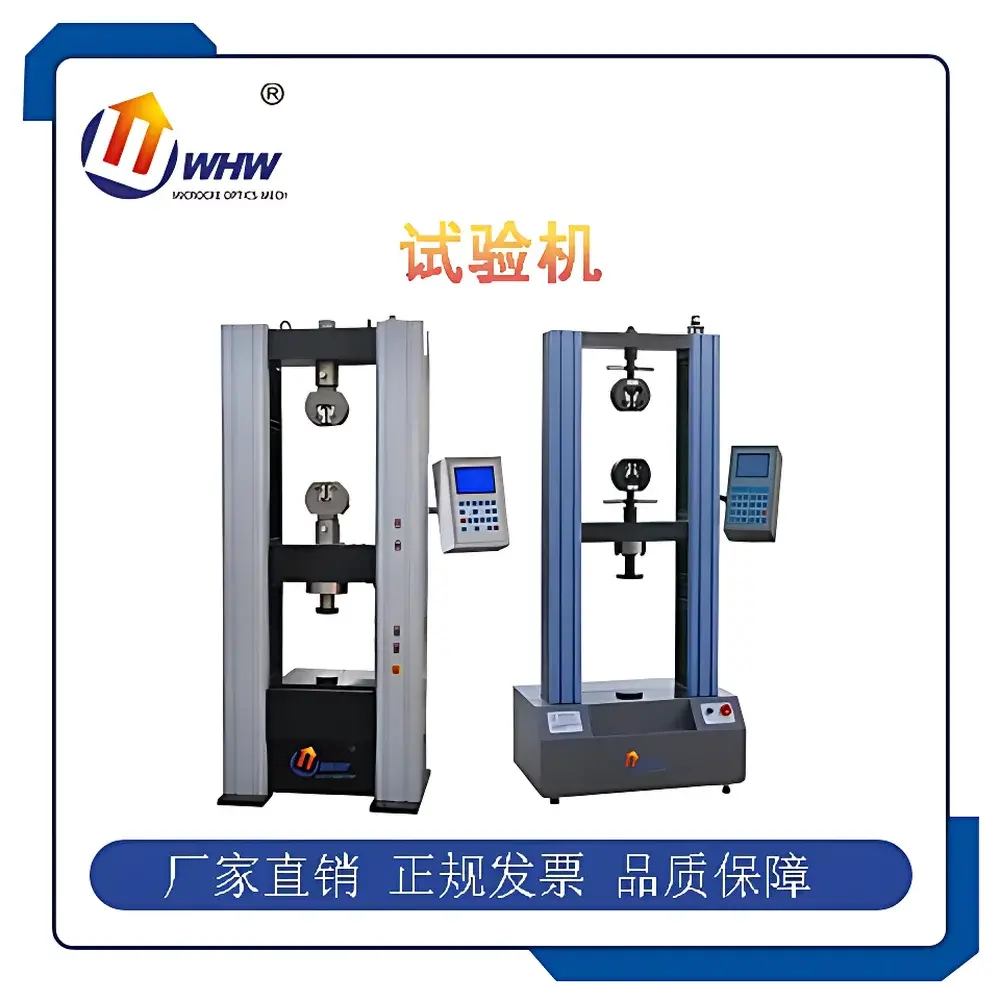
YANRUN MC009-WDS-10GL 0.5-Class High-Precision Floor-Mounted Digital Electronic Universal Testing Machine
| Brand | YANRUN |
|---|---|
| Origin | Shanghai, China |
| Manufacturer Type | Direct Manufacturer |
| Instrument Type | Electronic Universal Testing Machine |
| Model | MC009-WDS-10GL |
| Load Range | 0.04–10 kN |
| Load Accuracy | ±0.5% |
| Displacement Resolution | 0.0025 mm |
| Crosshead Speed Range | 0.001–500 mm/min (infinitely variable) |
| Test Space (Tension/Compression) | 600 mm |
| Effective Width | 570 mm |
| Machine Dimensions (W×D×H) | 560 × 850 × 1900 mm |
| Weight | 550 kg |
| Power Supply | Single-phase, 220 V ±10%, 50 Hz |
Overview
The YANRUN MC009-WDS-10GL is a floor-mounted, microprocessor-controlled electronic universal testing machine engineered for high-fidelity mechanical property characterization of engineering materials and components. Operating on the principle of controlled axial force application via a precision ball-screw-driven crosshead and high-stability load cell feedback, it conforms to ISO 7500-1:2018 (Class 0.5 accuracy) and ASTM E4, E8, E21, and E9 standards for verification and performance validation. Designed for laboratory and quality control environments requiring traceable, repeatable, and auditable mechanical test data, the WDS-10GL delivers calibrated force measurement across its full 0.04–10 kN range with ±0.5% indicated load accuracy—meeting the stringent requirements of GLP-compliant material certification, supplier qualification, and R&D validation workflows.
Key Features
- Floor-standing rigid frame architecture constructed from high-tensile steel, minimizing deflection under load and ensuring long-term geometric stability (frame stiffness > 150 kN/mm).
- Imported high-linearity load cell with temperature-compensated signal conditioning, enabling stable zero drift (< 0.02% FS/°C) and low hysteresis (< 0.03% FS).
- Precision AC servo motor coupled with planetary gear reduction and preloaded ball screw transmission, achieving speed resolution down to 0.001 mm/min and maximum speed of 500 mm/min with ≤±0.2% speed accuracy.
- Dual-channel digital displacement measurement system using high-resolution optical encoder (0.0025 mm resolution), synchronized with load acquisition at up to 1 kHz sampling rate.
- Integrated hardware safety interlocks: mechanical limit switches, overload cut-off, overcurrent protection, overvoltage monitoring, and emergency stop circuit compliant with IEC 60204-1.
- Modular design supporting optional accessories—including extensometers (contact/non-contact), environmental chambers (-70°C to +300°C), pneumatic wedge grips, and peel/adhesion fixtures—without structural modification.
Sample Compatibility & Compliance
The WDS-10GL accommodates specimens ranging from thin polymer films (≥25 µm) and fine metallic wires (Ø0.1–3 mm) to rigid composites and machined tensile bars per ISO 6892-1, ASTM D638, D790, D1709, and GB/T 228.1. Its 570 mm effective width and 600 mm vertical test space support standard dog-bone, strip, and sheet geometries, as well as custom fixtures for peel, shear, bend, and compression testing (e.g., PCB flexural rigidity per IPC-TM-650 2.4.1). The system meets ISO 17025 calibration traceability requirements when paired with accredited third-party verification; all force and displacement calibrations are documented with NIST-traceable certificates. It supports audit-ready operation under FDA 21 CFR Part 11 when configured with compliant software (see Software & Data Management section).
Software & Data Management
The instrument operates with YANRUN TestSuite™ v4.x—a Windows-based, multi-language platform supporting real-time curve overlay, automatic yield point detection (0.2% offset, tangent, or inflection methods), modulus calculation (secant, chord, tangent), and fracture energy integration. Data export formats include CSV, XLSX, PDF reports (with embedded metadata: operator ID, timestamp, calibration due date, environmental conditions), and XML for LIMS integration. Audit trail functionality logs all user actions—including method edits, result overrides, and calibration events—with immutable timestamps and digital signatures. Optional add-ons include automated report generation with company branding, electronic signature workflows, and networked fleet management for multi-unit labs operating under GMP/GLP frameworks.
Applications
- Mechanical qualification of thermoplastics (PP, ABS, PC), elastomers (NR, SBR), and biopolymers per ISO 527 and ASTM D638.
- Tensile strength and elongation-at-break testing of medical-grade silicone tubing, suture materials, and wound dressing substrates per ISO 10993-12 and USP .
- Peel adhesion testing of pressure-sensitive tapes, laminates, and pouch seals per ASTM D903 and FINAT FTM 1.
- Compression testing of foams, gaskets, and battery separator membranes (ASTM D3574, D1621).
- Bending modulus and flexural strength evaluation of printed circuit boards (IPC-TM-650 2.4.1), ceramic substrates, and thin-film solar cells.
- Quality assurance of wire bonding pull strength, solder joint shear, and micro-component detachment force in electronics manufacturing (JEDEC JESD22-B116).
FAQ
What international standards does the WDS-10GL comply with for force measurement accuracy?
It meets ISO 7500-1:2018 Class 0.5 requirements for static force verification and is validated against ASTM E4 procedures for load cell calibration.
Can the system be integrated into an existing LIMS or MES environment?
Yes—via standardized CSV/XML exports, OPC UA connectivity (optional), or RESTful API interface for bidirectional data exchange with laboratory information management systems.
Is third-party ISO/IEC 17025 calibration support available?
YANRUN provides factory calibration with NIST-traceable documentation; certified third-party recalibration services are coordinated globally through authorized metrology partners.
What is the recommended maintenance interval for the mechanical drive system?
Ball screw lubrication and drive belt tension verification are scheduled every 1,000 operational hours or annually—whichever occurs first—per the included maintenance logbook and OEM service manual.
Does the system support multi-step test profiles (e.g., preload → hold → ramp → dwell)?
Yes—TestSuite™ supports up to 20 programmable steps per test sequence, including conditional branching based on force, displacement, or time thresholds.
Related Products



