
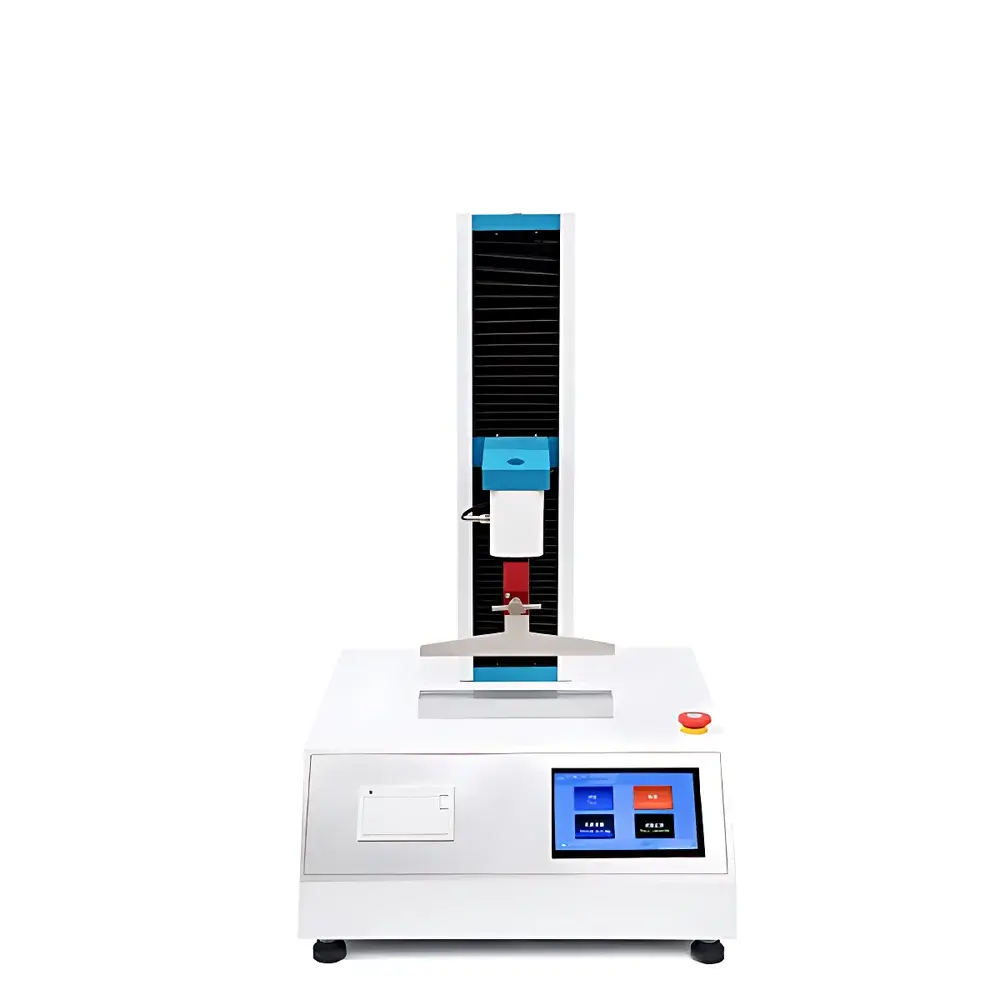
Jihengpin HP-ZRD-1000D Rubber Softness Tester
| Brand | Jihengpin |
|---|---|
| Origin | Shandong, China |
| Manufacturer Type | Direct Manufacturer |
| Product Category | Domestic |
| Model | HP-ZRD-1000D |
| Measuring Range | 10–1000 mN |
| Test Speed | 10 mm/min |
| Specimen Dimensions | 100×50 mm, 100×80 mm, 100×100 mm |
| Accuracy Class | Class 1 |
| Indenter Thickness | 2 mm (±0.05 mm tolerance) |
| Force Resolution | 0.001 N |
| Clamp Jaw Width | 18 mm |
| Speed Adjustment | Digital DC motor, 1–1000 mm/min |
| Drive System | Arc-synchronous timing belt + precision ball screw |
| Display | Touchscreen LCD, full Chinese UI |
| Power Supply | 200 V, 50 Hz |
| Host Dimensions | 540 × 280 × 1450 mm |
| Weight | ~70 kg |
Overview
The Jihengpin HP-ZRD-1000D Rubber Softness Tester is a dedicated mechanical testing instrument engineered for the quantitative evaluation of softness in elastomeric diaphragms and thin rubber components—primarily used in domestic gas metering systems. It operates on the principle defined in HG/T 2178–2019, which specifies a standardized bending deformation method: a rectangular rubber specimen is clamped horizontally and bent into a controlled arch; a flat indenter then applies axial load at the apex until collapse occurs. The peak force required to induce this controlled flattening is recorded and expressed as softness in newtons per meter (N/m), directly correlating with flexibility, resilience, and low-stress compliance under cyclic diaphragm operation.
Key Features
- High-resolution force measurement: Equipped with a calibrated load cell offering 0.001 N resolution and Class 1 accuracy per GB/T 228.1, ensuring traceable, repeatable quantification of softness across production batches.
- Precision electromechanical actuation: Digital DC motor drive with closed-loop speed control enables stable, noise-free displacement rates from 1 to 1000 mm/min—optimized for both rapid screening and slow-rate creep-sensitive evaluations.
- Architecturally robust single-column frame: Rigid aluminum-alloy construction with arc-synchronous timing belt transmission and preloaded ball screw assembly minimizes mechanical hysteresis and backlash, preserving signal fidelity during dynamic loading.
- Intuitive touchscreen interface: Full-color LCD with native Chinese GUI supports real-time display of test force, displacement, peak value, velocity, and system status—eliminating legacy LED-digit reliability issues while enabling immediate operator feedback.
- Automated test sequence execution: Predefined test parameters—including target speed, stop condition (e.g., force threshold or displacement limit), and data sampling interval—trigger fully autonomous test initiation, loading, and termination.
- Dedicated softness fixture set: Includes dual fixed-width clamping jaws (18 mm inner width), a 2 mm-thick flat indenter (±0.05 mm dimensional tolerance), and alignment guides conforming to HG/T 2178–2019 geometric requirements for specimen support and loading geometry.
Sample Compatibility & Compliance
The HP-ZRD-1000D accommodates standard specimen formats specified in HG/T 2178–2019: 100 × 50 mm, 100 × 80 mm, and 100 × 100 mm rubber diaphragms. Its mechanical design ensures consistent edge constraint and uniform arch formation prior to indentation—critical for eliminating boundary-condition variability. While primarily aligned with the Chinese chemical industry standard HG/T 2178–2019, the instrument’s force calibration traceability (via internal load cell verification routines), dimensional repeatability, and documented uncertainty budget support cross-referencing with ISO 7619-1 (rubber hardness), ASTM D3574 (flexible cellular materials), and internal QC protocols for gas meter component qualification. The system meets GB/T 8942 for aesthetic and structural conformity and complies with GB 4793.1–2007 (safety requirements for electrical equipment).
Software & Data Management
The embedded firmware provides local data storage for up to 500 test records, each containing timestamp, specimen ID, force–displacement curve (sampled at ≥100 Hz), peak load, and pass/fail flagging based on user-defined thresholds. Export is supported via USB 2.0 to CSV format for post-processing in Excel, MATLAB, or LIMS environments. Though not natively compliant with FDA 21 CFR Part 11, the system supports manual audit trail documentation through printed test reports (with operator ID, date/time stamp, and calibration certificate reference). For regulated environments, integration with third-party ELN platforms is feasible via RS-232 or analog voltage output (0–5 V proportional to load).
Applications
- Quality assurance of rubber diaphragms for membrane-type domestic gas meters (e.g., G1.6, G2.5, G4 models)
- R&D evaluation of compound formulation changes affecting low-force elasticity and fatigue resistance
- Batch-to-batch consistency monitoring in rubber molding facilities supplying OEM meter manufacturers
- Pre-shipment inspection for export-grade gas meter components targeting ASEAN, Middle East, and African markets with HG/T-aligned specifications
- Technical validation of reclaimed or bio-based elastomer alternatives in diaphragm applications
FAQ
What standard does the HP-ZRD-1000D comply with?
It is designed and validated per HG/T 2178–2019, the Chinese industry standard for testing rubber diaphragms used in diaphragm gas meters.
Can the instrument measure specimens outside the listed dimensions?
Only specimens matching the three defined sizes (100 × 50 mm, 100 × 80 mm, 100 × 100 mm) ensure geometric conformity with the standard’s arch formation and clamping requirements.
Is calibration certification included with delivery?
Yes—a factory calibration certificate traceable to CNAS-accredited national standards is supplied with each unit, including load verification points at 10%, 50%, and 100% of full scale.
Does the system support multi-speed ramp profiles?
No—it executes single-speed constant-rate compression per HG/T 2178–2019; programmable multi-stage profiles are not implemented in the base firmware.
What maintenance is required for long-term accuracy?
Annual recalibration of the load cell and mechanical verification of indenter thickness and jaw parallelism are recommended; no lubrication or consumable parts are required under normal operating conditions.



