
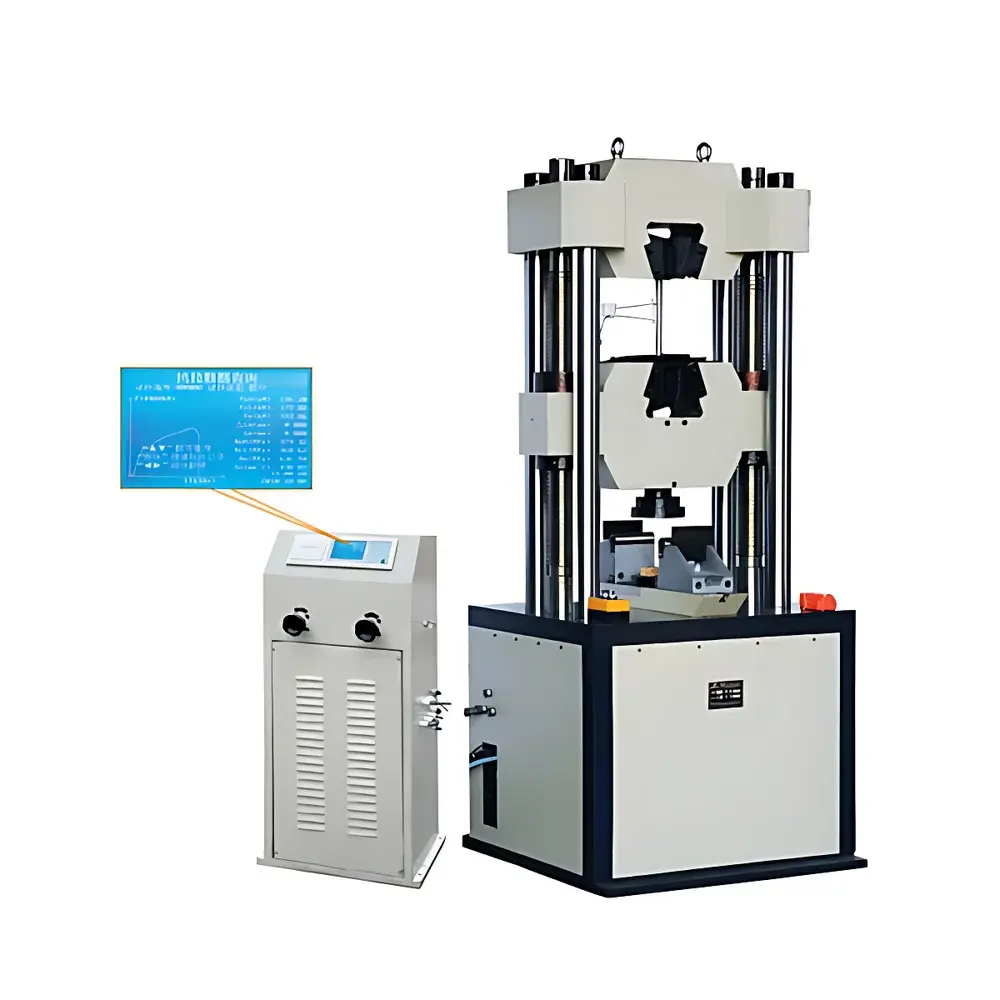
YANRUN WES-600 Digital Hydraulic Universal Testing Machine
| Brand | YANRUN |
|---|---|
| Origin | Shanghai, China |
| Manufacturer Type | Direct Manufacturer |
| Model | WES-600 |
| Max Test Force | 600 kN |
| Force Measurement Range | 4–100% FS |
| Force Accuracy | ≤ ±1% of reading |
| Force Resolution | 0.01 kN |
| Tensile Space | 650 mm |
| Compression Space | 380 mm |
| Gripping Method | Manual (hydraulic option available) |
| Round Specimen Clamping Diameter | Φ13–40 mm |
| Flat Specimen Thickness Capacity | 0–15 mm (optional: 15–30 mm) |
| Flat Specimen Max Width | 75 mm |
| Structural Layout | Bottom-mounted hydraulic actuator |
| Safety Protection | Overload and stroke limit protection |
| Display | LCD digital interface |
Overview
The YANRUN WES-600 Digital Hydraulic Universal Testing Machine is a statically rated, bottom-mounted electro-hydraulic universal testing system engineered for precision mechanical property evaluation of metallic, polymeric, and composite materials under tension, compression, bending, and shear loading conditions. Utilizing a robust dual-column frame with a low-profile hydraulic actuator positioned beneath the crosshead, the WES-600 achieves optimal center-of-gravity stability and operational safety while maintaining a compact footprint—ideal for constrained laboratory or quality control environments. Its force measurement architecture employs high-stability load cells calibrated to ISO 7500-1 Class 1 accuracy standards, delivering traceable force readings across 4–100% of full scale (FS) with a resolution of 0.01 kN and an indicated error not exceeding ±1% of reading. The system operates on a closed-loop hydraulic servo-control principle, where real-time feedback from displacement transducers and load cells regulates oil flow via proportional valves—ensuring consistent strain rate control per ASTM E8/E8M and ISO 6892-1 requirements.
Key Features
- Bottom-mounted hydraulic actuation design reduces overall machine height and improves structural rigidity during high-load testing.
- LCD digital display panel provides intuitive local readout of real-time load, displacement, and test duration—no external PC required for basic operation.
- Integrated overload and stroke-limit protection circuits safeguard the actuator, load cell, and specimen fixture assembly against mechanical damage during abnormal loading events.
- Hydraulically assisted manual gripping system ensures repeatable clamping force and minimizes slippage; optional fully hydraulic clamping kits are available for high-throughput production testing.
- Modular frame architecture supports field-upgradable accessories including extensometers (contact and non-contact), environmental chambers (-70°C to +300°C), and wedge-type or pneumatic grips.
- Standard RAL color finish options available; custom powder-coated enclosures can be specified to meet facility integration or safety zoning requirements.
Sample Compatibility & Compliance
The WES-600 accommodates standardized tensile specimens per ASTM E8, ISO 6892-1, and GB/T 228.1—including round bars (Φ13–40 mm), flat strips (up to 75 mm wide × 15 mm thick, extendable to 30 mm with optional jaw sets), and notched impact preforms when used in conjunction with pendulum impact adapters. Its 650 mm tensile and 380 mm compression clearances comply with minimum dimensional requirements for Type A and B tensile specimens up to 200 mm gauge length. All force transducers are factory-calibrated to ISO/IEC 17025-accredited procedures, and the system supports periodic verification per ASTM E4 and ISO 7500-1. Documentation packages include calibration certificates with uncertainty budgets, traceable to NIM (National Institute of Metrology, China) standards.
Software & Data Management
While the WES-600 operates independently via its embedded LCD controller, it features RS-232 and USB interfaces for seamless integration with third-party data acquisition platforms. Optional YANRUN TestMaster™ software (v4.2+) enables automated test sequencing, multi-curve overlay, modulus calculation (tangent, secant, chord), yield point determination (0.2% offset, automatic peak detection), and export to CSV, PDF, and XML formats. Audit trails, user-level access control (admin/operator/guest), and electronic signature support align with GLP and GMP documentation requirements. Raw data files retain native timestamping, sensor ID metadata, and environmental logging (when paired with optional temperature/humidity sensors), satisfying FDA 21 CFR Part 11 readiness criteria when deployed with validated software configurations.
Applications
- Mechanical validation of structural steel, aluminum alloys, and stainless grades in metallurgical QA/QC labs.
- Tensile strength, yield strength, elongation at break, and Young’s modulus characterization for polymer extrusions and injection-molded components.
- Compression testing of concrete cylinders, ceramic tiles, and foam insulation materials per ASTM C39, ISO 844, and GB/T 8813.
- Bending performance assessment of laminated composites and fiber-reinforced plastics using three-point or four-point loading fixtures.
- Verification of fastener mechanical properties—including bolt proof load, nut prevailing torque, and washer deformation—per ISO 898 and ASTM F606.
- Supporting ISO 17025 accredited testing laboratories requiring documented metrological traceability and reproducible force application.
FAQ
Is the WES-600 compliant with international testing standards such as ASTM and ISO?
Yes—the WES-600 meets the mechanical and metrological requirements of ASTM E4, E8/E8M, and ISO 7500-1 for force measurement systems, and supports test execution per ASTM E9, E292, ISO 6892-1, and ISO 37.
Can the machine be integrated into an existing LIMS or MES environment?
Yes—via ASCII-based serial protocol or Modbus TCP (with optional communication module), enabling bidirectional data exchange with laboratory information management systems and manufacturing execution systems.
What is the recommended maintenance schedule for the hydraulic system?
YANRUN specifies quarterly hydraulic oil inspection, annual filter replacement, and biennial load cell recalibration—aligned with ISO 13849-1 functional safety guidelines for industrial machinery.
Does the system support extensometer attachment for true strain measurement?
Yes—standard M6 threaded mounting points and analog/digital signal inputs (±10 V, LVDT, or strain-gauge compatible) allow integration of clip-on, video, or laser extensometers.
Is remote diagnostics or firmware update capability available?
Firmware updates are performed locally via USB drive; remote diagnostic support is provided through secure VPN-assisted sessions with YANRUN technical engineers under signed NDA agreements.
Related Products



