
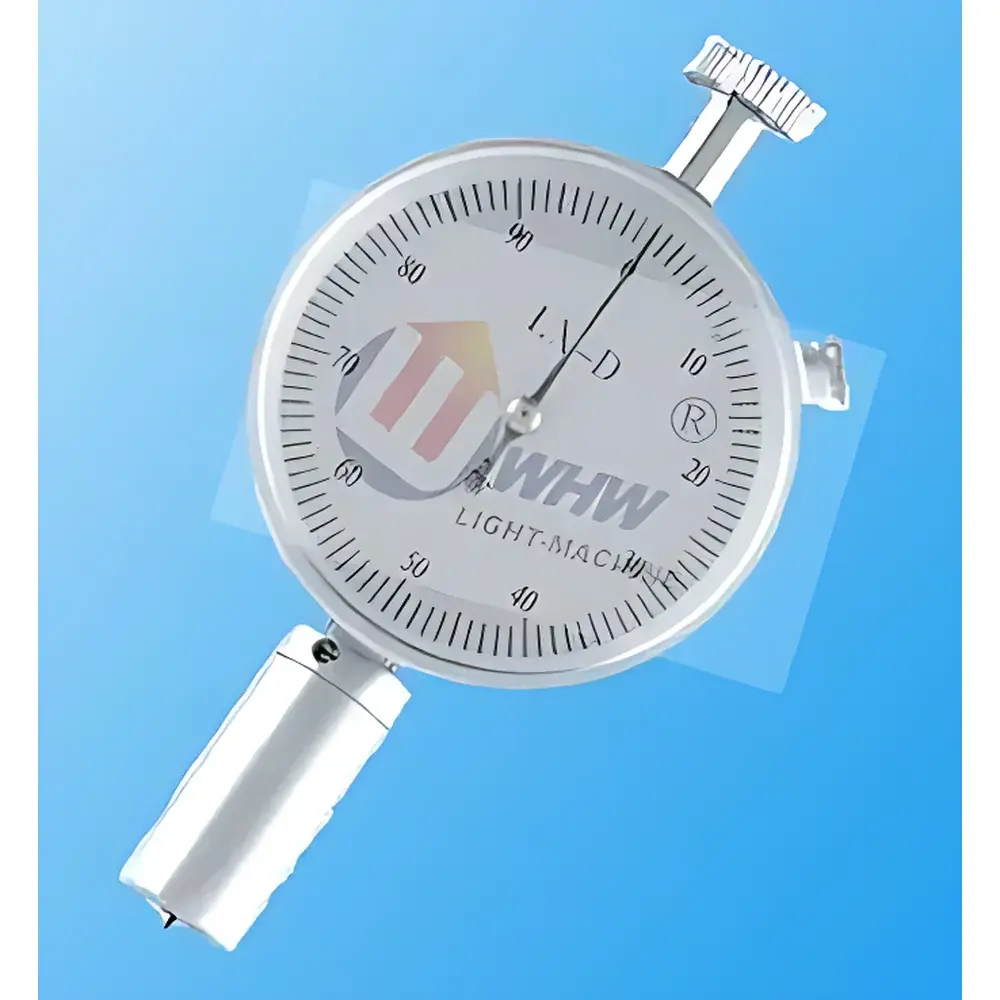
Shore D Hardness Tester MC010-LX-D
| Origin | Shanghai, China |
|---|---|
| Manufacturer Type | Distributor |
| Origin Category | Domestic (China) |
| Model | MC010-LX-D |
| Price | Upon Request |
| Scale Range | 0–100 HD |
| Recommended Measurement Range | 20–90 HD |
| Indenter Travel | 2.5 mm |
| Indenter Tip Radius | 0.1 mm (SR) |
| Dimensions | 115 × 60 × 25 mm |
| Weight | ~0.5 kg |
Overview
The Shore D Hardness Tester MC010-LX-D is a manually operated durometer engineered for the quantitative assessment of indentation hardness in rigid polymeric and elastomeric materials. It operates on the principle defined in ASTM D2240 and ISO 868, where hardness is determined by measuring the depth of penetration of a standardized conical indenter under a fixed spring-loaded force. Specifically calibrated for Shore D scale applications, this instrument delivers repeatable measurements on materials with higher rigidity—such as thermoset plastics, rigid PVC, acrylic sheets, fiberglass-reinforced composites, laminated circuit boards, and hardened rubber compounds—where softer Shore A or C scales would saturate or lack resolution. Its mechanical design complies with GB/T 531.1–2008 (equivalent to ISO 868:2003), ensuring metrological traceability for quality control laboratories operating under GLP or internal manufacturing specifications. The device requires no external power source, making it suitable for both benchtop use in QC labs and field verification during incoming material inspection or production line audits.
Key Features
- Mechanically robust, all-metal housing with precision-machined indenter assembly for long-term dimensional stability and resistance to thermal drift
- Direct-reading analog dial gauge (0–100 HD) with high-contrast刻度 markings and parallax-free pointer alignment
- Compact ergonomic form factor (115 × 60 × 25 mm) enabling one-handed operation without compromising measurement repeatability
- Interchangeable indenter configuration compliant with ASTM D2240 Type D geometry: 30° conical tip with 0.1 mm spherical radius (SR)
- Spring-loaded actuation mechanism delivering consistent 44.5 N (10 lbf) nominal test force per ISO 868 requirements
- Optional mounting compatibility with standardized Shore durometer test stands (e.g., MC010-STD-D series) for fixed-load, perpendicular-axis testing per ASTM D2240 Section 7.2
Sample Compatibility & Compliance
The MC010-LX-D is validated for use on flat, smooth, and homogeneous specimens ≥6 mm thick and ≥15 mm in lateral dimension—conditions necessary to prevent substrate deformation and ensure valid surface indentation response. It is unsuitable for foams, gels, or highly anisotropic textiles unless pre-conditioned and supported per ISO 2482. Calibration verification follows ISO 14644-1 protocols using certified reference blocks traceable to NIM (National Institute of Metrology, China) or NIST SRM 2450/2451 equivalents. Device conformity includes adherence to GB/T 531.1–2008, ASTM D2240–22, and ISO 868:2003. While not inherently 21 CFR Part 11 compliant (as it lacks digital audit trail functionality), its analog output may be documented within GMP-compliant paper-based or hybrid QC records when paired with controlled calibration logs and operator sign-off procedures.
Software & Data Management
As a purely mechanical analog instrument, the MC010-LX-D does not incorporate embedded electronics, firmware, or data connectivity. All readings are recorded manually into laboratory notebooks, LIMS templates, or Excel-based QC spreadsheets. For organizations requiring digital traceability, third-party optical digitizers or smartphone-based dial-read apps (validated per ASTM E2917) may be employed to capture and timestamp readings—though such integration falls outside the manufacturer’s scope of supply and validation. Calibration certificates issued by accredited service providers include uncertainty budgets calculated per ISO/IEC 17025:2017 Annex A.3.
Applications
- Quality assurance of injection-molded engineering thermoplastics (e.g., polycarbonate, ABS, POM) prior to CNC machining or assembly
- In-process verification of vulcanization degree in EPDM and nitrile rubber seals used in automotive and aerospace fluid systems
- Supplier qualification testing of printed circuit board substrates (FR-4, polyimide) for structural integrity under thermal cycling
- Material substitution validation in medical device housings (e.g., rigid PETG enclosures for diagnostic analyzers)
- Educational demonstrations of polymer structure–property relationships in university polymer science laboratories
FAQ
What is the difference between Shore D and Shore A hardness scales?
Shore D measures harder materials (typically >90A) using a steeper indenter angle and higher spring force; Shore A is intended for softer elastomers and flexible rubbers.
Can this durometer be used on curved surfaces?
No—ASTM D2240 mandates flat, uncurved test surfaces ≥6 mm thick to avoid edge effects and inaccurate deflection readings.
How often should the instrument be recalibrated?
Annual calibration is recommended; however, frequency must be risk-assessed per ISO/IEC 17025 and aligned with internal QA protocols—especially after mechanical shock or exposure to temperatures >50°C.
Is the indenter replaceable?
Yes—the SR 0.1 mm conical indenter is a field-serviceable component; replacement parts are supplied with NIST-traceable certification and require revalidation per ISO 868 Annex B.
Does this model meet FDA requirements for medical device manufacturing?
While the device itself is not FDA-certified, its compliance with ISO 868 and GB/T 531.1 supports use in FDA-regulated environments when integrated into a validated measurement process per 21 CFR Part 820.72.



