
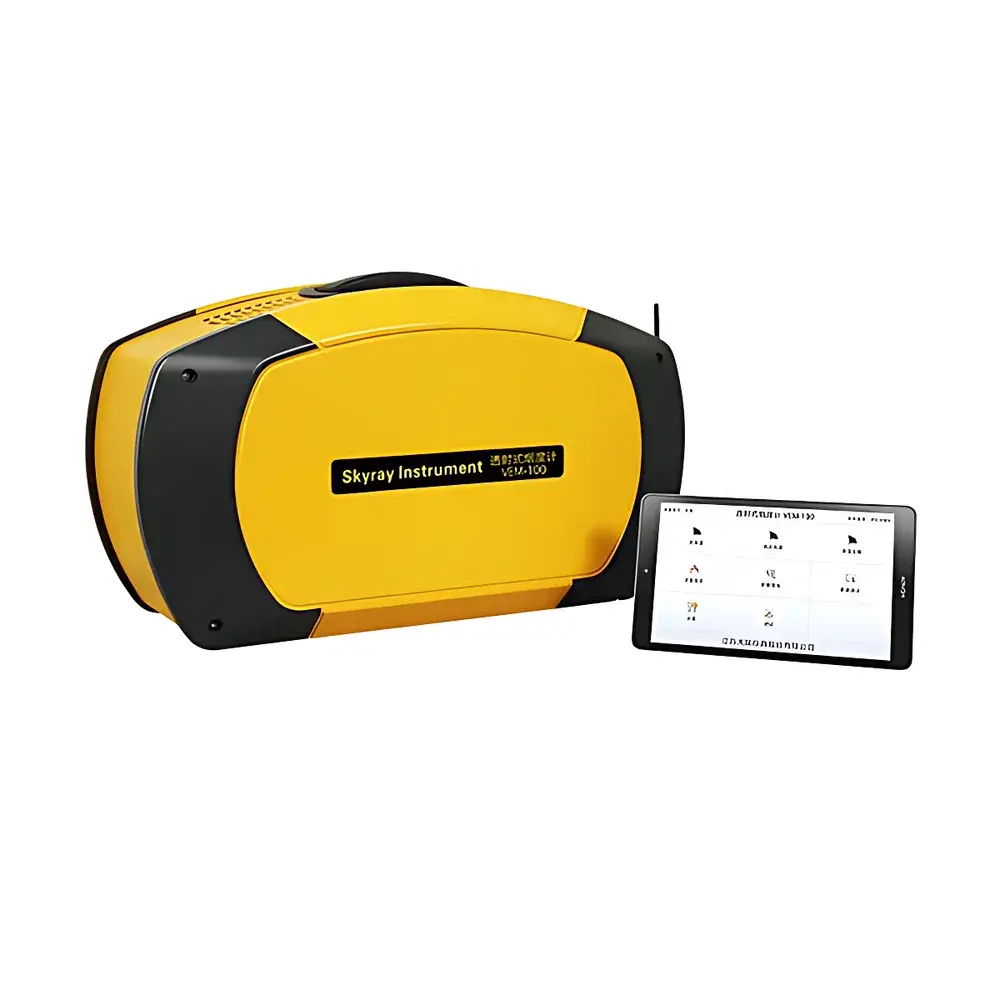
SkyRay VEM-100 Transmittance-Type Opacity Meter
| Brand | SkyRay Instrument |
|---|---|
| Origin | Jiangsu, China |
| Manufacturer Type | Direct Manufacturer |
| Country of Origin | China |
| Model | VEM-100 |
| Instrument Type | Portable |
| Measurement Principle | Optical Transmission (Light Absorption) |
| Max. Permissible Error | ±2.0% |
| Zero Drift | ≤1.0% |
| Span Drift | ≤1.0% |
| Repeatability | ≤1.0% |
| Light Absorption Coefficient (k) Resolution | 0.001 m⁻¹ |
| Opacity (N) Resolution | 0.01% |
| Operating Temperature Compensation | Integrated |
| Optional NOₓ Module | Available |
| Remote Control Interface | Industrial-grade Wi-Fi (up to 100 m) & Bluetooth |
| Data Output | Real-time cloud upload, QR code sharing, thermal printing |
| Dimensions | 470 × 195 × 280 mm |
| Weight | ~7.5 kg |
Overview
The SkyRay VEM-100 Transmittance-Type Opacity Meter is a portable, microprocessor-controlled instrument engineered for the quantitative measurement of visible particulate emissions from compression-ignition (diesel) engines. It operates on the principle of optical transmission attenuation—measuring the reduction in intensity of a collimated infrared or visible light beam as it passes through an exhaust gas stream. The instrument calculates two primary regulatory parameters: the light absorption coefficient (k, expressed in m⁻¹), and opacity (N, expressed as a percentage), both defined and standardized under GB 3847–2018, China’s national standard for diesel vehicle emission testing. Designed for field-deployable compliance verification, the VEM-100 supports both free-acceleration and loaded-mode test cycles, delivering traceable, repeatable measurements under variable ambient conditions—including extreme cold and high-temperature environments—thanks to its integrated temperature compensation algorithm.
Key Features
- Optical transmission architecture with dual-wavelength (optional) path-length calibration, ensuring robustness against lens fouling and signal drift.
- Real-time simultaneous acquisition of k-value (resolution: 0.001 m⁻¹) and opacity N (resolution: 0.01%), meeting the minimum resolution requirements specified in GB 3847–2018 Annex C.
- Integrated industrial-grade Wi-Fi module enabling stable remote control up to 100 meters; eliminates line-of-sight constraints during chassis dynamometer or roadside inspections.
- Auto-switching pneumatic manifold for seamless transition between zero-air calibration, span-gas verification, and sample aspiration—reducing operator intervention and procedural error.
- Optional electrochemical or NDIR-based NOₓ analysis module, allowing concurrent measurement of gaseous pollutants alongside opacity metrics within a single instrument footprint.
- Onboard self-diagnostic routines—including optical path integrity check, lamp intensity monitoring, and detector linearity validation—to ensure measurement validity prior to each test sequence.
- Dual-pressure interface support: standard vacuum/pressure port for real-time exhaust backpressure logging, aligned with diagnostic requirements for EGR and DPF health assessment.
Sample Compatibility & Compliance
The VEM-100 is validated for use with undiluted diesel exhaust streams from light-duty and heavy-duty vehicles, off-road machinery, and stationary diesel generators. Its sampling probe meets ISO 8573-1 Class 4 particulate cleanliness specifications when used with optional heated line filtration. All opacity measurements comply with GB 3847–2018, and the instrument’s metrological performance—including zero drift (≤1.0% over 30 min), span drift (≤1.0% over 30 min), and repeatability (≤1.0% RSD)—is verified per JJG 976–2019 (Chinese National Verification Regulation for Opacity Meters). Firmware and data handling protocols support audit-ready operation under GLP-aligned workflows, including timestamped metadata embedding and tamper-evident file encryption for uploaded datasets.
Software & Data Management
The VEM-100 operates via an embedded Android-based tablet interface with purpose-built firmware compliant with ISO/IEC 17025 documentation traceability requirements. Synchronized multi-parameter visualization includes overlay plots of k-value, opacity %, engine speed (RPM), coolant temperature, and optional NOₓ concentration—all time-stamped and aligned to millisecond-level precision. Data export supports CSV, PDF, and encrypted binary formats. Bluetooth-enabled thermal printing generates calibrated reports with embedded QR codes linking to cloud-hosted raw datasets. All measurement records include digital signatures, operator ID, GPS coordinates (when enabled), and system health logs—facilitating FDA 21 CFR Part 11–compatible electronic record retention where required.
Applications
- Regulatory enforcement: roadside emission screening and periodic inspection at authorized motor vehicle testing stations.
- Engine development: real-time opacity feedback during transient cycle testing (e.g., WHTC, WHSC) in OEM powertrain labs.
- Aftertreatment diagnostics: correlation of opacity spikes with DPF regeneration events or SCR catalyst deactivation trends.
- Fleet maintenance: preventive assessment of injector wear, turbocharger efficiency loss, or air intake restriction in commercial transport operations.
- Academic research: particulate mass estimation modeling using k-to-PM₂.₅ correlation coefficients derived from gravimetric filter sampling co-location studies.
FAQ
What standards does the VEM-100 comply with for official diesel emission testing?
It conforms to GB 3847–2018, JJG 976–2019, and incorporates design elements consistent with ISO 20845 and EN 15854 for opacity meter performance validation.
Can the VEM-100 be used for continuous emissions monitoring (CEM) applications?
No—it is designed for periodic compliance testing per GB 3847–2018, not for unattended, long-term stack monitoring. Continuous operation requires additional environmental enclosures and certification per HJ 75–2017.
Is firmware update capability available remotely?
Yes. Over-the-air (OTA) updates are supported via secure HTTPS channel with SHA-256 signature verification and rollback protection.
Does the device support third-party data integration?
Yes. RESTful API endpoints enable bidirectional communication with LIMS, fleet management platforms, and municipal environmental monitoring networks.
How is measurement traceability maintained across calibration intervals?
Each unit ships with a factory-issued calibration certificate traceable to NIM (National Institute of Metrology, China); user-performed zero/span checks are logged with cryptographic hash timestamps and stored locally and in the cloud.







