
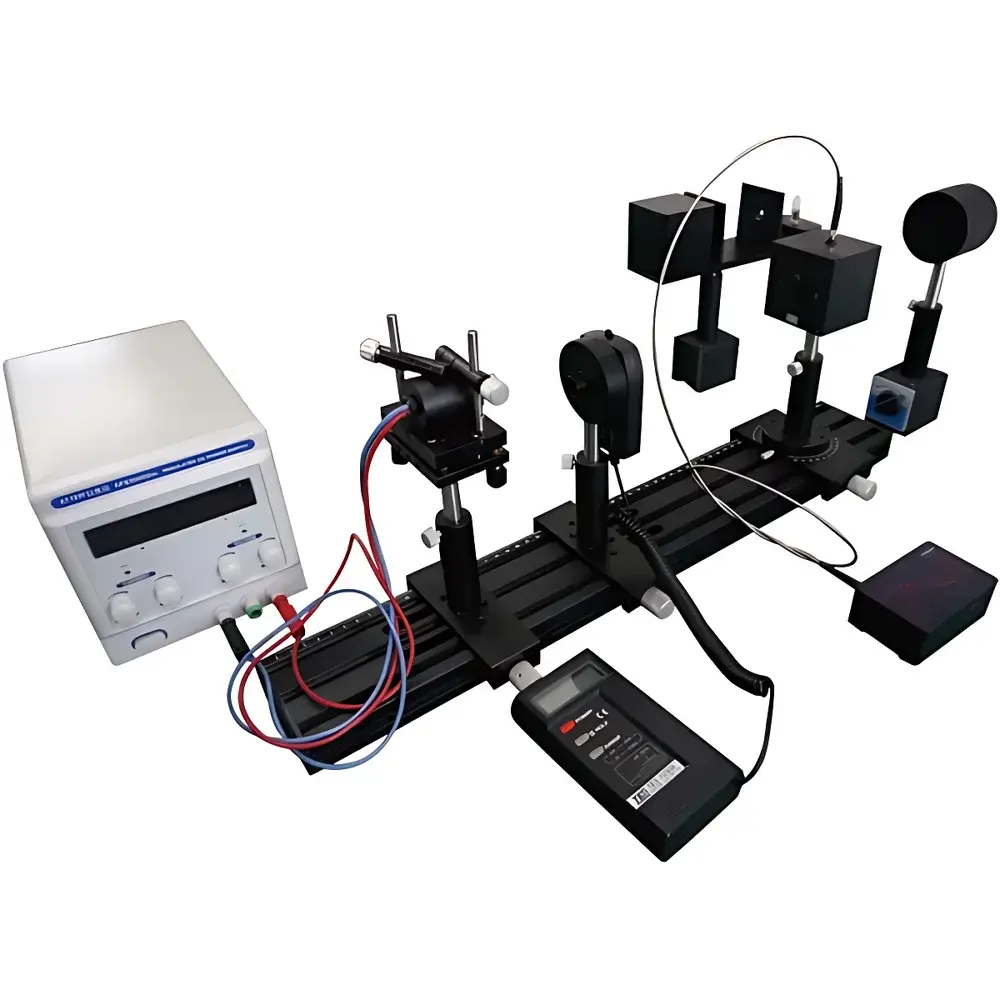
Radiometry, Photometry, and Colorimetry Comprehensive Experiment System
| Brand | YIXIST |
|---|---|
| Model | ROE-ME04 |
| Type | Educational Practical Training Device for Optical Metrology |
| Origin | Zhejiang, China |
| Compliance | Designed for ISO/CIE-aligned academic metrology education |
| Software Interface | CIE 1931 xy Chromaticity Diagram Integration, Spectral Data Export (CSV, TXT) |
| Measurement Support | Radiant Flux (W), Luminous Flux (lm), Illuminance (lx), Luminous Efficacy (lm/W), Chromaticity Coordinates (x, y), Correlated Color Temperature (CCT, K) |
Overview
The YIXIST ROE-ME04 Radiometry, Photometry, and Colorimetry Comprehensive Experiment System is an integrated educational platform engineered for university-level optics, photonics, and illumination engineering curricula. It enables hands-on instruction in the foundational photometric and radiometric measurement disciplines defined by the International Commission on Illumination (CIE) and standardized under ISO/CIE 11664 and ISO/CIE 11754. The system operates on core physical principles: radiometric measurements quantify electromagnetic power across the full optical spectrum (200–2500 nm) using calibrated silicon photodiodes and thermopile sensors; photometric measurements apply the CIE photopic luminosity function V(λ) to weight spectral irradiance into human-eye-referenced quantities (e.g., luminous flux in lumens); colorimetric analysis employs tristimulus integration with CIE 1931 2° standard observer functions to compute chromaticity coordinates (x, y), dominant wavelength, excitation purity, and correlated color temperature (CCT). This tripartite architecture supports quantitative traceability to national metrology institutes via NIST-traceable calibration certificates supplied with each sensor module.
Key Features
- Modular sensor suite including broadband radiometric detector (±3% uncertainty, 350–1100 nm), V(λ)-matched photometric head (f₁′ < 4%, per CIE S 023/E:2013), and fiber-coupled spectroradiometer (360–850 nm, 2 nm optical resolution)
- Integrated LED-based tunable light source with adjustable current control (0–350 mA), enabling spectral power distribution (SPD) variation for efficacy and color rendering studies
- Dedicated experiment control unit with real-time data acquisition (10 Hz sampling), digital display of SI units, and USB/RS-232 interface for external logging
- Pre-configured experiment protocols aligned with undergraduate laboratory syllabi — including inverse square law verification, luminous efficacy calculation, additive color mixing, and chromaticity diagram mapping
- Robust aluminum-alloy optical bench (600 mm length, M6 threaded mounting holes) with precision translation stages (±0.1 mm repeatability) for controlled distance and alignment experiments
Sample Compatibility & Compliance
The ROE-ME04 accommodates a wide range of light-emitting samples: incandescent filaments, halogen lamps, fluorescent tubes, white and monochromatic LEDs, OLED panels, and laser diodes (Class 1/2 only). All optical paths comply with IEC 62471 photobiological safety classification requirements for educational use. Calibration documentation adheres to ISO/IEC 17025 guidelines, with individual sensor calibration reports traceable to NIM (National Institute of Metrology, China) standards. The system supports teaching compliance with CIE Publication 127:2007 (LED measurement), CIE 13.3 (color rendering index), and ANSI/IES LM-79-19 (electrical and photometric measurements of solid-state lighting). No hazardous materials or high-voltage components are employed — all circuits operate at ≤24 V DC.
Software & Data Management
The ROE-ME04 includes YIXIST LabView-compatible software (Windows 10/11) that provides real-time spectral visualization, CIE 1931 xy chromaticity plotting, CCT calculation via McCamy’s cubic approximation, and automatic generation of photometric reports compliant with GLP documentation templates. Raw spectral data exports in CSV and plain-text formats support post-processing in MATLAB, Python (NumPy/Pandas), or OriginLab. Audit trail functionality logs user ID, timestamp, instrument configuration, and calibration status for each measurement session — satisfying basic requirements for academic integrity and curriculum assessment frameworks. While not FDA 21 CFR Part 11 certified (as intended for teaching, not regulated production), the software architecture supports export of metadata-rich datasets suitable for accreditation reviews (e.g., ABET Criterion 3 student outcome assessment).
Applications
This system serves as a pedagogical bridge between theoretical radiative transfer models and real-world optical metrology practice. Typical applications include: validating Lambert’s cosine law and inverse-square law using calibrated illuminance probes; calculating luminous efficacy (lm/W) from simultaneous electrical input (wattmeter) and photometric output (integrating sphere or goniophotometer mode); analyzing metamerism through spectral comparison of different white-light sources; determining color rendering index (CRI) and TM-30 metrics using spectral decomposition; and investigating the impact of optical filters on spectral transmittance and resultant chromaticity shift. It further supports capstone projects involving smart lighting control algorithms, daylight harvesting simulation, and human-centric lighting design validation.
FAQ
Is the ROE-ME04 suitable for research-grade measurements?
It is designed for educational accuracy and repeatability (±3–5% typical uncertainty), not primary metrology. For NIST-traceable R&D, users should supplement with accredited calibration services.
Can third-party spectrometers be integrated?
Yes — the system features standard SMA-905 fiber ports and provides spectral response correction files for interoperability with Ocean Insight, Avantes, or StellarNet devices.
Does it support CIE 1964 10° observer calculations?
Basic software includes CIE 1931 2°; CIE 1964 10° observer functions are available via optional firmware update and MATLAB script library.
What safety certifications does the unit hold?
CE marking per EN 61010-1:2010 for laboratory electrical equipment; no Class 3B/4 lasers or UV-C sources are included.
Is training material provided in English?
Yes — comprehensive English-language lab manuals, experiment worksheets, instructor guides, and PowerPoint lecture decks are included with every unit.




