
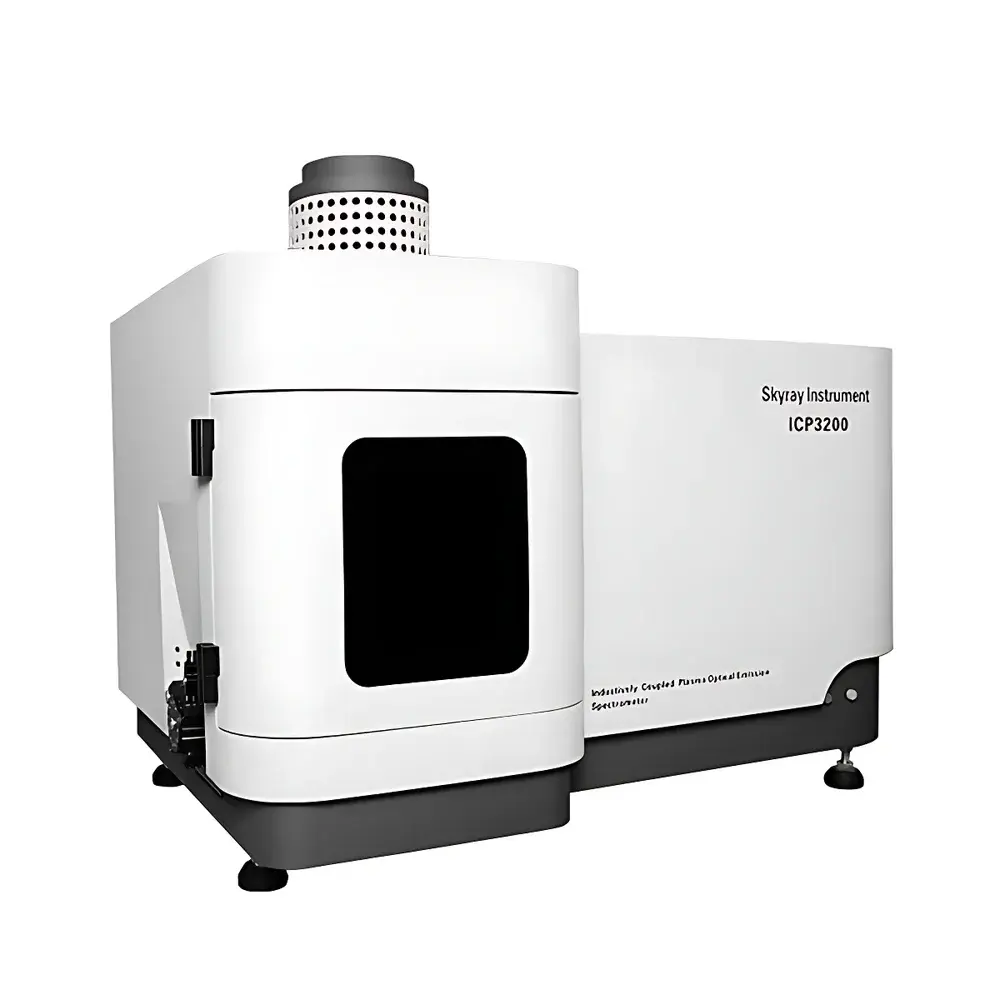
SkyRay Instrument ICP 3200 Full-Spectrum Direct-Reading Inductively Coupled Plasma Optical Emission Spectrometer
| Brand | SkyRay Instrument |
|---|---|
| Origin | Jiangsu, China |
| Manufacturer Type | Original Equipment Manufacturer (OEM) |
| Regional Classification | Domestic (PRC) |
| Model | ICP 3200 |
| Instrument Type | Full-Spectrum Direct-Reading ICP-OES |
| Power Supply | Frequency-Convertible RF Generator |
| Optical Configuration | Dual-View (Axial & Radial) Simultaneous Observation |
| Spectral Coverage | 165–900 nm |
| Detector | Back-Illuminated CCD with Deep Depletion Technology |
| Resolution | ≤0.007 nm at 200 nm |
| Wavelength Calibration | Automated 2D Spatial Mapping Algorithm |
| Software Compliance | Supports Audit Trail, User Access Levels, and Electronic Signature per FDA 21 CFR Part 11 Requirements |
Overview
The SkyRay Instrument ICP 3200 is a full-spectrum direct-reading inductively coupled plasma optical emission spectrometer engineered for high-throughput, multi-element quantitative and qualitative analysis in regulated and research laboratory environments. It operates on the fundamental principle of inductively coupled plasma atomic emission spectroscopy (ICP-OES), where liquid samples are nebulized into an argon plasma sustained at ~6,000–10,000 K, causing atomization, excitation, and subsequent emission of element-specific photons across the ultraviolet–visible–near-infrared spectrum (165–900 nm). Unlike sequential scanning instruments, the ICP 3200 captures the entire emission spectrum simultaneously using a high-quantum-efficiency, back-illuminated charge-coupled device (CCD) detector with deep depletion architecture—enabling detection of trace to major constituents without dwell-time compromises. Its dual-view optical path supports both axial and radial plasma observation modes, automatically selected by software based on elemental emission characteristics, matrix complexity, and required detection limits—thereby optimizing sensitivity for volatile elements (e.g., As, Se, Pb) in axial view and robustness against polyatomic interferences (e.g., ArO⁺, ClO⁺) in radial view.
Key Features
- Dual-view intelligent optical positioning: Motorized optical path switching enables real-time selection between axial and radial plasma observation; system self-calibrates spatial coordinates upon startup, eliminating manual torch alignment or repeated peak centering.
- Full-spectrum acquisition with high-resolution dispersion: Equipped with a Czerny–Turner monochromator and thermally stabilized optical bench, delivering spectral resolution ≤0.007 nm at 200 nm and wavelength repeatability < ±0.002 nm over 8-hour operation.
- Proprietary 2D spectral mapping algorithm: Replaces conventional single-wavelength calibration with coordinate-based wavelength referencing across the entire detector surface—reducing calibration frequency to once per weekly maintenance cycle under GLP-compliant workflows.
- Multi-peak fitting and interference correction: Implements constrained Gaussian–Lorentzian deconvolution to resolve overlapping emission lines (e.g., Fe 238.204 nm / Cr 238.203 nm), suppressing spectral interferences from complex matrices such as metallurgical slags or geological digests.
- Automated method development engine: Built-in spectral database cross-references >12,000 certified emission lines (NIST SRD 78) with user-defined analytes; recommends optimal observation mode, integration time, and background correction zones prior to measurement.
Sample Compatibility & Compliance
The ICP 3200 accommodates aqueous solutions (0.1–5% v/v HNO₃/HCl), organic solvents (up to 30% MIBK or xylene with micro-nebulization), and digested solid matrices including soils (EPA Method 6010D), ores (ASTM D5686), catalysts, and polymer leachates (EN71-3). Sample introduction utilizes a concentric glass nebulizer and cyclonic spray chamber, compatible with autosamplers meeting ISO 8655-4 precision standards. The instrument conforms to key regulatory frameworks: hardware and firmware support audit trail logging, role-based user authentication, and electronic signature enforcement aligned with FDA 21 CFR Part 11 and EU Annex 11 requirements. Routine performance verification follows ASTM D1976 (water analysis), ISO 11885 (wastewater metals), and USP for pharmaceutical elemental impurities.
Software & Data Management
SkyRay’s proprietary ICP Analysis Suite v4.2 provides a validated, modular interface compliant with GxP data integrity principles. It features stepwise method setup wizards, automated QC flagging (e.g., drift correction via internal standard ratio thresholds), and batched result export in ASTM E1382-compliant .csv and .xml formats. All raw spectral files (.spc) retain embedded metadata—including lamp status, RF power history, gas flow logs, and detector temperature—ensuring full traceability. Offline reprocessing allows retrospective background subtraction, peak reintegration, and multivariate interference modeling without re-running samples. Data archives support hierarchical folder structures for sample grouping by project, batch, or regulatory submission ID, with optional encryption and network backup integration.
Applications
The ICP 3200 serves as a primary analytical platform in environmental laboratories performing EPA 200.7 and 6020B compliance testing for heavy metals in drinking water and wastewater. In metallurgy, it quantifies alloying elements (Ni, Co, Mo) and tramp contaminants (Sn, Sb, Bi) in stainless steel melts per ASTM E3061. Geological surveys apply it to rare earth element (REE) fingerprinting in monazite and bastnäsite ores using La/Ce/Nd/Y ratios. Regulatory testing labs deploy it for toy safety (EN71-3 migration limits), precious metal assay (ISO 11426), and catalyst characterization (Pt/Pd/Rh loading in automotive converters). Its dual-view flexibility ensures reliable detection of low-level As (<0.1 µg/L) in groundwater while maintaining linearity up to 100 mg/L for Ca in brine matrices.
FAQ
Does the ICP 3200 support regulatory audit requirements for electronic records?
Yes—the software enforces ALCOA+ principles: attributable, legible, contemporaneous, original, accurate, complete, consistent, enduring, and available. All method changes, calibration events, and result modifications generate immutable timestamps and operator IDs.
Can the system analyze high-salt or suspended particulate samples without clogging?
It supports optional desolvation systems and high-solids nebulizers (e.g., Babington-type); routine operation with saline matrices requires <0.2% total dissolved solids (TDS) unless paired with a microconcentric nebulizer and chilled spray chamber.
Is spectral library update available post-purchase?
Yes—SkyRay provides biannual spectral database updates via secure portal, including newly certified lines for emerging contaminants (e.g., Tl, Te, Ge) and updated interference tables per latest NIST and IUPAC recommendations.
What maintenance intervals are recommended for routine GLP operation?
Daily: Nebulizer inspection and torch cleaning. Weekly: Wavelength calibration verification and plasma gas leak check. Quarterly: RF generator impedance tuning and detector dark current validation. Annual: Full optical alignment and vacuum system integrity test.
How does the dual-view mode selection algorithm determine optimal observation geometry?
The software evaluates ionization potential, excitation energy, and known spectral interference patterns for each target element; it selects axial view for elements with low first ionization potential (<7 eV) and radial view for those prone to oxide formation (e.g., CeO⁺, BaO⁺) or exhibiting strong continuum background in axial configuration.




