
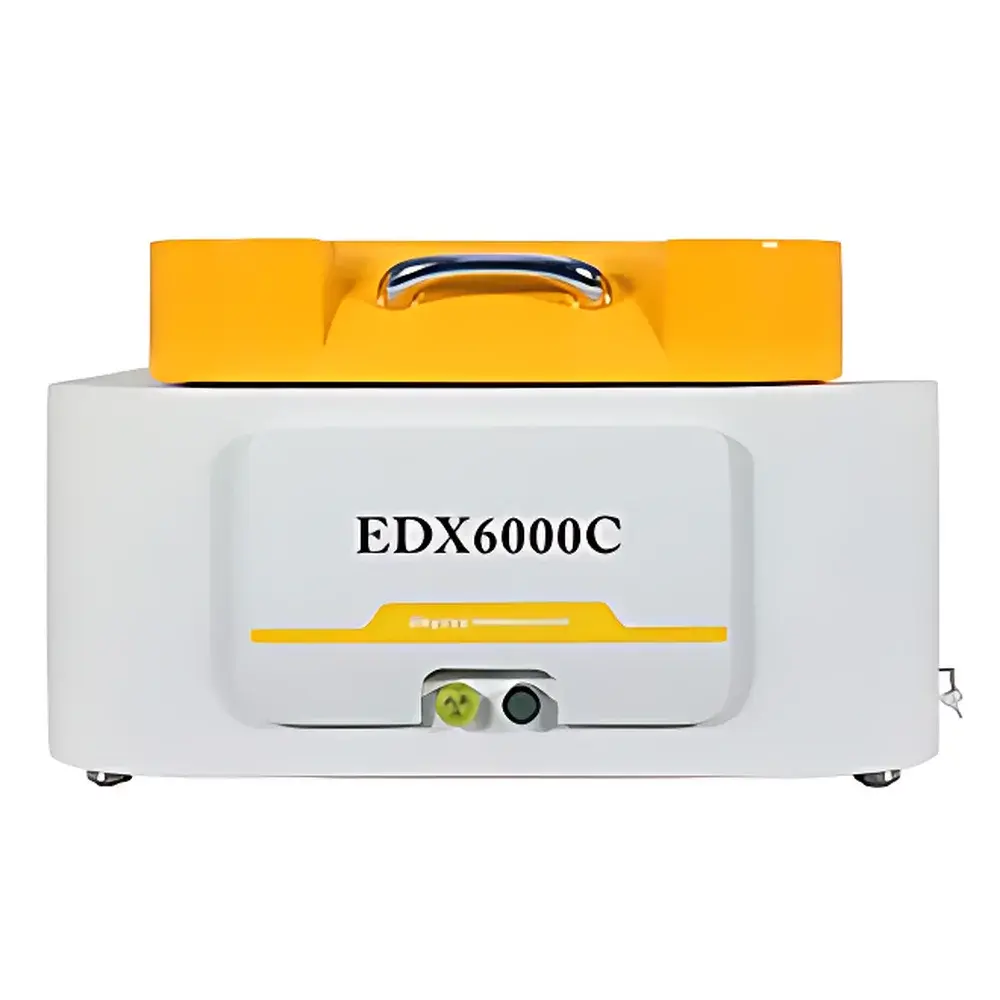
Skyray Instrument EDX6000C Energy Dispersive X-Ray Fluorescence Spectrometer
| Brand | Skyray Instrument |
|---|---|
| Origin | Jiangsu, China |
| Manufacturer Type | Original Equipment Manufacturer (OEM) |
| Model | EDX6000C |
| Configuration | Benchtop / Floor-standing |
| Instrument Type | Conventional ED-XRF |
| Application Scope | Universal |
| Elemental Range | F to U (Atomic Number 9–92) |
| Quantification Range | 0.2 ppm – 99.99 wt% |
| Energy Resolution | <129 eV at Mn Kα |
| Detector | Silicon Drift Detector (SDD), Peltier-cooled, graphene ultra-thin polymer window |
| Sample Handling | PLC-controlled multi-position sample chamber (1/9/12/20 positions), motorized sample rotation |
| Atmosphere Control | Dual-mode vacuum & helium purge |
| Safety System | Triple interlock (detector shutter auto-close, high-voltage key switch, motorized lid lock with electromagnetic latch) |
| Software | SkyRay XRF Composition Analysis Software v4.0 & RoHS Compliance Suite v5.0, AI-driven material recognition and automatic calibration curve selection |
Overview
The Skyray Instrument EDX6000C is a benchtop-to-floor-standing energy dispersive X-ray fluorescence (ED-XRF) spectrometer engineered for high-precision, multi-element quantitative and qualitative analysis of solid, powdered, and liquid samples across diverse industrial and regulatory environments. Based on over a decade of field-proven instrument deployment—exceeding 10,000 installed units—the EDX6000C integrates fundamental advances in excitation geometry, detector physics, and automated sample handling to deliver enhanced sensitivity for light elements (down to fluorine, Z = 9), improved counting statistics, and robust reproducibility under routine laboratory conditions. Its analytical principle relies on primary X-ray excitation of sample atoms, followed by detection of characteristic secondary (fluorescent) X-rays emitted during electron relaxation. The energy-dispersive detection architecture enables simultaneous acquisition of the full elemental spectrum (F–U), with spectral deconvolution performed via peak-fitting algorithms calibrated against certified reference materials traceable to NIST and ISO standards.
Key Features
- Graphene ultra-thin polymer window SDD detector with Peltier cooling: Enables high quantum efficiency for low-energy X-rays (F–Na), critical for light-element quantification in polymers, ceramics, and halogen-free materials.
- Optimized low-loss excitation path: Features a micro-focus X-ray tube with programmable high-voltage (up to 50 kV) and current (up to 1 mA), coupled with collimation optics that minimize scatter and maximize signal-to-background ratio.
- PLC-driven multi-position sample chamber: Supports 1-, 9-, 12-, or 20-position configurations; 12- and 20-position variants allow rapid mechanical reconfiguration to single-sample mode within 1 second for large or irregular specimens.
- Dual-atmosphere control system: Integrated vacuum (<10 Pa) and helium purge (≥99.999% purity) pathways enable seamless switching—critical for detecting F, Na, Mg, Al, and Si in liquids or low-Z matrices without matrix-induced absorption artifacts.
- Motorized sample rotation: Ensures representative averaging for heterogeneous solids (e.g., ores, slag, composites), reducing particle-size and surface-topography bias per ASTM E1621 and ISO 21043.
- Triple-layer hardware safety architecture: Includes (1) automatic SDD shutter closure post-analysis to prevent mechanical puncture; (2) high-voltage interlock keyed to physical access; and (3) electromagnetic lid lock synchronized with X-ray tube power state—fully compliant with IEC 61010-1 and GB/T 18804 requirements.
Sample Compatibility & Compliance
The EDX6000C accommodates flat solids (≤50 mm diameter), pressed pellets (Ø32 mm), loose powders (in quartz or polyethylene cups), and sealed liquid cells (with Mylar or Kapton windows). It supports regulated testing workflows aligned with RoHS Directive 2011/65/EU, ELV 2000/53/EC, Toy Safety Directive 2009/48/EC, and US CPSC 16 CFR Part 1303. Full audit trail, electronic signature support, and user-level permission management comply with FDA 21 CFR Part 11 and GLP/GMP documentation requirements when operated with optional LIMS integration. All calibration curves are validated per ISO 18557 and certified against CRM series such as NIST SRM 2782 (Pb in paint), BAM MM 101 (steel alloys), and IRMM-540R (soil).
Software & Data Management
SkyRay’s XRF Composition Analysis Software v4.0 and RoHS Compliance Suite v5.0 provide a unified interface supporting method development, batch processing, statistical reporting (RSD, recovery %, LOD/LOQ), and automated compliance flagging. The AI-powered material recognition engine classifies unknown samples into >20 pre-trained categories (e.g., “ABS plastic”, “stainless steel 304”, “lead glass”) using spectral shape and intensity ratios, then selects optimal excitation parameters and calibration curves without user intervention. Background modeling employs iterative polynomial + Gaussian residual fitting to correct for matrix effects. Raw spectra and processed reports are exportable in .csv, .pdf, and .dxp formats; metadata—including instrument logs, operator ID, date/time stamps, and environmental sensor readings—is embedded and cryptographically hashed for data integrity.
Applications
- Regulatory screening: RoHS/ELV restricted substances (Pb, Cd, Hg, Cr⁶⁺, Br), toy safety (As, Sb, Ba, Se), and packaging compliance (EU 10/2011).
- Geosciences: Multi-element analysis of soils, sediments, and drill cores (Fe, Mn, Zn, Cu, Ni, Co, V) for contamination assessment and resource evaluation.
- Metallurgy: Alloy grade identification (Al, Ti, Mg, Cu, Zn, Sn), coating thickness measurement (Ni, Cr, Zn on steel), and electroplating bath monitoring.
- Materials science: Catalyst composition (Pt, Pd, Rh), battery cathode materials (Li, Co, Ni, Mn), and glass/ceramic raw material QC (SiO₂, Al₂O₃, CaO, Na₂O).
- Petrochemicals: Sulfur content in fuels (ASTM D2622), wear metals in lubricants (Fe, Cu, Pb, Cr), and catalyst residue analysis.
- Pharma & food: Inorganic impurities per ICH Q3D (As, Cd, Hg, Pb, Ir, Os, Pd, Rh, Ru, Tl), and mineral nutrient profiling (Ca, K, Mg, Zn, Fe) in supplements and fortified foods.
FAQ
What light elements can the EDX6000C reliably quantify?
Fluorine (F), sodium (Na), magnesium (Mg), aluminum (Al), and silicon (Si) are routinely quantified with detection limits ≤0.2 ppm in low-absorption matrices (e.g., polymer films, aqueous solutions under He purge).
Is helium purging required for all liquid analyses?
Yes—helium atmosphere is mandatory for detecting elements below phosphorus (Z < 15) in liquids due to air absorption; vacuum alone is insufficient for F–Mg in solution.
How does the system ensure long-term calibration stability?
The software performs daily internal standard checks using built-in reference targets; drift correction is applied automatically using intensity ratios of stable lines (e.g., Rh Lα from tube anode), validated against CRMs at user-defined intervals.
Can the EDX6000C be integrated into an automated lab workflow?
Yes—RS-232, Ethernet, and Modbus TCP interfaces support integration with robotic sample handlers, LIMS, and MES platforms; PLC-controlled sample changers operate synchronously with instrument status signals.
What maintenance is required for the SDD detector?
No periodic cryogen refills: the Peltier cooler operates continuously with <0.5°C temperature stability; annual verification of energy resolution (Mn Kα FWHM) and gain stability is recommended per ISO 21043 Annex B.




