
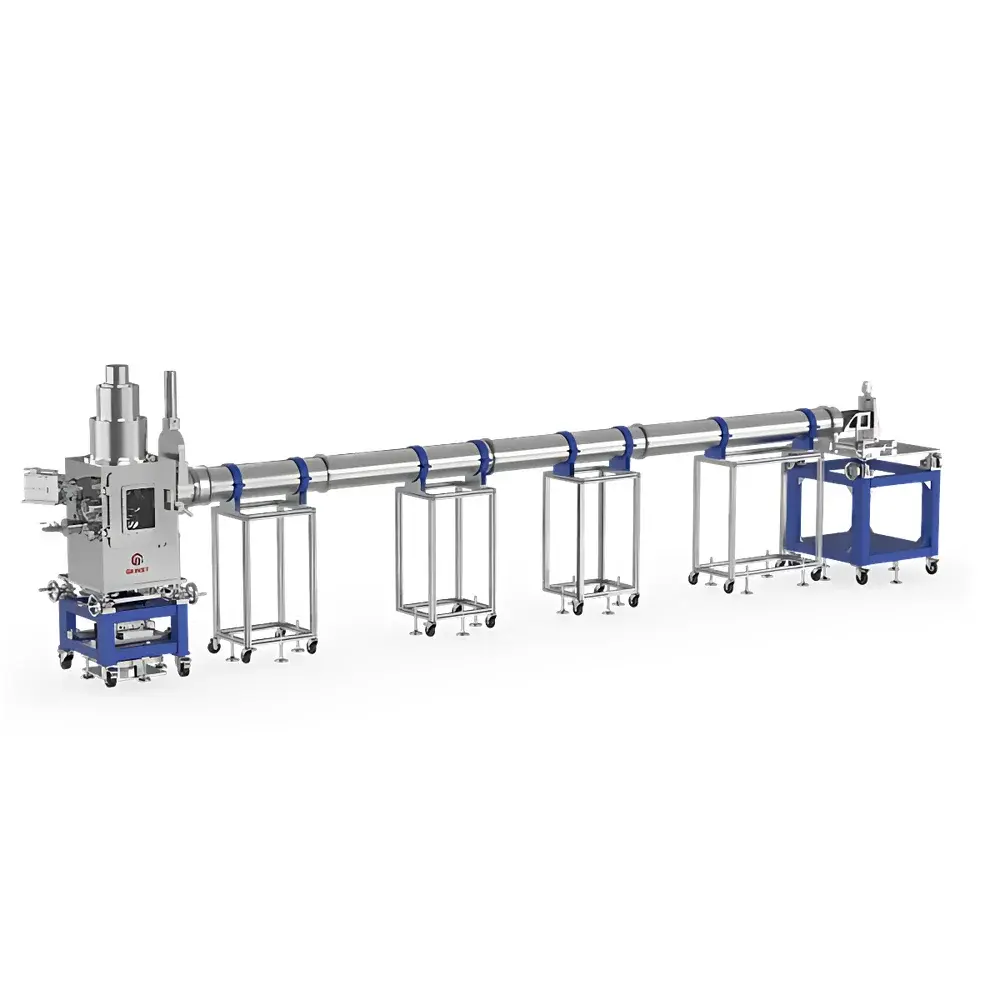
GKINST Custom Synchrotron Beamline and End-Station Design Service
| Brand | GKINST |
|---|---|
| Origin | Anhui, China |
| Manufacturer Type | Authorized Distributor & Engineering Service Provider |
| Regional Classification | Domestic (PRC) |
| Model | Fully Custom-Engineered |
| Pricing | Upon Technical Specification Review |
Overview
GKINST Custom Synchrotron Beamline and End-Station Design Service delivers turnkey engineering solutions for third- and fourth-generation synchrotron radiation facilities. Grounded in the principles of X-ray optics, ultra-high vacuum (UHV) systems engineering, and precision motion control, this service supports the full lifecycle—from conceptual optical layout and ray-tracing simulation to mechanical integration, vacuum qualification, and commissioning-ready delivery. As global synchrotron science shifts toward dynamic, in situ/operando, and nanoscale-resolved experiments—spanning catalysis, quantum materials, structural biology, paleontology, and operando battery research—the demand for beamlines with high photon flux (>10¹³ ph/s/0.1%BW at 10 keV), sub-microradian angular stability, and <10⁻⁹ mbar UHV performance has intensified. GKINST’s design methodology adheres to ISO 14644-1 (Class 4 cleanroom protocols for optical component assembly), ASTM E2859 (standard practice for synchrotron beamline alignment verification), and IEC 61508-compliant safety architecture for interlocked shutter and vacuum interlock systems.
Key Features
- End-to-end beamline engineering: Optical design (grazing-incidence mirrors, crystal monochromators, KB mirrors, multilayer optics), mechanical layout (kinematic mounts, thermal drift compensation structures), UHV system integration (CF/NF flanges, NEG pumps, RGA monitoring), and motion control architecture (PI, SmarAct, or Newport-compatible stages with µrad repeatability)
- Experiment-specific end-station design: Tailored configurations for XRD, XAS (EXAFS/XANES), XRF mapping, ptychography, coherent diffraction imaging (CDI), and time-resolved pump-probe setups—including sample environments (cryostats, furnaces, electrochemical cells, gas/liquid flow cells) and detector integration (Pilatus, Eiger, Timepix)
- Control system framework: EPICS-based distributed control architecture with IOC development, CSS/BOY GUIs, and OPC UA gateway support for integration into facility-wide control networks; compliant with IEC 62443-3-3 for industrial cybersecurity baseline
- Commissioning support: On-site alignment using He–Ne laser interferometry and X-ray beam profiling (pinhole cameras, scintillator + sCMOS), vacuum leak-checking per ISO 20487, and beam characterization (flux, energy resolution ΔE/E, spatial coherence length)
- Documentation package: Full ASME Y14.5-compliant mechanical drawings, Zemax/Oasys optical simulation reports, vacuum schematics (ISO 15510), FMEA analysis, and FAT/SAT test protocols aligned with GLP audit requirements
Sample Compatibility & Compliance
The design service accommodates diverse sample forms—including single crystals (<10 µm), frozen-hydrated biological specimens, heterogeneous catalysts on conductive substrates, fossilized microstructures embedded in silicate matrices, and operando solid-electrolyte interfaces—within mechanically stable, radiatively cooled, and vibration-isolated end-stations. All mechanical components meet ASTM B209 (aluminum alloys) and ASTM A276 (stainless steel 316L) standards. UHV chambers conform to ISO 1127 (tube dimensional tolerances) and EN 1591-1 (flange sealing integrity). Radiation shielding designs follow IAEA Safety Standards Series No. GSR Part 3 (Radiation Protection and Safety of Radiation Sources), with dose rate modeling performed using MCNP6.2 for beamstop, collimator, and hutch barrier validation.
Software & Data Management
Beamline control software is developed under the EPICS base 7.0.6+ ecosystem with custom device support layers (DSLv3) for piezo actuators, piezoelectric translators, and fast-gating detectors. Data acquisition pipelines integrate with NeXus/HDF5 file standards (NXmx, NXxas) for compatibility with Diamond Light Source’s DAWN, DESY’s Karabo, and APS’s Bluesky frameworks. Audit trails for all hardware configuration changes, calibration updates, and user access events are maintained in accordance with FDA 21 CFR Part 11 Annex 11 requirements, including electronic signatures, immutable logs, and role-based permission hierarchies. Remote diagnostics and predictive maintenance modules leverage MQTT-based telemetry for real-time status monitoring of vacuum gauges, cooling water flow, and power supply ripple.
Applications
- In situ X-ray absorption spectroscopy (XAS) of Ni–Fe oxyhydroxide catalysts during OER in alkaline electrolyte, requiring millisecond temporal resolution and simultaneous pH/temperature feedback
- Ptychographic tomography of fossilized dinosaur osteocytes at 30 nm voxel resolution, enabled by high-coherence undulator beam and phase-retrieval algorithms
- Time-resolved grazing-incidence XRD of perovskite thin-film crystallization under controlled N₂/H₂O partial pressures, integrated with environmental cell and fast-readout Pilatus3 X CdTe detector
- Coherent diffraction imaging (CDI) of individual Au–Pd bimetallic nanoparticles under CO oxidation conditions, utilizing ptychographic reconstruction with constrained oversampling smoothness (OSS) regularization
- Micro-XRF mapping of trace metal distributions (Zn, Cu, Fe) across 100-µm-thick brain tissue sections from neurodegenerative models, with 2 µm spatial resolution and sub-ppm detection limits
FAQ
Does GKINST provide full turnkey delivery—including civil works interface coordination?
Yes. GKINST coordinates with facility architects and civil engineers to define penetrations, floor loading (≥1,500 kg/m²), seismic anchoring, and utility routing (cooling water, LN₂, compressed air, electrical grounding) per IEEE 1100-2005 recommendations.
Can GKINST support beamline upgrades for existing light sources such as SSRF or Hefei Light Source?
Yes. Our team has delivered optical reconfiguration, vacuum system modernization, and detector integration projects for Phase II upgrades at Shanghai Synchrotron Radiation Facility and Hefei National Synchrotron Radiation Laboratory.
What is the typical lead time for a medium-complexity hard X-ray beamline (e.g., 5–25 keV, XRD/XAS end-station)?
From contract signature to SAT completion: 14–18 months, inclusive of 3 months for optical design validation, 6 months for component fabrication and UHV chamber assembly, and 4 months for on-site integration and beam commissioning.
Do you offer long-term technical support and spare parts logistics?
Yes. GKINST maintains a dedicated spares inventory for critical optical mounts, UHV feedthroughs, and motion controllers, with SLA-backed remote diagnostics and on-call engineer dispatch within 72 hours for Level-3 incidents.
Is your design documentation compatible with international peer review and funding agency reporting requirements (e.g., DOE, ERC, NSFC)?
Yes. All deliverables include traceable requirements specifications (per IEEE 830), risk registers (ISO 31000), and verification/test reports aligned with NSF 10-502 and ERC Grant Agreement Annex I templates.





