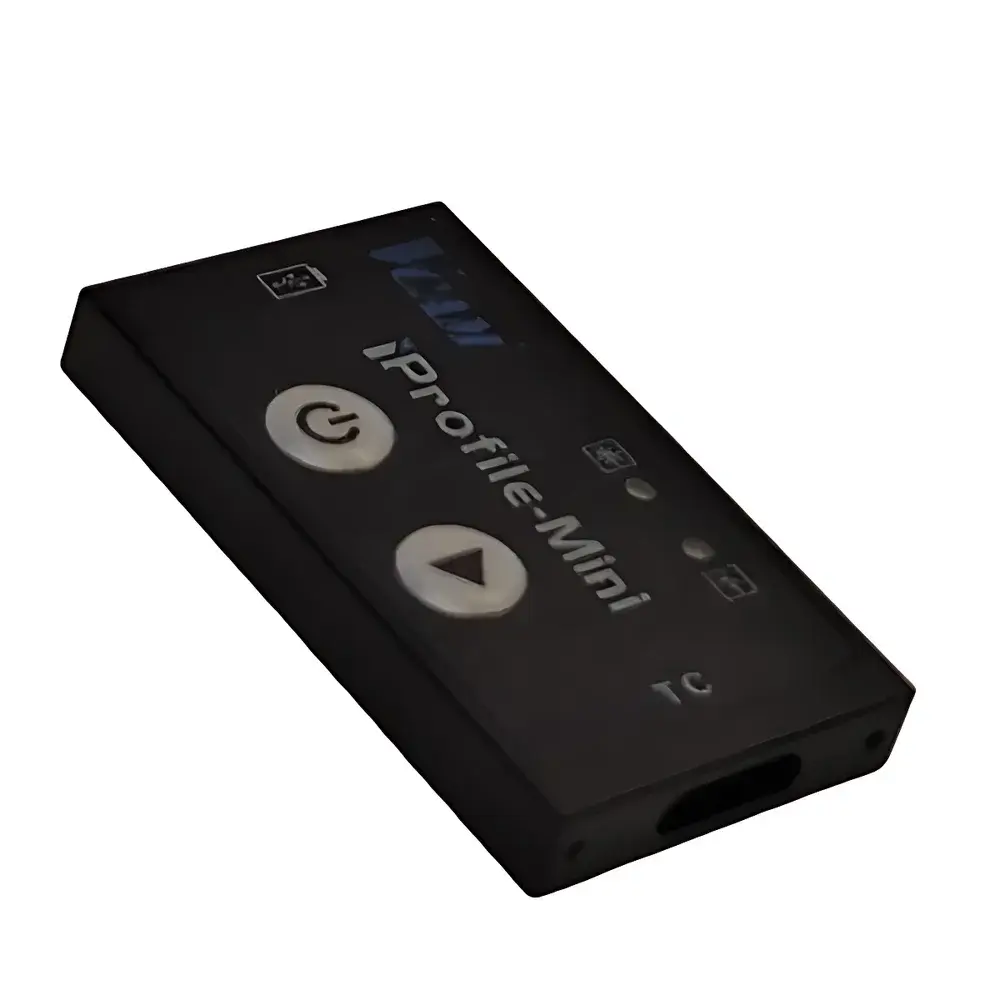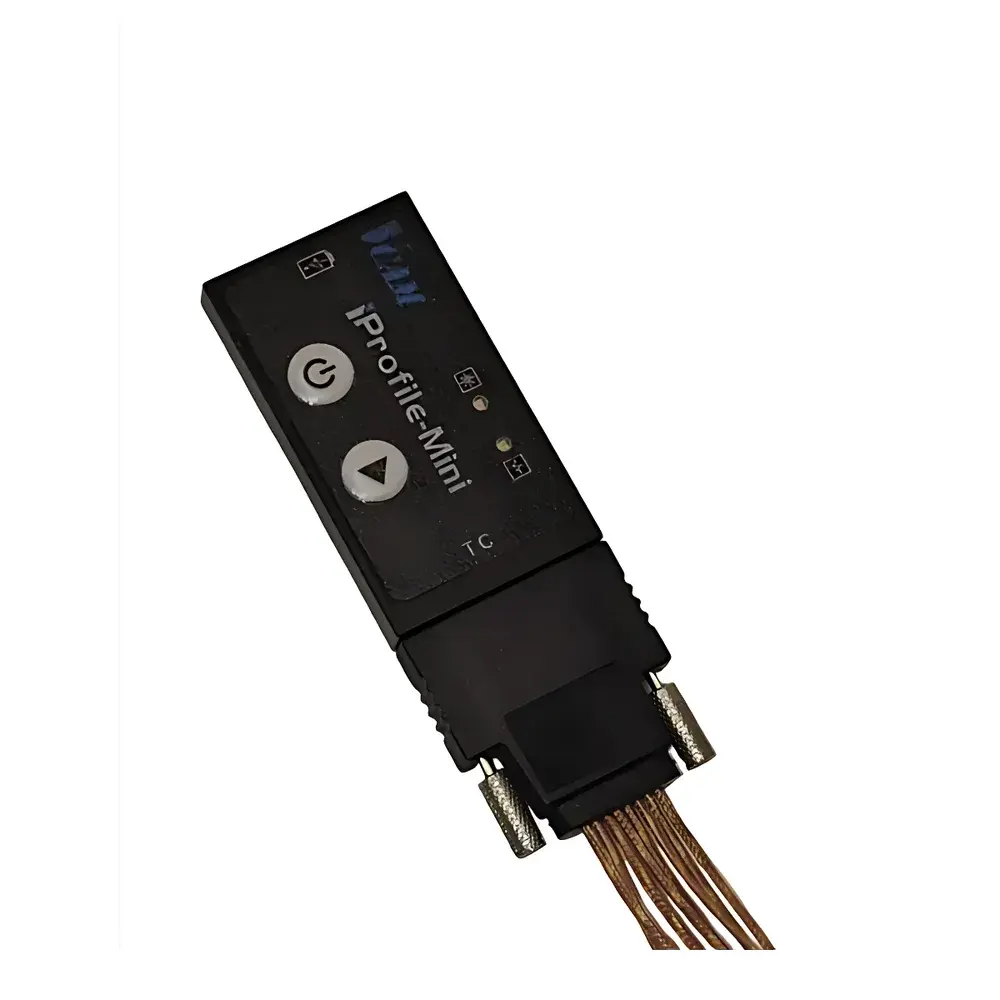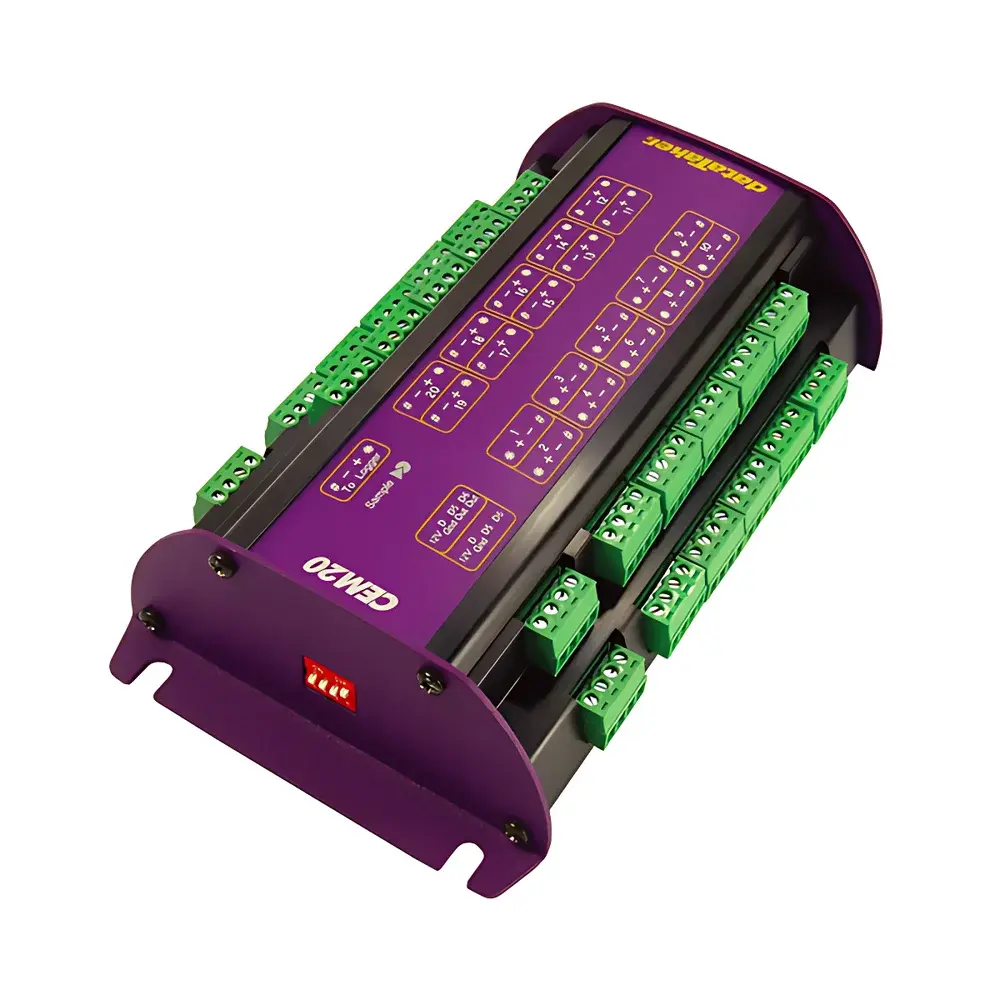
DataTaker CEM20 Channel Expansion Module
| Brand | DataTaker |
|---|---|
| Origin | Imported |
| Manufacturer Type | Authorized Distributor |
| Model | CEM20 |
| Price | USD 1,120 (FOB) |
| Input Channels | 20 per module |
| Max. Modules per DT80 (v2+) | 5 |
| Max. Modules per DT85 (v2+) | 16 |
| Max. Analog Inputs | 300 (DT80), 960 (DT85) |
| Isolation | Dual-channel galvanic isolation per input pair |
| Input Configurations | 2 isolated differential or 3 shared single-ended per channel |
| Max. Input Voltage | 30 Vdc |
| Sampling Rate | 12 Hz (per CEM20) |
| Power Supply | 12 Vdc ±5% (from host or external) |
| Power Consumption | 0.36 W (active), <0.1 W (sleep mode) |
| Operating Temperature | −45 °C to +70 °C |
| Enclosure | Anodized aluminum housing with steel end plates |
| Dimensions | 180 × 100 × 50 mm |
| Weight | 0.55 kg |
| Communication Interface | Digital control via 5D/6D I/O lines |
| Max. Cable Distance (host to last CEM20) | 100 m |
| Addressing | 4-bit DIP switch (address range 1–15) |
| Status Indication | LED indicators for power, communication, and sampling activity |
| Included | Analog interface cable for DT80/DT85 host connection |
Overview
The DataTaker CEM20 Channel Expansion Module is an engineered extension solution designed exclusively for the DT80 and DT85 series of high-reliability data acquisition systems. It operates on a deterministic, host-controlled architecture where each CEM20 connects to a single analog input channel on the host logger—functioning not as a standalone recorder but as a synchronized, addressable analog multiplexer subsystem. Internally, it employs electromechanical relays to sequentially route up to 20 user-configurable analog inputs (differential or single-ended) to the host’s ADC input under precise timing control. This architecture preserves signal integrity through dual-channel galvanic isolation per input pair—a critical feature for environments subject to ground potential differences, EMI, or long sensor cable runs common in civil infrastructure and geotechnical monitoring. The CEM20 does not perform local signal conditioning or digitization; all analog-to-digital conversion, scaling, linearization, and timestamping occur within the host DT80/DT85 unit, ensuring full traceability, consistent calibration, and compliance with audit requirements under GLP and ISO/IEC 17025 frameworks.
Key Features
- Scalable channel expansion: Adds 20 fully isolated analog inputs per module, enabling up to 300 total analog channels on DT80 (v2+) and 960 on DT85 (v2+).
- Dual-input flexibility: Each of the 20 channels supports either two isolated differential inputs or three shared single-ended inputs—maximizing sensor density without compromising noise rejection.
- Host-powered operation: Draws regulated 12 Vdc ±5% directly from the DT80/DT85’s auxiliary output, eliminating need for separate power supplies and reducing installation complexity.
- Low-power design: Consumes only 0.36 W during active sampling (12 V @ 30 mA); automatically enters ultra-low-power sleep mode during idle intervals to extend system longevity in remote deployments.
- Rugged industrial enclosure: Precision die-cast anodized aluminum housing with steel-coated end plates ensures mechanical durability and thermal stability across −45 °C to +70 °C operating range.
- Modular addressing & diagnostics: 4-position DIP switch sets unique module address (1–15); integrated LEDs provide real-time status feedback for power, communication handshake, and sampling activity.
Sample Compatibility & Compliance
The CEM20 interfaces seamlessly with thermistors, RTDs, strain gauges, LVDTs, potentiometers, 4–20 mA transmitters, and other low-level DC voltage/current sensors compliant with IEC 61000-4 immunity standards. Its 30 Vdc maximum input rating and relay-based multiplexing support legacy and modern sensor types without signal degradation. All configurations adhere to IEC 61000-6-2 (immunity) and IEC 61000-6-4 (emissions) for industrial environments. When deployed with DT80/DT85 loggers running firmware v2.0 or later, the complete system satisfies data integrity requirements for ASTM E1133 (temperature mapping), ISO 14644-3 (cleanroom monitoring), and USP (analytical instrument qualification), particularly when combined with DataTaker’s optional 21 CFR Part 11-compliant software packages.
Software & Data Management
CEM20 modules are fully transparent within DataTaker’s DeLogger and DeTransfer software suites. Channel configuration—including input type (differential/single-ended), scaling factors, engineering units, and alarm thresholds—is defined at the host level and stored in non-volatile memory. All acquired data retains native time stamps generated by the DT80/DT85’s temperature-compensated quartz oscillator (±10 ppm accuracy). Raw binary files (.DTA) preserve unprocessed ADC counts alongside metadata (module address, channel index, scan sequence), enabling post-acquisition reprocessing, uncertainty budgeting, and third-party validation. Audit trails, electronic signatures, and role-based access control are available via optional DeLogger Enterprise Edition, supporting FDA 21 CFR Part 11 and EU Annex 11 compliance for regulated applications.
Applications
The CEM20 is widely deployed in long-term, unattended monitoring scenarios requiring high channel count and field robustness: structural health monitoring of bridges and high-rise buildings; temperature profiling in mass concrete curing; distributed strain and tilt measurement in dam and landslide instrumentation; thermal mapping of HVAC ductwork and pharmaceutical cold chain logistics; environmental chamber validation; and calibration lab multi-sensor referencing. Its 100 m daisy-chain capability supports large-scale sensor arrays across tunnels, mines, and geotechnical boreholes—where centralized logging with distributed analog expansion minimizes wiring cost, point-of-failure risk, and maintenance overhead compared to distributed micro-loggers.
FAQ
How many CEM20 modules can be connected to a DT85 logger?
Up to 16 CEM20 modules may be daisy-chained to a DT85 Series 2 or newer logger, expanding its analog input capacity to 960 channels.
Does the CEM20 require external power?
No—it is powered entirely by the 12 Vdc output from the host DT80/DT85 logger; an external 12 Vdc ±5% supply is optional only if host power is unavailable.
Can CEM20 modules be mixed with other expansion devices on the same logger?
Yes—CEM20 modules operate independently of digital I/O expanders (e.g., DEX20) and serial sensor hubs (e.g., SENS20), provided sufficient analog input channels and digital control lines are available.
Is firmware update required for compatibility?
CEM20 requires DT80/DT85 firmware version 2.0 or higher; earlier versions lack the necessary control protocol and address resolution logic.
What is the maximum allowable distance between the host logger and the farthest CEM20 in a daisy chain?
The total cable length from host to last module must not exceed 100 meters using shielded twisted-pair (STP) cable meeting IEC 60228 Class 5 specifications.