
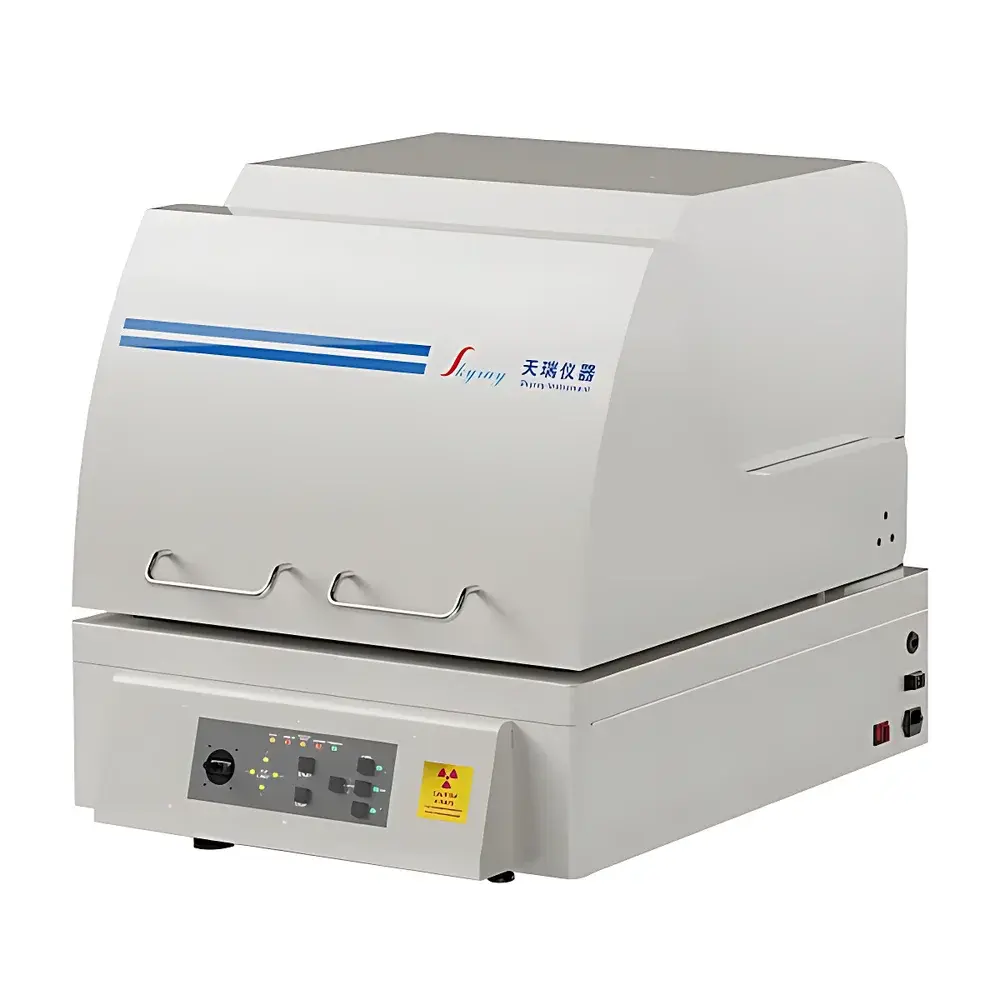
SkyRay Instrument EDX-T Energy Dispersive X-Ray Fluorescence Spectrometer
| Brand | SkyRay Instrument |
|---|---|
| Origin | Jiangsu, China |
| Manufacturer Type | Original Equipment Manufacturer (OEM) |
| Product Origin | Domestic (PRC) |
| Model | EDX-T |
| Pricing | Available upon Request |
Overview
The SkyRay Instrument EDX-T is an advanced energy dispersive X-ray fluorescence (EDXRF) spectrometer engineered for non-contact, micro-area thickness measurement and elemental composition analysis of ultra-thin coatings and miniature samples. Designed with an innovative top-illumination geometry, the EDX-T overcomes geometric limitations common in conventional side- or bottom-irradiation systems—enabling reliable analysis of complex sample topographies including stepped surfaces, deep recesses, blind holes, curved substrates, and irregularly shaped components. Its core analytical principle relies on primary X-ray excitation of characteristic fluorescent radiation from elements present in the sample; emitted photons are collected by a high-resolution silicon drift detector (SDD), then spectrally resolved to quantify elemental mass thickness (ng/cm²) or weight percentage (wt%) based on fundamental parameter (FP) algorithms and empirical calibration models. The system is optimized for applications demanding sub-micron resolution, high spatial reproducibility, and trace-level detection limits—particularly in high-precision electronics manufacturing environments.
Key Features
- Top-illumination optical configuration with adjustable working distance, enabling unobstructed access to vertically constrained or multi-tiered samples such as stacked dies, wafer bump structures, and embedded PCB vias.
- Integrated multi-aperture collimator turret and automated filter wheel—providing real-time optimization of excitation conditions for diverse elements (e.g., Au, Pd, Rh, Pt, Ni, Cu, Sn, Pb) across varying matrix types and coating thicknesses.
- Dual high-definition cameras: one fixed wide-angle lens for contextual navigation and macro-positioning; one motorized zoom lens with real-time focus feedback and distance compensation—ensuring accurate targeting of features down to 100 µm in diameter.
- High-precision XYZ motorized stage driven by independent servo motors, supporting programmable multi-point, grid, and matrix scanning sequences—fully automating batch analysis of wafers, lead frames, connectors, or SMT components.
- Onboard spectral calibration and drift correction system utilizing reference standards and internal monitoring channels—maintaining long-term measurement stability without manual recalibration between runs.
Sample Compatibility & Compliance
The EDX-T accommodates solid, flat, curved, or recessed samples up to 300 mm × 300 mm in footprint and 150 mm in height. It supports direct analysis of bare substrates, multilayer stacks (e.g., Cu/Ni/Au, Ti/Pt/Au), electroplated deposits, sputtered films, and evaporated coatings. Sample holders are configurable for wafer chucks, custom fixtures, or vacuum-compatible stages. The instrument complies with IEC 61000-6-3 (EMC emissions), IEC 61000-6-2 (EMC immunity), and GB/T 18268.1–2010 (industrial measurement equipment safety). While not certified to ISO/IEC 17025 out-of-the-box, its measurement traceability aligns with ASTM E1598 (XRF coating thickness), ASTM E2421 (EDXRF quantitative analysis), and ISO 3497 (metallic coatings—thickness measurement by XRF), supporting GLP/GMP-aligned validation protocols when operated under documented SOPs.
Software & Data Management
The proprietary SkyRay EDX Analysis Suite provides intuitive workflow control—from sample registration and region-of-interest (ROI) definition to automated quantification and statistical reporting. All spectra, acquisition parameters, stage coordinates, and camera images are timestamped and stored in a relational database with user-access controls. Audit trails log operator actions, method modifications, and calibration events in accordance with FDA 21 CFR Part 11 requirements when enabled. Export options include CSV, PDF reports, and XML-based data interchange compliant with ASTM E1341 and ASTM E1441 metadata conventions. Optional integration with LIMS via ODBC or RESTful API enables centralized data governance in regulated QC laboratories.
Applications
- Quantitative measurement of functional plating layers ≤10 nm thick (e.g., Au on NiP underbump metallization, Rh on electrical contacts, Pd on connector pins).
- Routine RoHS-compliant screening of Pb, Cd, Hg, Cr(VI), and Br in solder finishes, component leads, and conformal coatings on PCB assemblies with feature sizes <0.1 mm.
- Composition verification of alloy thin films (e.g., NiFe, CoCrTa, TiW) used in MEMS, sensors, and magnetic recording heads.
- In-process monitoring of electroplating bath chemistry through periodic analysis of deposited layer stoichiometry and contamination trends.
- Failure analysis of delamination, interdiffusion, or oxidation at metal–dielectric interfaces in advanced packaging substrates.
FAQ
What is the minimum detectable thickness for gold using the EDX-T?
For pure Au on Ni substrate under standard measurement conditions (100 s live time, 50 kV excitation), the typical detection limit is approximately 0.3 nm (3 Å) mass thickness, corresponding to ~0.003 µm geometric thickness.
Can the EDX-T analyze liquid samples such as plating baths?
Yes—using disposable sample cups with ultrathin polymer windows (e.g., 4 µm Mylar), the system performs semi-quantitative bath monitoring for major and minor constituents (e.g., Ni²⁺, Co²⁺, Fe³⁺, Cl⁻ via Cl Kα), though certified reference solutions are required for full quantification.
Is the instrument compatible with ISO/IEC 17025 accreditation?
The hardware and software architecture support key technical requirements—including uncertainty estimation, calibration traceability, and environmental monitoring—but formal accreditation requires laboratory-specific validation, documented procedures, and participation in proficiency testing schemes.
Does the dual-camera system require manual focusing during routine operation?
No—the zoom lens incorporates closed-loop focus sensing and dynamic distance compensation; focus is automatically maintained across Z-axis travel ranges from 5 mm to 35 mm without user intervention.
What maintenance is required for long-term operational stability?
Annual SDD energy calibration, quarterly collimator alignment verification, and biannual vacuum pump oil replacement (if equipped with Peltier-cooled detector housing) constitute the recommended preventive maintenance schedule.





