
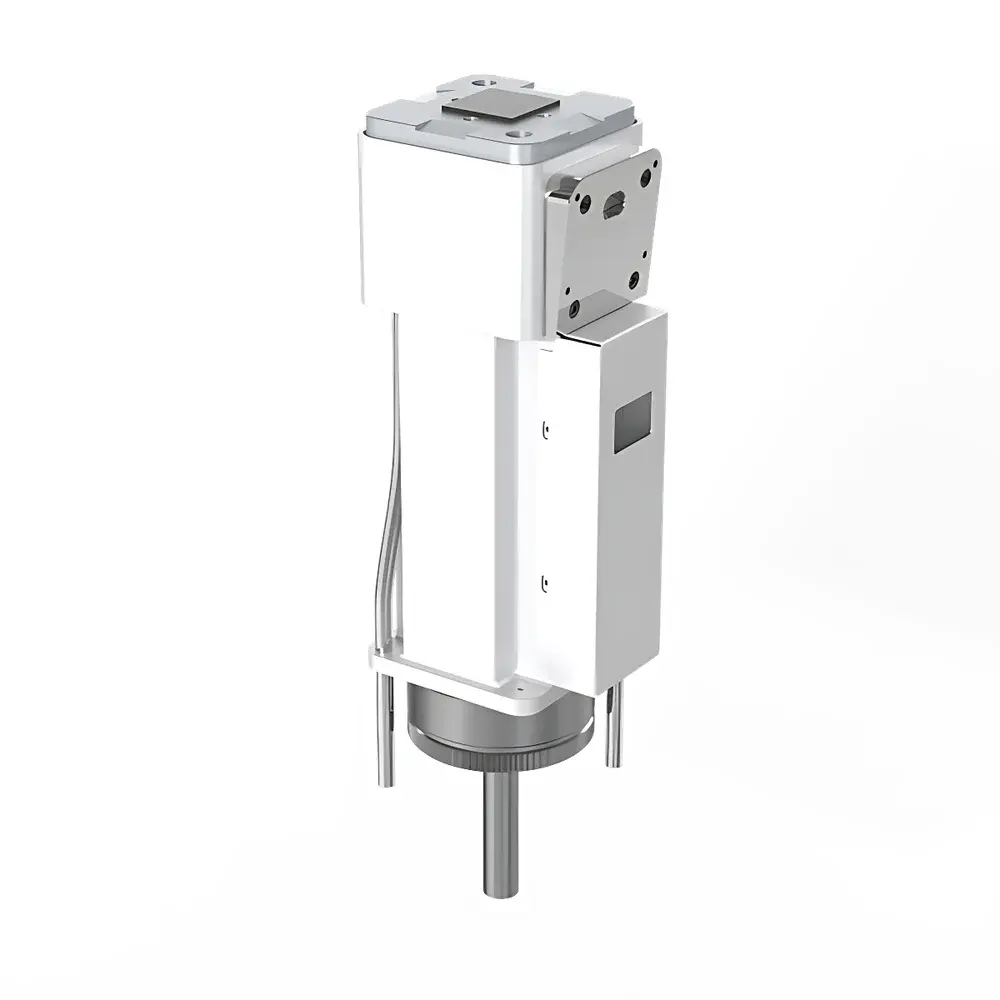
GKInst LFocus Line-Focus X-ray Source
| Brand | GKInst |
|---|---|
| Origin | Anhui, China |
| Manufacturer Type | Authorized Distributor |
| Country of Origin | China |
| Model | LFocus |
| Pricing | Available Upon Request |
| Target Applications | XRD, XRF |
| Anode Materials | Mo, Cu, W, Ag, Cr, Co, Fe, Ti |
| Tube Voltage Range | 20–60 kV |
| Tube Current Range | 5–40 mA |
| Max Power Output | 0.4–3.0 kW (material-dependent) |
| Beam Geometry | Linear focal spot (line focus) |
| Protection Features | Overvoltage, Overcurrent, Overpower shutdown |
| Thermal Management | Adaptive preheat algorithm based on idle time |
Overview
The GKInst LFocus Line-Focus X-ray Source is an engineered component designed for integration into high-performance X-ray analytical systems, including laboratory-scale X-ray diffractometers (XRD) and benchtop or floor-standing X-ray fluorescence spectrometers (XRF). Unlike point-focus sources, the LFocus utilizes a linear anode geometry—where the electron beam strikes a narrow, elongated focal track—to generate a collimated line-shaped X-ray emission profile. This configuration enables efficient coupling with parallel-beam or Johansson-type optics, improves photon flux per unit area across extended detector rows (e.g., in 1D or 2D strip detectors), and supports high-resolution diffraction pattern acquisition without sacrificing intensity uniformity along the scattering plane. The source operates on standard sealed-tube architecture with thermionic cathode emission, delivering stable, reproducible output under controlled vacuum and thermal conditions.
Key Features
- Multi-material anode compatibility: Interchangeable anodes (Mo, Cu, W, Ag, Cr, Co, Fe, Ti) enable wavelength selection aligned with sample absorption edges and crystalline phase excitation requirements—critical for quantitative XRD phase analysis and multi-element XRF calibration.
- Dynamic power management: Programmable tube voltage (20–60 kV) and current (5–40 mA) allow fine-tuned optimization of Bremsstrahlung continuum and characteristic line intensity, balancing signal-to-noise ratio against thermal load and target degradation.
- Integrated safety architecture: Real-time monitoring of filament current, tube arcing events, and voltage/current deviation triggers automatic shutdown to prevent catastrophic failure. Filament current limits are user-configurable to extend cathode lifetime under variable duty cycles.
- Adaptive thermal conditioning: Embedded idle-time tracking logic calculates optimal preheat duration prior to reactivation, ensuring cathode temperature homogeneity and minimizing thermal shock during repeated start-stop operation—essential for GLP-compliant routine analysis workflows.
- Low-ripple high-voltage supply: <0.1% RMS ripple ensures minimal spectral broadening of Kα/Kβ lines and improved peak shape fidelity in energy-dispersive or wavelength-dispersive detection modes.
Sample Compatibility & Compliance
The LFocus is compatible with standard XRD goniometers equipped with fixed or rotating anode mounts, as well as monochromator-based XRF platforms requiring line-source illumination geometry. Its mechanical interface conforms to ISO 9001-certified mounting standards used by major OEMs (e.g., Rigaku, PANalytical, Bruker). While not a standalone instrument, the LFocus complies with IEC 61000-6-3 (EMC emissions) and IEC 61000-6-4 (industrial immunity) when installed per manufacturer guidelines. Its operational parameters support adherence to ASTM E915 (residual stress measurement), ASTM E1361 (XRF calibration), and ISO 21377-1 (XRD instrumentation specifications) when integrated into validated system configurations.
Software & Data Management
The LFocus communicates via RS-232 or optional Ethernet interface, supporting integration with third-party control software (e.g., Diffrac.Suite, SpectraCollector, PyMca) through standardized SCPI-like command sets. All operational parameters—including voltage, current, exposure time, anode selection, and fault logs—are timestamped and exportable in CSV format. Audit trails meet basic GLP requirements; full 21 CFR Part 11 compliance (electronic signatures, role-based access, immutable logs) requires deployment within a validated host system architecture—not provided by the source alone.
Applications
- X-ray Diffraction (XRD): Enables rapid acquisition of high-statistics powder patterns for Rietveld refinement, texture analysis, and in-situ/operando studies where line-focus geometry enhances detector coverage without scanning motion.
- X-ray Fluorescence (XRF): Delivers uniform excitation across large-area samples (e.g., geological thin sections, alloy slabs, coated substrates), reducing spatial averaging artifacts and improving detection limits for trace elements (sub-ppm level achievable with optimized Mo or W anodes).
- Micro-CT Pre-alignment: Used as a low-cost, high-stability reference source during optical-mechanical alignment of microfocus CT stages prior to switching to higher-resolution microfocus tubes.
- Educational & Training Systems: Provides robust, serviceable X-ray generation for university teaching labs emphasizing radiation safety, Bragg’s law validation, and fundamental XRF spectroscopy principles.
FAQ
Is the LFocus suitable for use in regulated pharmaceutical QC laboratories?
Yes—when integrated into a fully validated XRD or XRF platform and operated under documented SOPs, the LFocus meets foundational hardware reliability and traceability criteria required for GMP environments.
Can the anode be replaced in the field by the end user?
Anode replacement requires factory-level vacuum resealing and high-voltage certification; it is not a user-serviceable procedure and must be performed by authorized GKInst service centers.
What cooling method does the LFocus require?
Standard operation mandates forced-air cooling with ≥20 CFM airflow; water-cooled variants (LFocus-WC) are available for continuous-duty applications exceeding 2.5 kW.
Does the LFocus support pulsed operation or gated exposure?
No—it is designed for DC operation only; pulse modulation requires external high-speed shutter or beam chopper systems.
Is CE marking applicable to this component?
As a subsystem intended for OEM integration, the LFocus carries CE marking under the EMC Directive 2014/30/EU and RoHS 2011/65/EU, but final CE conformity rests with the complete analytical instrument manufacturer.
Related Products



