
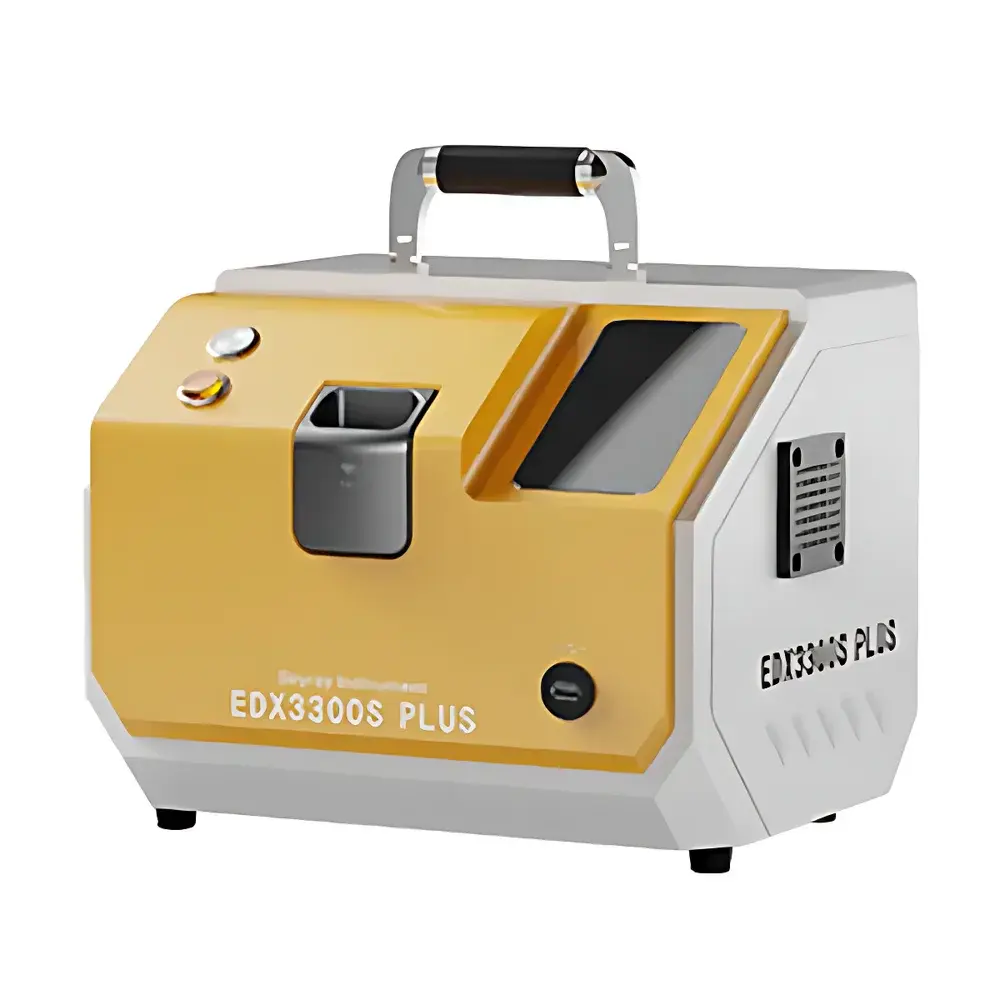
Thermo Scientific iXR EDX3300S PLUS Side-Illumination Monochromatic Energy Dispersive X-Ray Fluorescence Spectrometer
| Brand | Skyray Instrument |
|---|---|
| Origin | Jiangsu, China |
| Manufacturer Type | OEM Manufacturer |
| Regional Classification | Domestic (China) |
| Model | EDX3300S PLUS |
| Configuration | Benchtop / Floor-Standing |
| Instrument Class | Conventional ED-XRF |
| Industry-Specific Design | Energy & Petrochemical Applications |
| Measurement Principle | Monochromatic Side-Illumination ED-XRF |
Overview
The Thermo Scientific iXR EDX3300S PLUS is a purpose-engineered side-illumination monochromatic energy dispersive X-ray fluorescence (ED-XRF) spectrometer designed for quantitative elemental analysis of low-Z elements—specifically sulfur (S), chlorine (Cl), phosphorus (P), and silicon (Si)—in liquid and powdered samples across petrochemical, lubricant, biofuel, edible oil, and environmental monitoring applications. Unlike conventional top-illumination ED-XRF systems, its side-illumination geometry enables optimized excitation efficiency for light elements by minimizing absorption path length through sample matrices and reducing scattering interference from container walls or surface films. The instrument employs a high-stability microfocus X-ray tube with a fixed monochromatic excitation line (typically Al Kα or Ti Kα, selectable per application configuration), coupled with a large-area silicon drift detector (SDD) delivering high count-rate capability and excellent energy resolution (<135 eV at Mn Kα). This architecture ensures robust detection limits in the sub-ppm range for S and Cl in hydrocarbon matrices, and low-ppm sensitivity for P and Si in complex organic and inorganic powders—without requiring vacuum or helium purge for routine operation.
Key Features
- Side-illumination optical path design minimizes matrix absorption effects and enhances signal-to-background ratio for light elements (Z = 14–17)
- Monochromatic excitation source reduces spectral background and improves peak-to-background ratios for accurate quantification of S, Cl, P, and Si
- Dual-mode sample handling: accommodates both sealed liquid cells (for gasoline, diesel, lubricants, crude oil) and pressed powder pellets (e.g., ash, catalysts, soil derivatives)
- Integrated temperature-controlled sample chamber (±0.5 °C stability) to mitigate volatility-related drift in volatile liquid fuels
- Robust mechanical design certified for operation in non-laboratory environments: mobile labs, offshore platforms, marine vessels, and roadside monitoring units
- Automated calibration verification using built-in reference standards traceable to NIST SRM materials
Sample Compatibility & Compliance
The EDX3300S PLUS supports direct analysis of undiluted liquid hydrocarbons—including gasoline, diesel, jet fuel (Jet A-1), biodiesel (B100), biodiesel blends (B5–B20), naphtha, residual fuel oil, and lubricating oils—as well as edible oils (soybean, palm, rapeseed, animal tallow) and solid residues such as plant ash, catalyst fines, and refinery sludge. All liquid measurements comply with ASTM D4294 (S in petroleum products), ASTM D7039 (Cl in hydrocarbons), and ISO 8754 (S in crude oil). For phosphorus quantification in edible oils, the system meets the detection limit requirements specified in GB 5009.272–2016—achieving ≤120 µg/g for phosphatidylcholine (PC), ≤470 µg/g for phosphatidylethanolamine (PE), and ≤800 µg/g for phosphatidylinositol (PI)—through direct P-Kα measurement without derivatization or chromatographic separation. Instrument software includes audit-trail functionality compliant with GLP and GMP data integrity principles per FDA 21 CFR Part 11.
Software & Data Management
Powered by Thermo Scientific Q-Scan Pro v3.2 software, the EDX3300S PLUS delivers fully automated workflow management—from method setup and calibration curve generation to real-time spectral deconvolution and statistical reporting. Quantitative models support fundamental parameter (FP) and empirical calibration modes, with optional matrix-matched standard libraries for petrochemical and food-grade oils. All spectra are stored in standardized .rxf format with embedded metadata (operator ID, timestamp, instrument conditions, sample ID). Raw data export supports CSV, ASCII, and XML formats for LIMS integration. Software includes built-in uncertainty estimation per ISO/IEC 17025 guidelines and supports multi-user role-based access control with electronic signatures.
Applications
- Routine sulfur screening in refinery streams to ensure compliance with Euro 6/VII and Tier 3 fuel specifications (≤10 ppm S)
- Chlorine contamination monitoring in feedstocks and process intermediates to prevent catalyst poisoning in hydrotreating units
- Phosphorus quantification in edible oils to verify degumming efficiency and assess oxidative stability risks
- Silicon analysis in plant ash for agronomic assessment of phytolith accumulation and soil silica bioavailability
- Field-deployable screening of marine fuel (IFO 380, IFO 180) for Annex VI SOx compliance verification
- QC testing of lubricant additives and used oil analysis for wear metal and contaminant profiling
FAQ
Does the EDX3300S PLUS require vacuum or helium purge for sulfur analysis?
No. Its side-illumination geometry and monochromatic excitation enable reliable S-Kα detection in air for liquid fuels and oils, eliminating gas-purge dependency.
Can it analyze viscous or high-boiling-point samples like bitumen or heavy fuel oil?
Yes—when prepared as thin-film samples on quartz carriers or diluted with low-S/Cl solvents (e.g., cyclohexane), with method validation per ASTM D7039 Annex A3.
Is calibration transfer possible between different EDX3300S PLUS units?
Yes. Cross-unit calibration portability is supported via Q-Scan Pro’s standardized FP library and shared instrument response function (IRF) files.
What is the typical detection limit for chlorine in diesel fuel?
Under standard operating conditions (300 s counting time, 1 mm path length), typical Cl detection limit is 0.8–1.2 ppm (w/w) with RSD < 3.5% (n = 10).
How does the system handle spectral interferences between P-Kα and Ca-Kβ or S-Kα and Pb-Mα?
Q-Scan Pro applies iterative least-squares deconvolution with physically constrained peak shape modeling and background subtraction based on SNIP algorithm, validated against NIST SRM 2720a and 1634c.





