
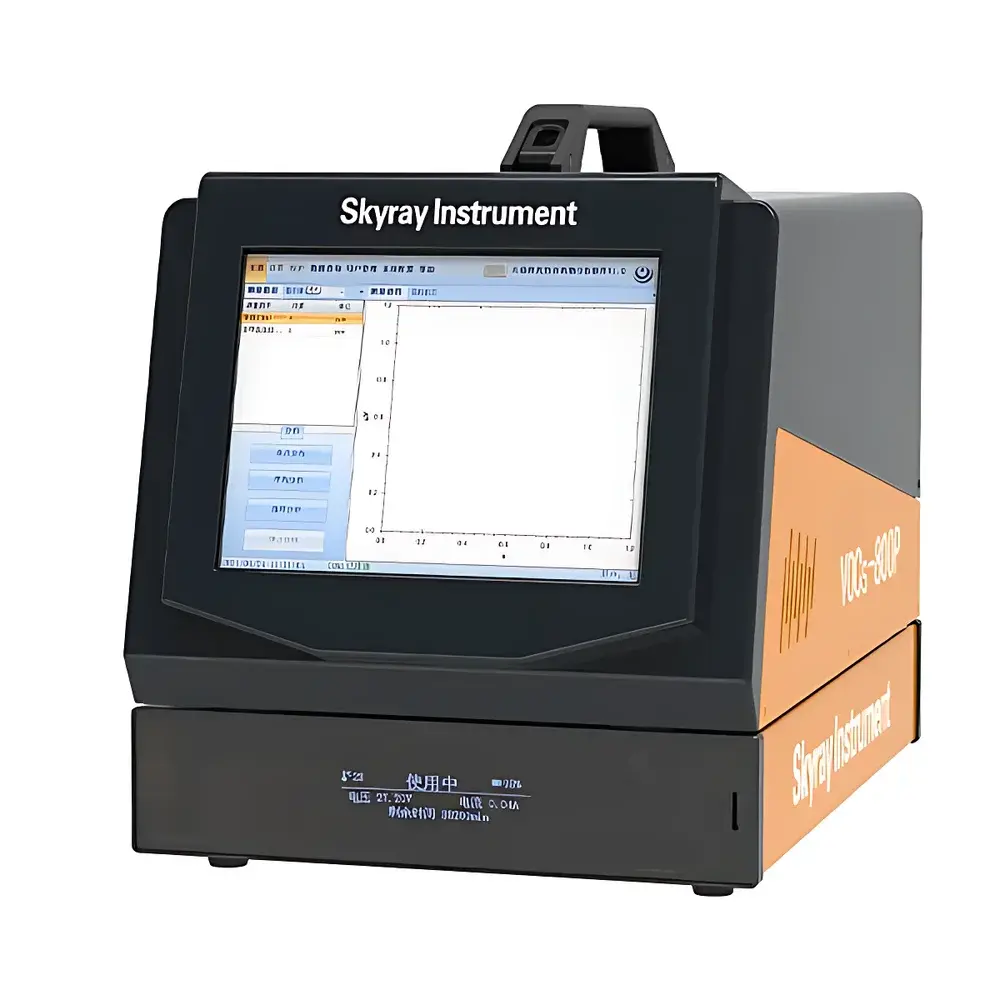
SkyRay VOCs-800P Portable Total Hydrocarbons, Methane and Non-Methane Hydrocarbons Analyzer
| Brand | SkyRay Instrument |
|---|---|
| Origin | Jiangsu, China |
| Manufacturer Type | Direct Manufacturer |
| Country of Origin | China |
| Model | VOCs-800P |
| Detection Target | NMHC (Non-Methane Hydrocarbons) |
| Detection Limit | ≤0.07 mg/m³ |
| Response Time | ≤60 s |
Overview
The SkyRay VOCs-800P is a field-deployable gas chromatography–flame ionization detector (GC-FID) analyzer engineered for real-time, on-site quantification of total hydrocarbons (THC), methane (CH₄), and non-methane hydrocarbons (NMHC) in ambient air and industrial exhaust streams. Operating on the fundamental principle of separation via capillary GC followed by selective, high-sensitivity carbon-specific detection using a hydrogen-air flame, the instrument delivers trace-level quantification with metrological rigor required for regulatory compliance and enforcement applications. Its design fully conforms to Chinese national standard HJ 1012–2018 (Technical Requirements and Test Methods for Portable Instruments Measuring THC, CH₄, and NMHC in Ambient Air and Exhaust Gas) and HJ 38–2017 (Determination of THC, CH₄, and NMHC in Stationary Source Exhaust Gas by Gas Chromatography). Unlike benchtop GC-FID systems, the VOCs-800P integrates analytical performance with true portability—achieving sub-ppb-equivalent detection limits (≤0.07 mg/m³ as NMHC) while maintaining thermal stability, inert flow path integrity, and operational autonomy in uncontrolled field environments.
Key Features
- Full-thermal sample pathway: Entire sampling train—including probe, transfer line, GC column oven, and FID detector—is actively heated to ≥180 °C with no cold spots, preventing condensation or adsorption of semi-volatile and polar VOCs (e.g., aldehydes, ketones, oxygenates).
- Ultra-inert flow path: All internal surfaces (sample loop, valves, tubing, liner) undergo dual-stage surface passivation: silanization followed by sulfur-passivated stainless steel treatment, minimizing memory effects and ensuring method detection limits (MDLs) remain stable over extended operation.
- Electrically actuated 10-port rotary valve: Eliminates pneumatic actuation, removing pressure-induced baseline drift during valve switching; reduces carrier gas consumption by >40% versus solenoid-driven systems and extends service life beyond 500,000 cycles.
- Integrated solid-state hydrogen generator: Utilizes metal hydride storage technology delivering ultra-high-purity H₂ (>99.999%) at low delivery pressure (<0.3 MPa), eliminating explosion risk associated with compressed gas cylinders while meeting FID stoichiometric requirements.
- Modular mechanical architecture: Main analyzer unit (<9 kg), rechargeable Li-ion battery pack, and auxiliary gas modules (H₂, zero air, N₂) are mechanically decoupled—enabling configuration flexibility for backpack, vehicle-mount, or trailer-based deployment.
- Field-optimized human interface: 7-inch capacitive touchscreen with ambient-light-readable display; embedded GPS module geotags every data point; optional Bluetooth/Wi-Fi connectivity supports remote instrument control and firmware updates via Android/iOS companion app.
Sample Compatibility & Compliance
The VOCs-800P is validated for direct analysis of undiluted ambient air, stack gas (dilution ratio configurable), and fugitive emission plumes. It quantifies C₁–C₁₂ hydrocarbons including methane, ethane, propane, butanes, pentanes, BTEX (benzene, toluene, ethylbenzene, xylenes), and selected oxygenated VOCs (e.g., acetone, MEK) when configured with appropriate column chemistry. Regulatory alignment includes full technical conformance with HJ 1012–2018 Class I and II portable analyzers, and equivalence to laboratory-grade NMHC instrumentation per HJ 38–2017 validation protocols. The system supports audit-ready data logging compliant with GLP principles, including electronic signatures, time-stamped calibration records, and full chain-of-custody metadata export (CSV/Excel).
Software & Data Management
Embedded firmware provides real-time chromatogram visualization, automatic peak integration using ASTM D6348–17-compliant algorithms, and on-device calculation of NMHC = THC − CH₄. Data files include raw chromatograms (.CDF), processed results (.XLSX), and instrument diagnostic logs—all timestamped, GPS-georeferenced, and digitally signed. Export options include USB mass storage, Wi-Fi FTP, or direct thermal printing via integrated mini-printer interface. Cloud synchronization (optional) enables centralized fleet management, QA/QC trending, and automated report generation aligned with EPA Method 25A and ISO 11890-2 reporting templates.
Applications
- Regulatory compliance verification at stationary sources (stack testing, fence-line monitoring, leak detection and repair—LDAR)
- Mobile source emissions profiling (refueling stations, tank truck loading/unloading zones)
- Emergency response to chemical spills or industrial accidents requiring rapid VOC screening
- Performance evaluation of VOC abatement technologies (RTOs, carbon adsorbers, biofilters)
- Intercomparison studies between continuous emission monitoring systems (CEMS) and reference methods
- Environmental inspection campaigns and enforcement actions under China’s “Blue Sky Defense War” framework
FAQ
What is the certified detection limit for NMHC according to HJ 1012–2018?
The VOCs-800P achieves ≤0.07 mg/m³ (as carbon) for NMHC, satisfying the Class I requirement for portable instruments specified in HJ 1012–2018.
Can the instrument operate without external power for an 8-hour field shift?
Yes—the integrated battery supports >10 hours of continuous GC-FID operation; combined with solid-state H₂ and high-pressure air/N₂ cylinders, total field endurance exceeds 8 hours without refueling or recharging.
Is the FID detector compatible with EPA Method 25A or ISO 11890-2?
While not formally certified under U.S. or EU regulatory frameworks, its GC-FID architecture, linear dynamic range (>10⁶), and calibration traceability to NIST-traceable standards enable method-equivalent implementation of both EPA Method 25A and ISO 11890-2 for total hydrocarbon measurement.
How is data integrity ensured during field use?
All measurements are cryptographically signed, time-stamped, and linked to GPS coordinates; audit trails record operator ID, calibration events, maintenance logs, and environmental conditions (T, P, RH) in accordance with GLP data governance requirements.
Does the system support custom VOC speciation beyond NMHC and CH₄?
Yes—by installing alternative capillary columns (e.g., DB-VRX, Rtx-VMS) and adjusting temperature programming, users can configure the VOCs-800P for targeted BTEX, halogenated VOCs, or carbonyl compound analysis per project-specific protocols.
Related Products







