
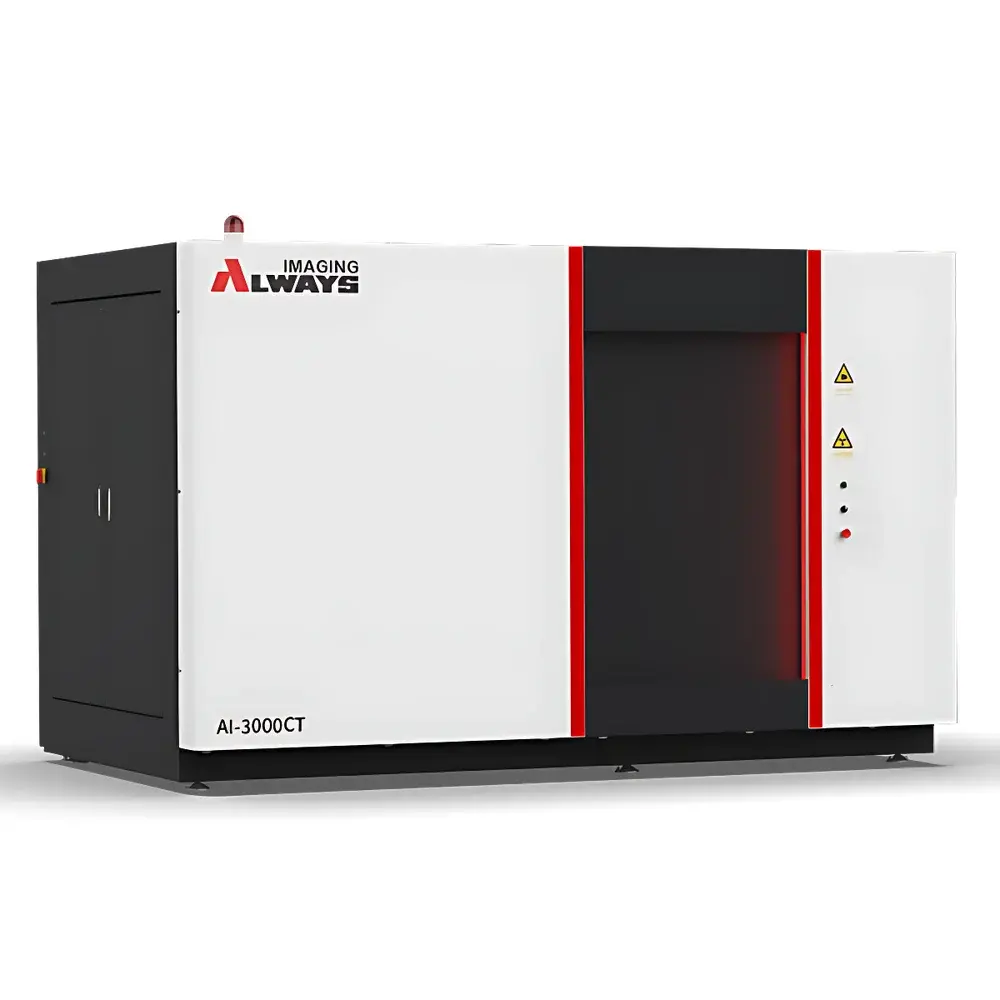
Always Imaging AI-3000CT Industrial Micro-CT System for Medium-to-Small Castings
| Brand | Always Imaging |
|---|---|
| Origin | Shanghai, China |
| Manufacturer | Yes |
| Country of Origin | China |
| Model | AI-3000CT |
| Detector Type | Flat-Panel Detector |
| Scanning Mode | Translation-Rotation (TR) |
| X-ray Energy Options | 250 kV / 320 kV / 450 kV |
| Maximum Sample Dimensions | Ø600 mm × H1000 mm |
| Maximum Sample Weight | 50 kg |
| System Dimensions (L×W×H) | 3500 mm × 2100 mm × 2250 mm |
| Contrast Resolution | <1% |
| Spatial Resolution (Defect Detection Limit) | 0.1 mm |
| Radiation Leakage | <1 µSv/h |
| Net Weight | 5000–6000 kg |
Overview
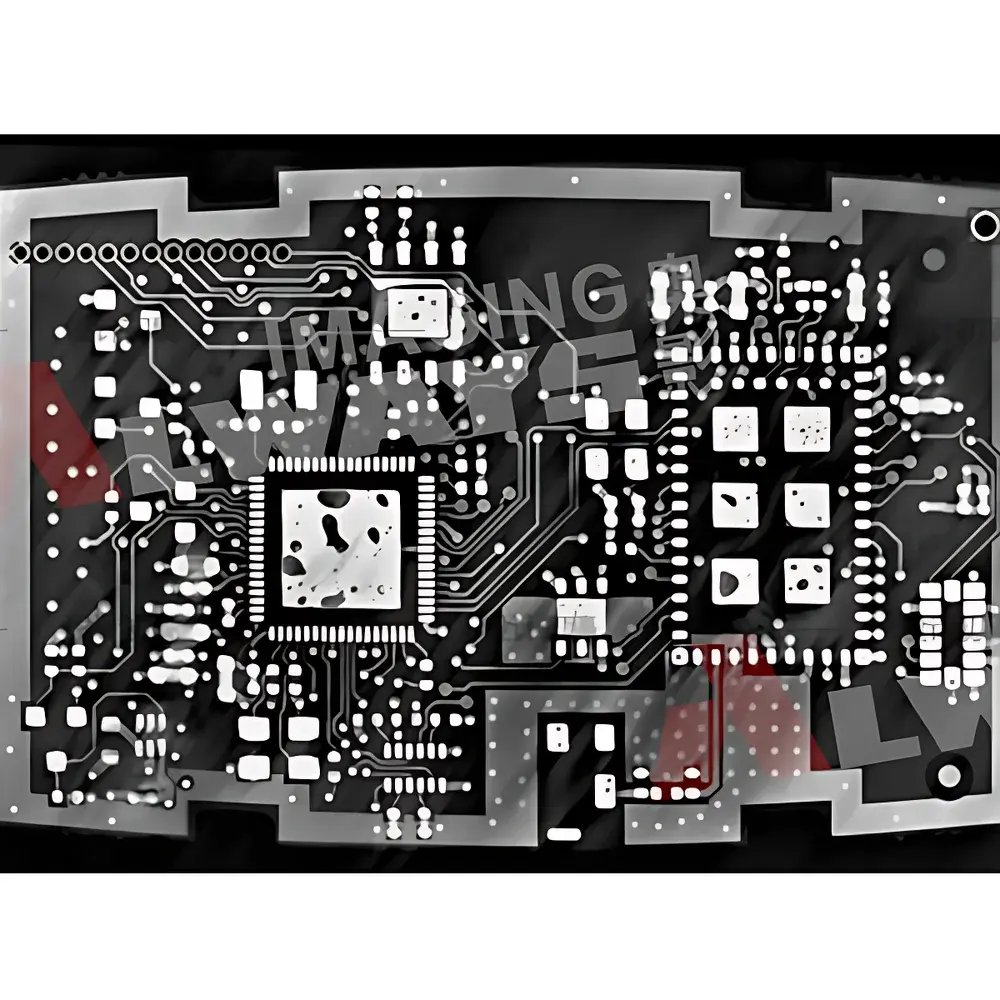
The Always Imaging AI-3000CT is a high-performance industrial micro-computed tomography (micro-CT) system engineered specifically for non-destructive 3D inspection of medium-to-small metallic castings. Based on the physical principle of X-ray absorption contrast and cone-beam reconstruction, the AI-3000CT acquires hundreds of projection images during a precise translation-rotation (TR) scanning sequence, followed by filtered back-projection or iterative reconstruction algorithms to generate isotropic volumetric datasets with sub-0.1 mm feature resolution. Its modular high-voltage X-ray source platform—offering selectable 250 kV, 320 kV, and 450 kV energy levels—ensures optimal penetration and contrast for aluminum, magnesium, iron, and nickel-based alloys commonly used in automotive engine blocks, transmission housings, aerospace brackets, and power-generation components. Designed for production-integrated quality assurance, the system delivers repeatable dimensional metrology, porosity quantification, and internal defect mapping without sample sectioning or surface preparation.
Key Features
- Multi-energy X-ray source (250/320/450 kV) optimized for varying alloy densities and wall thicknesses up to 120 mm in steel
- High-dynamic-range flat-panel detector with >16-bit depth and active area ≥ 300 mm × 300 mm for high-fidelity projection capture
- Translation-rotation (TR) scanning architecture enabling high geometric accuracy, reduced cone-beam artifacts, and improved spatial linearity versus pure rotational setups
- Integrated radiation shielding compliant with IEC 61331-1 and national Class II radiation facility requirements; measured leakage dose <1 µSv/h at 1 m from cabinet surface
- Rigid mechanical frame with granite base and air-suspended motion stages, supporting 50 kg maximum load while maintaining sub-micron positional repeatability
- Thermally stabilized X-ray tube housing and detector cooling system ensuring long-term intensity stability and signal-to-noise consistency across multi-hour scans
Sample Compatibility & Compliance
The AI-3000CT accommodates cylindrical samples up to Ø600 mm in diameter and 1000 mm in height, making it suitable for cylinder heads, pump housings, turbine blades, and structural die-cast parts. Its open-access gantry design allows flexible mounting via custom fixtures or optional robotic handling interfaces. All scan protocols and reconstruction parameters are traceable and auditable, supporting compliance with ISO 17025-accredited laboratories and manufacturing environments governed by AS9100, IATF 16949, and ASTM E1441/E2737 standards for computed tomography. Radiation safety documentation—including shielding verification reports, interlock schematics, and operator training modules—is provided as part of factory acceptance testing.
Software & Data Management
The system ships with Always Imaging’s proprietary CT Control Suite v4.x, featuring real-time projection monitoring, adaptive exposure control, and automatic beam-hardening correction. Reconstruction is performed using GPU-accelerated Feldkamp-Davis-Kress (FDK) and SART algorithms, generating DICOM-RT and VTK-compatible volume datasets. Integrated analysis modules support ISO 5022-compliant porosity classification, GD&T-conformant dimensional metrology (per ASME Y14.5), and voxel-based wall thickness mapping. Optional software packages include ADR (Automated Defect Recognition) with configurable neural network models trained on casting-specific flaw libraries, VGStudio MAX 3.4 for advanced visualization and reporting, and secure data export modules compliant with FDA 21 CFR Part 11 requirements—including electronic signatures, audit trails, and role-based access control.
Applications
- Porosity and inclusion analysis in aluminum high-pressure die-castings for automotive powertrain components
- Core shift validation and sand residue detection in investment-cast turbine vanes
- Dimensional verification of internal cooling channels in additively manufactured heat exchangers
- Crack propagation assessment in fatigue-tested nodular iron brackets under cyclic loading
- Reverse engineering of legacy cast parts via surface mesh extraction and deviation analysis against CAD
- Process development support for squeeze casting and centrifugal casting parameter optimization
FAQ
What is the minimum detectable defect size under standard scanning conditions?
The system achieves a practical defect detection limit of 0.1 mm for voids in aluminum alloys at 320 kV, assuming optimal signal-to-noise ratio and reconstruction voxel size ≤ 20 µm.
Does the AI-3000CT support automated batch scanning for production line integration?
Yes—optional PLC interface modules and SECS/GEM protocol support enable synchronization with conveyor systems, robotic arms, and MES platforms for unattended multi-part sequencing.
Is the reconstruction software validated for regulated industries such as aerospace or medical device manufacturing?
Reconstruction algorithms are documented per ASTM E2807 and include uncertainty quantification reports; software validation packages (IQ/OQ/PQ) are available upon request for GxP environments.
Can users import third-party CAD models for GD&T-based comparison?
Yes—the metrology module supports STEP AP242 and IGES import, with alignment via best-fit, datum-based, or RPS referencing strategies.
What maintenance intervals and service coverage options are offered?
Preventive maintenance is recommended every 12 months or 2000 operating hours; extended warranty and remote diagnostics support are included in the Premium Service Agreement.



