
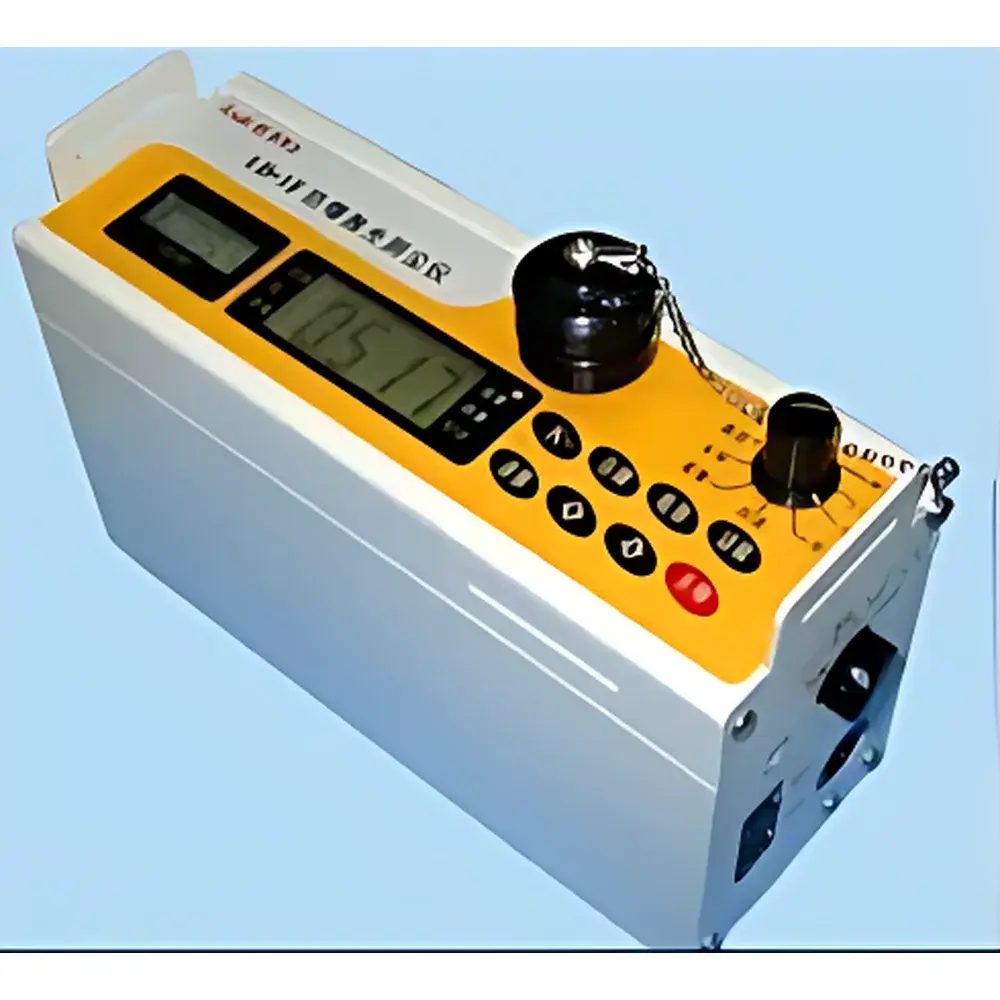
LD-3F Intrinsically Safe Laser Dust Monitor
| Origin | Beijing, China |
|---|---|
| Manufacturer Type | Authorized Distributor |
| Country of Origin | China |
| Model | LD-3F |
| Pricing | Available Upon Request |
Overview
The LD-3F Intrinsically Safe Laser Dust Monitor is a portable, real-time particulate matter (PM) concentration measurement instrument engineered for hazardous environments where explosive atmospheres may be present. It operates on the principle of forward-scattered laser light detection—where airborne particles passing through a collimated laser beam generate scattered light proportional to their mass concentration. This optical signal is converted into a quantitative mass concentration reading (mg/m³) using factory-calibrated algorithms traceable to NIST-traceable reference aerosols. Designed and certified to meet the stringent requirements of Zone 1 and Zone 2 hazardous areas under IEC 60079-0 and IEC 60079-11, the device carries the Exib II B T3 intrinsic safety certification (Certificate No. CE082051), enabling safe deployment in petrochemical refineries, coal handling facilities, grain silos, pharmaceutical manufacturing suites with solvent vapors, and underground mining operations where flammable gas groups (II B) and temperature class T3 (surface max. temp. ≤ 200 °C) apply.
Key Features
- Intrinsically safe design compliant with Exib II B T3 for use in classified hazardous locations (IEC 60079 series)
- Real-time PM mass concentration output in mg/m³ with 1-minute standard sampling cycle; configurable sampling duration from 0.1 s to 9999 s
- Dual sensitivity modes: high-sensitivity range (0.001–10 mg/m³) and standard range (0.01–100 mg/m³), optimized for both ambient air quality monitoring and occupational exposure assessment
- Integrated optical protection system featuring laminar air curtain shielding and clean-air self-cleaning mechanism to prevent lens fouling and maintain long-term photometric stability
- Onboard automatic zero calibration routine executed prior to each measurement cycle, minimizing drift and ensuring baseline consistency
- Repeatability of ±2% and overall measurement accuracy of ±10% (as validated against gravimetric reference methods per ISO 7708 and EN 481)
- Backlit 4-digit LCD display with intuitive unit labeling and status indicators for battery, flow, and alarm conditions
- Internal data logger supporting cyclic storage of up to 99 measurement records with timestamp and configuration metadata
Sample Compatibility & Compliance
The LD-3F is optimized for inhalable particulate fraction (PM10) as defined by ISO/CEN/ACGIH conventions. Its optical response aligns with the particle size-dependent scattering characteristics specified in WS/T 206–2001 (China’s Public Health Standard for PM10 Measurement via Light Scattering), LD 98–1996 (China’s Occupational Health Standard for Dust Monitoring), and TB/T 2323–92 (Railway Industry Standard for Mass Concentration Conversion). While not a certified respirable dust (PM4) instrument, its inlet geometry and cut-point response are consistent with 10 µm aerodynamic diameter sampling efficiency curves per ISO 7708. The device is intended for use with ambient air, process air streams, and indoor workplace air—excluding corrosive, condensing, or highly hygroscopic aerosols without pre-conditioning.
Software & Data Management
Data exchange is supported via isolated RS-232 serial interface (galvanically separated for safety compliance), enabling bidirectional communication with external PCs running proprietary Windows-based configuration and analysis software. This software supports export of time-stamped datasets in CSV format, generation of temporal concentration profiles, statistical summaries (mean, max, min, STDEV), and customizable reporting templates compatible with internal QA/QC documentation. All data transfers and firmware updates must be conducted outside hazardous zones, in accordance with IEC 60079-14 requirements for instrumentation maintenance. Audit trails, user access logs, and electronic signature capability are not natively embedded but can be implemented at the host PC level within GLP/GMP-aligned laboratory information management systems (LIMS).
Applications
- Occupational hygiene monitoring in coal mines, cement plants, metal grinding facilities, and woodworking shops
- Leak detection and fugitive emission verification in hydrocarbon processing units and LNG terminals
- Real-time dust control validation during confined space entry, abrasive blasting, and demolition activities
- Indoor air quality assessment in pharmaceutical cleanrooms, hospital HVAC ducts, and educational laboratories
- Compliance verification for OSHA Permissible Exposure Limits (PELs) and ACGIH Threshold Limit Values (TLVs®) for total and respirable dust
- Field validation of engineering controls such as local exhaust ventilation (LEV) system performance
FAQ
Is the LD-3F certified for use in Zone 0 environments?
No. The LD-3F holds Exib II B T3 certification, which permits operation only in Zone 1 and Zone 2 hazardous areas—not Zone 0.
Can the instrument measure PM₂.₅ separately?
No. The LD-3F is calibrated and validated for PM10 mass concentration; it does not provide size-fractionated PM₂.₅ output.
What is the recommended calibration frequency?
Annual calibration against traceable gravimetric standards is advised; field zero checks should be performed before each shift using clean air or zero air filter.
Does the device support analog 4–20 mA output?
No. Output is limited to RS-232 serial communication and optional thermal printer interface (both restricted to non-hazardous area use).
Is battery charging permitted inside an explosion-proof enclosure?
No. Charging must occur externally, outside classified zones, using the supplied AC adapter and designated charging station per manufacturer instructions.
Related Products







