
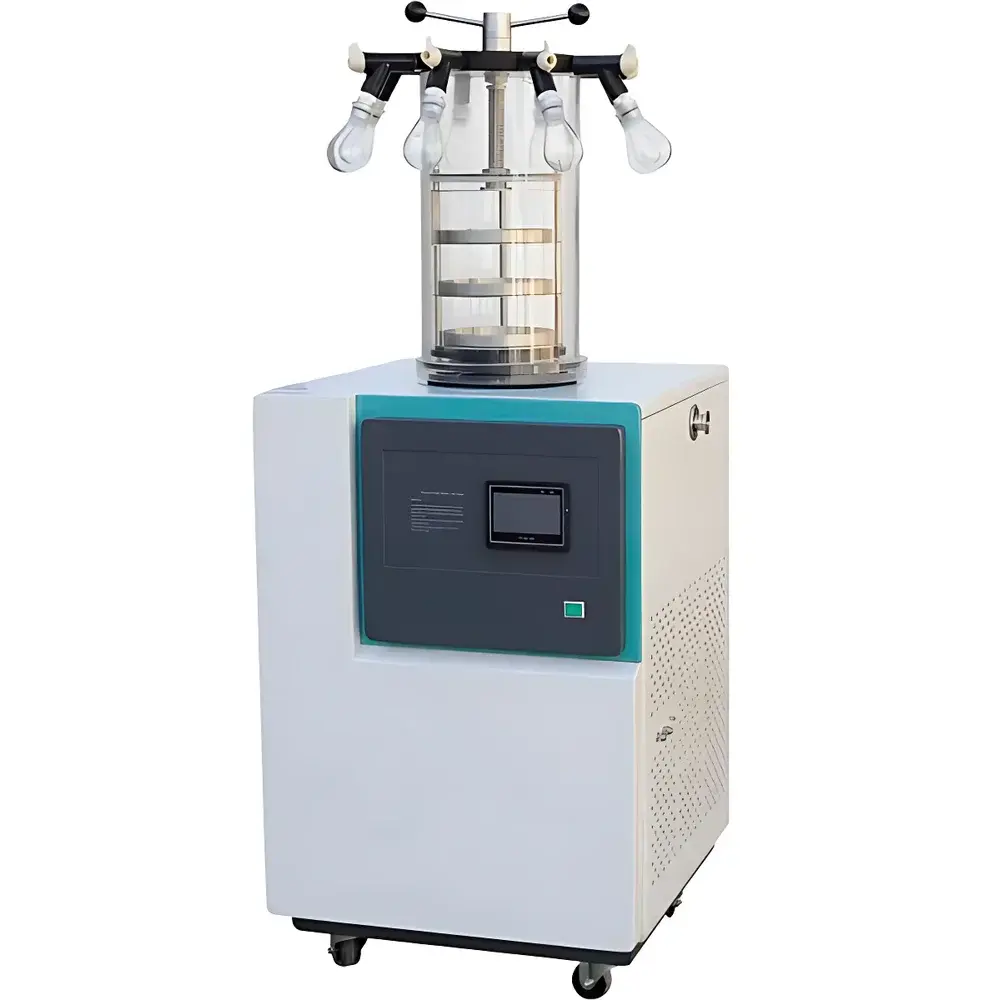
BIOCOOL Lab-1C-110E Laboratory Freeze Dryer
| Brand | BIOCOOL |
|---|---|
| Origin | Beijing, China |
| Model | Lab-1C-110E |
| Instrument Type | Standard Shelf-Type Freeze Dryer |
| Application Scope | Laboratory Use |
| Lyophilization Area | 0.12 m² |
| Ultimate Vacuum | <3 Pa |
| Condensate Capacity (24 h) | 3 L |
| Cold Trap Temperature | −110 °C |
| Compressor Power | 1 HP |
| Vacuum Pump Speed | 2 L/s |
| Dimensions (W×D×H) | ~640×640×1000 mm |
| Power Supply | 220 V / 50 Hz / 1400 W |
Overview
The BIOCOOL Lab-1C-110E is a high-performance laboratory-scale freeze dryer engineered for reproducible, scalable lyophilization of heat-sensitive biologicals, pharmaceuticals, and organic-solvent-based formulations. It operates on the fundamental principles of sublimation under deep vacuum and cryogenic condensation—where frozen water or volatile solvents are removed directly from the solid phase without passing through the liquid state. Its −110 °C cold trap enables efficient capture of both water vapor and low-boiling organic solvents (e.g., acetone, ethanol, acetonitrile), making it uniquely suited for formulations containing up to 95 vol% organic solvent—a critical capability not supported by conventional −50 °C or −80 °C systems. The unit integrates a robust refrigeration architecture with dual-stage cascade cooling, industrial-grade hermetic compressors, and a Korean-sourced high-speed rotary vane vacuum pump (2 L/s), ensuring stable operation across extended cycles while maintaining vacuum integrity below 3 Pa.
Key Features
- Deep-cold trap at −110 °C with integrated pre-freezing function, enabling direct freezing of samples within the cold trap prior to chamber loading—reducing thermal shock and improving ice morphology.
- Aerospace-grade acrylic drying chamber: seamless, bond-free construction with high impact resistance and zero leakage risk; optimized for visual process monitoring and rapid pressure equilibration.
- Programmable PLC-based control system with 7-inch industrial touchscreen interface: supports full-cycle automation including freezing, primary drying, secondary drying, defrosting, and inert gas backfilling.
- Fuzzy PID-controlled shelf heating system with real-time thermal loop monitoring; ensures precise, uniform temperature ramping and hold profiles across all shelf zones.
- Non-electric cold trap defrosting mechanism: utilizes controlled ambient air exchange and internal heat redistribution—eliminating electrical hazards, minimizing downtime, and avoiding water immersion risks associated with manual defrosting.
- Three-mode pulse backfill system (slow/medium/fast) with adjustable gas flow rate and pressure ramping—prevents particle dispersion, foam collapse, or vial tipping during repressurization, especially critical for fragile lyophiles such as monoclonal antibodies or nanoparticle suspensions.
- Integrated vacuum regulation module (optional): dynamically adjusts chamber pressure during sublimation and desorption phases to suppress boil-over, minimize cake collapse, and optimize mass transfer efficiency.
Sample Compatibility & Compliance
The Lab-1C-110E accommodates diverse sample formats—including bulk solutions in stainless steel trays, serum vials (2–20 mL), and externally mounted glass flasks via multi-port manifold configurations. It is validated for processing aqueous and organic-aqueous mixtures with eutectic points above −20 °C, covering common biologics buffers, polymer dispersions, enzyme formulations, and small-molecule APIs. All operational parameters—including shelf temperature (−50 °C to +60 °C), vacuum setpoints (0.1–100 Pa), and time-based steps—are fully traceable and audit-ready. The system supports GLP-compliant data integrity requirements via optional 21 CFR Part 11–enabled PC database logging, electronic signatures, and immutable audit trails. Temperature and vacuum sensors are field-calibratable per ISO/IEC 17025 guidelines, with calibration certificates available upon request.
Software & Data Management
Data acquisition occurs at 50 ms intervals for shelf temperature, condenser temperature, and chamber pressure—capturing transient events during nucleation, ice front propagation, and pore structure evolution. Up to 500 user-defined lyophilization protocols can be stored onboard. Local storage retains ≥3 months of cycle logs in non-volatile memory; external U盘 (USB flash drive) support allows export of CSV-formatted time-series data for offline analysis in MATLAB, Python, or JMP. Optional PC-based remote monitoring extends supervision to distances up to 1.5 km via Ethernet or Wi-Fi, enabling centralized lab management across multiple instruments. The embedded HMI provides intuitive navigation without reference manuals—ideal for cross-trained QC technicians and research staff operating under GMP-aligned SOPs.
Applications
- Stabilization of thermolabile proteins, vaccines, and diagnostic reagents for long-term storage and transport.
- Lyophilization of organic-solvent-based nanocarriers (e.g., PLGA nanoparticles, liposomes) where residual solvent removal is essential for regulatory compliance.
- Preparation of standards and reference materials for analytical chemistry (HPLC, MS) requiring minimal degradation and maximal recovery.
- Rapid prototyping of freeze-drying cycles during formulation development—leveraging programmable ramps, holds, and vacuum modulation to map critical quality attributes (CQAs) such as residual moisture, reconstitution time, and structural integrity.
- Processing of botanical extracts, probiotics, and microbial cultures where oxygen exclusion and low-temperature preservation are mandatory.
FAQ
What types of solvents can the Lab-1C-110E safely handle?
It is specifically designed for aqueous-organic mixtures containing ≤95% vol/vol low-boiling solvents (e.g., methanol, ethanol, acetone, ethyl acetate) due to its −110 °C condenser and corrosion-resistant internal surfaces.
Is the system compliant with FDA 21 CFR Part 11 for electronic records?
Yes—when equipped with the optional PC database logging module, it provides role-based access control, electronic signatures, and tamper-evident audit trails meeting Part 11 requirements.
Can I perform in-situ freezing of samples inside the drying chamber?
No—the Lab-1C-110E does not feature shelf refrigeration; however, the cold trap pre-freeze function allows direct freezing of loaded vials or flasks prior to primary drying.
What maintenance intervals are recommended for the vacuum pump?
Per manufacturer specifications, oil changes are required every 500 operating hours; use only ISO VG 100 synthetic vacuum oil and install the optional oil mist filter to extend pump life and maintain ultimate vacuum performance.
Does the system support validation documentation (IQ/OQ/PQ)?
Yes—BIOCOOL provides standardized IQ/OQ protocols and on-site PQ support (travel and labor billed separately); all sensors ship with NIST-traceable calibration certificates.



